• 文献检索
  • 文档翻译
  • 深度研究
  • 学术资讯
  • Suppr Zotero 插件Zotero 插件
  • 邀请有礼
  • 套餐&价格
  • 历史记录
应用&插件
Suppr Zotero 插件Zotero 插件浏览器插件Mac 客户端Windows 客户端微信小程序
定价
高级版会员购买积分包购买API积分包
服务
文献检索文档翻译深度研究API 文档MCP 服务
关于我们
关于 Suppr公司介绍联系我们用户协议隐私条款
关注我们

Suppr 超能文献

核心技术专利:CN118964589B侵权必究
粤ICP备2023148730 号-1Suppr @ 2026

文献检索

告别复杂PubMed语法,用中文像聊天一样搜索,搜遍4000万医学文献。AI智能推荐,让科研检索更轻松。

立即免费搜索

文件翻译

保留排版,准确专业,支持PDF/Word/PPT等文件格式,支持 12+语言互译。

免费翻译文档

深度研究

AI帮你快速写综述,25分钟生成高质量综述,智能提取关键信息,辅助科研写作。

立即免费体验

重症监护中的血液保护装置:一篇叙述性综述。

Blood conservation devices in critical care: a narrative review.

作者信息

Page Catherine, Retter Andrew, Wyncoll Duncan

机构信息

Intensive Care Unit, Guy's and St. Thomas' Foundation Trust, Lambeth Palace Road, London SE1 7EH, UK.

出版信息

Ann Intensive Care. 2013 May 28;3:14. doi: 10.1186/2110-5820-3-14. eCollection 2013.

DOI:10.1186/2110-5820-3-14
PMID:23714376
原文链接:https://pmc.ncbi.nlm.nih.gov/articles/PMC3673809/
Abstract

Anaemia is associated with inferior outcomes in critically ill patients. It is difficult to prevent and is treated commonly with the transfusion of packed red cells. However, transfusion to augment oxygen delivery has not been shown to consistently offer a survival advantage when the haemoglobin concentration exceeds 7 g/dL. Several studies point to inferior outcomes when patients are transfused. Observational studies have confirmed that critically ill patients have frequent blood draws as part of their routine daily care. Cumulatively large volumes of blood are frequently taken, which contribute significantly towards the development of anaemia. Reducing iatrogenic blood loss may reduce the risk of developing anaemia and possibly the need for transfusion. Blood conservation devices may help to achieve this goal. The integration of blood conservation devices into routine care has been relatively slow in critical care. This review summarises the current evidence base and confirms that blood conservation devices do reduce the volume of iatrogenic blood loss. In the most recent studies, these devices have been shown to reduce transfusion requirements even in those intensive care units that follow a restrictive transfusion strategy.

摘要

贫血与危重症患者的不良预后相关。贫血难以预防,通常采用输注浓缩红细胞进行治疗。然而,当血红蛋白浓度超过7 g/dL时,通过输血增加氧输送并未始终显示出具有生存优势。多项研究表明,患者接受输血时预后较差。观察性研究证实,危重症患者在日常常规护理中经常进行采血。累计采血量往往很大,这对贫血的发生有很大影响。减少医源性失血可能会降低发生贫血的风险,并可能减少输血需求。血液保护装置可能有助于实现这一目标。在重症监护中,将血液保护装置整合到常规护理中的进程相对缓慢。本综述总结了当前的证据基础,并证实血液保护装置确实能减少医源性失血量。在最近的研究中,这些装置已被证明即使在遵循限制性输血策略的重症监护病房中也能减少输血需求。
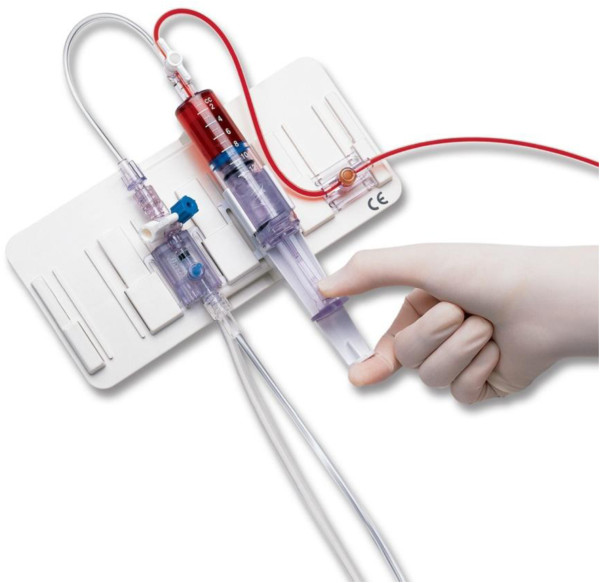
https://cdn.ncbi.nlm.nih.gov/pmc/blobs/5af5/3673809/641977d1c613/2110-5820-3-14-1.jpg

相似文献

1
Blood conservation devices in critical care: a narrative review.重症监护中的血液保护装置:一篇叙述性综述。
Ann Intensive Care. 2013 May 28;3:14. doi: 10.1186/2110-5820-3-14. eCollection 2013.
2
Benefits and harms of red blood cell transfusions in patients with septic shock in the intensive care unit.重症监护病房中感染性休克患者红细胞输血的益处与危害
Dan Med J. 2016 Feb;63(2).
3
[Transfusion of recuperated blood in total knee arthroplasty].[全膝关节置换术中回收血的输注]
Rev Chir Orthop Reparatrice Appar Mot. 2002 Dec;88(8):777-89.
4
Red cell transfusion therapy in the critical care setting.重症监护环境下的红细胞输血治疗
Transfus Sci. 1997 Sep;18(3):459-77. doi: 10.1016/S0955-3886(97)00044-1.
5
Red cell transfusion practice following the transfusion requirements in critical care (TRICC) study: prospective observational cohort study in a large UK intensive care unit.遵循重症监护输血需求(TRICC)研究后的红细胞输血实践:英国一家大型重症监护病房的前瞻性观察队列研究。
Vox Sang. 2003 Apr;84(3):211-8. doi: 10.1046/j.1423-0410.2003.00284.x.
6
Is a low transfusion threshold safe in critically ill patients with cardiovascular diseases?对于患有心血管疾病的危重症患者,较低的输血阈值是否安全?
Crit Care Med. 2001 Feb;29(2):227-34. doi: 10.1097/00003246-200102000-00001.
7
Blood conservation strategies to reduce the need for red blood cell transfusion in critically ill patients.减少危重症患者红细胞输注需求的血液保护策略。
CMAJ. 2008 Jan 1;178(1):49-57. doi: 10.1503/cmaj.071298.
8
Impact of allogenic packed red blood cell transfusion on nosocomial infection rates in the critically ill patient.异体浓缩红细胞输注对危重症患者医院感染率的影响。
Crit Care Med. 2002 Oct;30(10):2249-54. doi: 10.1097/00003246-200210000-00012.
9
Red blood cell transfusion in critically ill children: a narrative review.危重症儿童的红细胞输血:叙述性综述。
Pediatr Crit Care Med. 2011 Mar;12(2):174-83. doi: 10.1097/PCC.0b013e3181e30d09.
10
Anaemia and transfusion triggers in critically ill patients - What we have learnt thus far.危重症患者的贫血与输血触发因素——我们目前所了解的情况。
J Intensive Care Soc. 2019 Nov;20(4):284-289. doi: 10.1177/1751143718783615. Epub 2018 Jun 25.

引用本文的文献

1
Clot formation risk in the clearing fluid after arterial catheter blood sampling: coagulation factors consumption over time - a prospective pilot study.动脉导管采血后清除液中的凝血形成风险:凝血因子随时间的消耗——一项前瞻性初步研究。
J Clin Monit Comput. 2025 Jun;39(3):607-612. doi: 10.1007/s10877-024-01252-0. Epub 2024 Dec 12.
2
Best practices for iatrogenic anaemia prevention in the intensive care unit: Blood-sparing techniques.重症监护病房中预防医源性贫血的最佳实践:血液保护技术。
Nurs Crit Care. 2025 Jan;30(1):47-52. doi: 10.1111/nicc.13084. Epub 2024 Apr 23.
3
Patient harm associated with serial phlebotomy and blood waste in the intensive care unit: A retrospective cohort study.

本文引用的文献

1
Closed system for blood sampling and transfusion in critically ill patients.
Rev Bras Ter Intensiva. 2010 Mar;22(1):5-10.
2
Transfusion strategies for acute upper gastrointestinal bleeding.急性上消化道出血的输血策略。
N Engl J Med. 2013 Jan 3;368(1):11-21. doi: 10.1056/NEJMoa1211801.
3
Guidelines on the management of anaemia and red cell transfusion in adult critically ill patients.成人危重症患者贫血及红细胞输注管理指南
Br J Haematol. 2013 Feb;160(4):445-64. doi: 10.1111/bjh.12143. Epub 2012 Dec 27.
重症监护病房中连续采血和血液浪费相关的患者伤害:一项回顾性队列研究。
PLoS One. 2021 Jan 13;16(1):e0243782. doi: 10.1371/journal.pone.0243782. eCollection 2021.
4
Transfusion strategies in non-bleeding critically ill adults: a clinical practice guideline from the European Society of Intensive Care Medicine.非出血性危重症成人输血策略:欧洲重症监护医学学会临床实践指南。
Intensive Care Med. 2020 Apr;46(4):673-696. doi: 10.1007/s00134-019-05884-8. Epub 2020 Jan 7.
5
Interventions to prevent iatrogenic anemia: a Laboratory Medicine Best Practices systematic review.干预措施预防医源性贫血:检验医学最佳实践系统评价。
Crit Care. 2019 Aug 9;23(1):278. doi: 10.1186/s13054-019-2511-9.
6
Long length of stay in the ICU associates with a high erythrocyte transfusion rate in critically ill patients.重症监护病房(ICU)住院时间长与危重症患者红细胞输注率高相关。
J Int Med Res. 2019 May;47(5):1948-1957. doi: 10.1177/0300060519832458. Epub 2019 Mar 12.
7
Blood sampling as a cause of anemia in a general ICU - a pilot study.普通重症监护病房中采血作为贫血原因的一项初步研究。
Rom J Anaesth Intensive Care. 2015 Apr;22(1):13-16.
8
A Simple "Blood-Saving Bundle" Reduces Diagnostic Blood Loss and the Transfusion Rate in Mechanically Ventilated Patients.一种简单的“血液保护套餐”可减少机械通气患者的诊断性失血及输血率。
PLoS One. 2015 Sep 30;10(9):e0138879. doi: 10.1371/journal.pone.0138879. eCollection 2015.
9
Point-of-care blood glucose testing for diabetes care in hospitalized patients: an evidence-based review.住院患者糖尿病护理中的即时血糖检测:一项循证综述
J Diabetes Sci Technol. 2014 Nov;8(6):1081-90. doi: 10.1177/1932296814538940. Epub 2014 Jun 5.
4
Liberal or restrictive transfusion in high-risk patients after hip surgery.髋关节手术后高危患者的自由输血或限制性输血。
N Engl J Med. 2011 Dec 29;365(26):2453-62. doi: 10.1056/NEJMoa1012452. Epub 2011 Dec 14.
5
Comparison of bacterial contamination of blood conservation system and stopcock system arterial sampling lines used in critically ill patients.比较危急重症患者使用的血液回收系统和动脉采血系统旋塞细菌污染情况。
Am J Infect Control. 2012 Aug;40(6):530-4. doi: 10.1016/j.ajic.2011.08.006. Epub 2011 Nov 3.
6
Transfusion requirements after cardiac surgery: the TRACS randomized controlled trial.心脏手术后的输血需求:TRACS 随机对照试验。
JAMA. 2010 Oct 13;304(14):1559-67. doi: 10.1001/jama.2010.1446.
7
The use of a blood conservation device to reduce red blood cell transfusion requirements: a before and after study.使用血液保护装置减少红细胞输血需求:一项前后对照研究。
Crit Care. 2010;14(1):R7. doi: 10.1186/cc8859. Epub 2010 Jan 27.
8
Evaluation of a blood conservation strategy in the intensive care unit: a prospective, randomised study.重症监护病房血液保护策略的评估:一项前瞻性随机研究。
Middle East J Anaesthesiol. 2009 Jun;20(2):219-23.
9
Efficacy of red blood cell transfusion in the critically ill: a systematic review of the literature.红细胞输注对危重症患者的疗效:文献系统综述
Crit Care Med. 2008 Sep;36(9):2667-74. doi: 10.1097/CCM.0b013e3181844677.
10
Blood conservation strategies to reduce the need for red blood cell transfusion in critically ill patients.减少危重症患者红细胞输注需求的血液保护策略。
CMAJ. 2008 Jan 1;178(1):49-57. doi: 10.1503/cmaj.071298.