Laboratoire de biologie moléculaire, Département des Sciences Biologiques, and BioMed, centre de recherches biomédicales, Université du Québec à Montréal, Montréal, Québec, Canada.
Mol Neurobiol. 2013 Dec;48(3):669-80. doi: 10.1007/s12035-013-8456-0. Epub 2013 May 30.
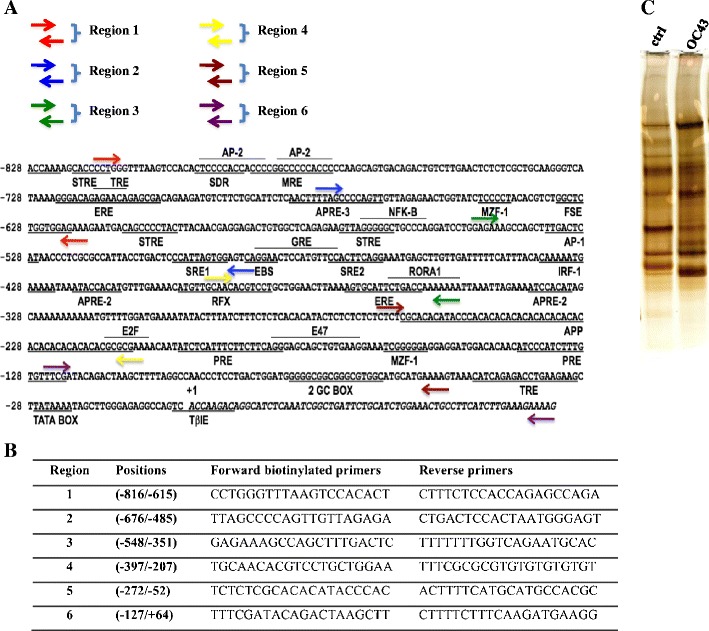
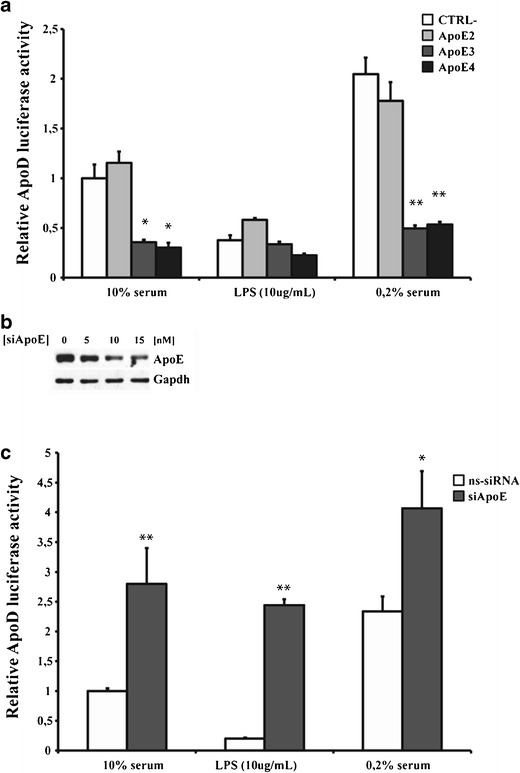
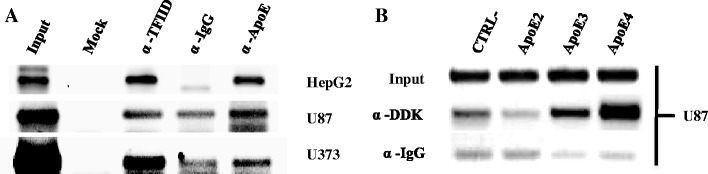
Apolipoprotein D (ApoD) gene expression is increased in several neurological disorders such as Alzheimer's disease (AD) and multiple sclerosis. We previously showed that transgenic mice that overexpress human ApoD show a better resistance against paraquat or OC43 coronavirus-induced neurodegeneration. Here, we identified several nuclear factors from the cortex of control and OC43-infected mice which bind a fragment of the proximal ApoD promoter in vitro. Of interest, we detected apolipoprotein E (ApoE). Human ApoE consists of three isoforms (E2, E3, and E4) with the E4 and E2 alleles representing a greater and a lower risk for developping AD, respectively. Our results show that ApoE is located in the nucleus and on the ApoD promoter in human hepatic and glioblastoma cells lines. Furthermore, overexpression of ApoE3 and ApoE4 isoforms but not ApoE2 significantly inhibited the ApoD promoter activity in U87 cells (E3/E3 genotype) cultured under normal or different stress conditions while ApoE knock-down by siRNA had a converse effect. Consistent with these results, we also demonstrated by ChIP assay that E3 and E4 isoforms, but not E2, bind the ApoD promoter. Moreover, using the Allen Brain Atlas in situ hybridization database, we observed an inverse correlation between ApoD and ApoE mRNA expression during development and in several regions of the mouse brain, notably in the cortex, hippocampus, plexus choroid, and cerebellum. This negative correlation was also observed for cortex layers IV-VI based on a new Transcriptomic Atlas of the Mouse Neocortical Layers. These findings reveal a new function for ApoE by regulating ApoD gene expression.
载脂蛋白 D(ApoD)基因表达在几种神经退行性疾病中增加,如阿尔茨海默病(AD)和多发性硬化症。我们之前曾表明,过表达人 ApoD 的转基因小鼠对百草枯或 OC43 冠状病毒诱导的神经退行性变具有更好的抗性。在这里,我们从对照和 OC43 感染的小鼠的皮质中鉴定出几种核因子,这些核因子在体外与近端 ApoD 启动子的片段结合。有趣的是,我们检测到载脂蛋白 E(ApoE)。人 ApoE 由三种同工型(E2、E3 和 E4)组成,E4 和 E2 等位基因分别代表 AD 发展的更高和更低风险。我们的结果表明,ApoE 位于人肝和神经胶质瘤细胞系的细胞核中和 ApoD 启动子上。此外,ApoE3 和 ApoE4 同工型的过表达(E3/E3 基因型)而不是 ApoE2 显著抑制 U87 细胞(正常或不同应激条件下培养的 E3/E3 基因型)中的 ApoD 启动子活性,而 ApoE 通过 siRNA 敲低则产生相反的效果。与这些结果一致,我们还通过 ChIP 测定证明,E3 和 E4 同工型而不是 E2 结合 ApoD 启动子。此外,我们使用 Allen Brain Atlas 原位杂交数据库观察到在发育过程中和小鼠大脑的几个区域中 ApoD 和 ApoE mRNA 表达之间的反比关系,特别是在皮质、海马、脉络丛和小脑。基于新的小鼠新皮层层转录组图谱,还观察到皮质层 IV-VI 之间的这种负相关。这些发现揭示了 ApoE 通过调节 ApoD 基因表达的新功能。