Dr Foster Unit at Imperial College, Department of Primary Care and Public Health, School of Public Health, Imperial College, London W6 8RP, UK.
BMJ. 2013 May 28;346:f2424. doi: 10.1136/bmj.f2424.
To assess the association between mortality and the day of elective surgical procedure.
Retrospective analysis of national hospital administrative data.
All acute and specialist English hospitals carrying out elective surgery over three financial years, from 2008-09 to 2010-11.
Patients undergoing elective surgery in English public hospitals.
Death in or out of hospital within 30 days of the procedure.
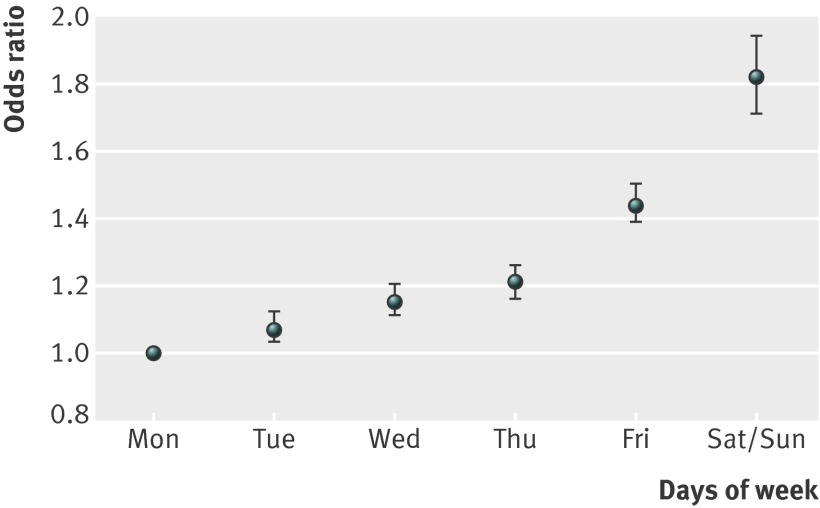
There were 27,582 deaths within 30 days after 4,133,346 inpatient admissions for elective operating room procedures (overall crude mortality rate 6.7 per 1000). The number of weekday and weekend procedures decreased over the three years (by 4.5% and 26.8%, respectively). The adjusted odds of death were 44% and 82% higher, respectively, if the procedures were carried out on Friday (odds ratio 1.44, 95% confidence interval 1.39 to 1.50) or a weekend (1.82, 1.71 to 1.94) compared with Monday.
The study suggests a higher risk of death for patients who have elective surgical procedures carried out later in the working week and at the weekend.
评估择期手术日期与死亡率之间的关联。
对国家医院管理数据的回顾性分析。
2008-09 年至 2010-11 年三个财政年度期间,所有进行择期手术的英国急性和专科医院。
在英国公立医院接受择期手术的患者。
术后 30 天内在医院内或外死亡。
在 4133346 例择期手术室住院患者中,术后 30 天内有 27582 人死亡(总体粗死亡率为每 1000 人 6.7 人)。三年间工作日和周末手术的数量均有所减少(分别减少了 4.5%和 26.8%)。如果手术在周五(比值比 1.44,95%置信区间 1.39 至 1.50)或周末(1.82,1.71 至 1.94)进行,与周一相比,死亡的调整后几率分别高出 44%和 82%。
该研究表明,在工作周的后期和周末进行择期手术的患者死亡风险更高。