Lab of Translational Medicine, Lee Gil Ya Cancer and Diabetes Institute, Gachon Univeristy of Medicine and Science, Incheon 406-840, Korea.
J Ginseng Res. 2012 Apr;36(2):135-45. doi: 10.5142/jgr.2012.36.2.135.
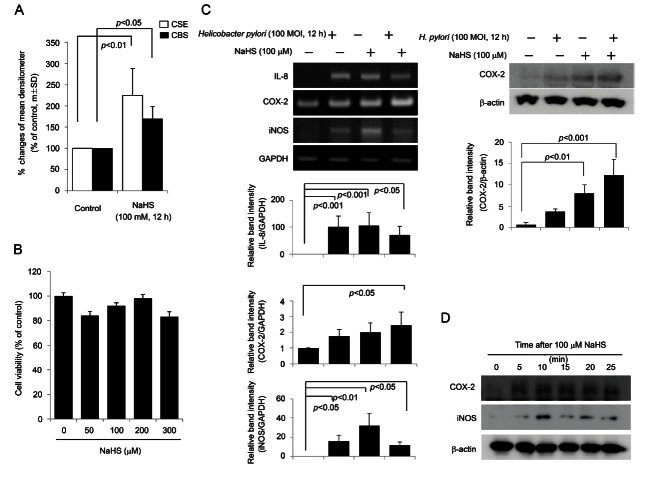
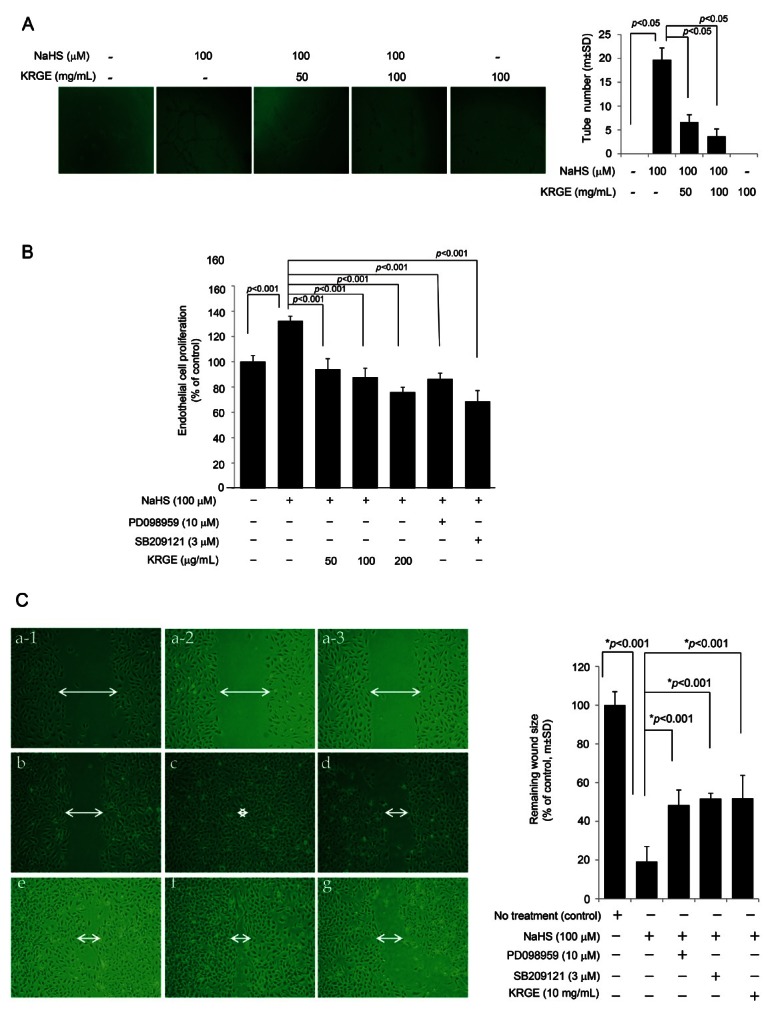
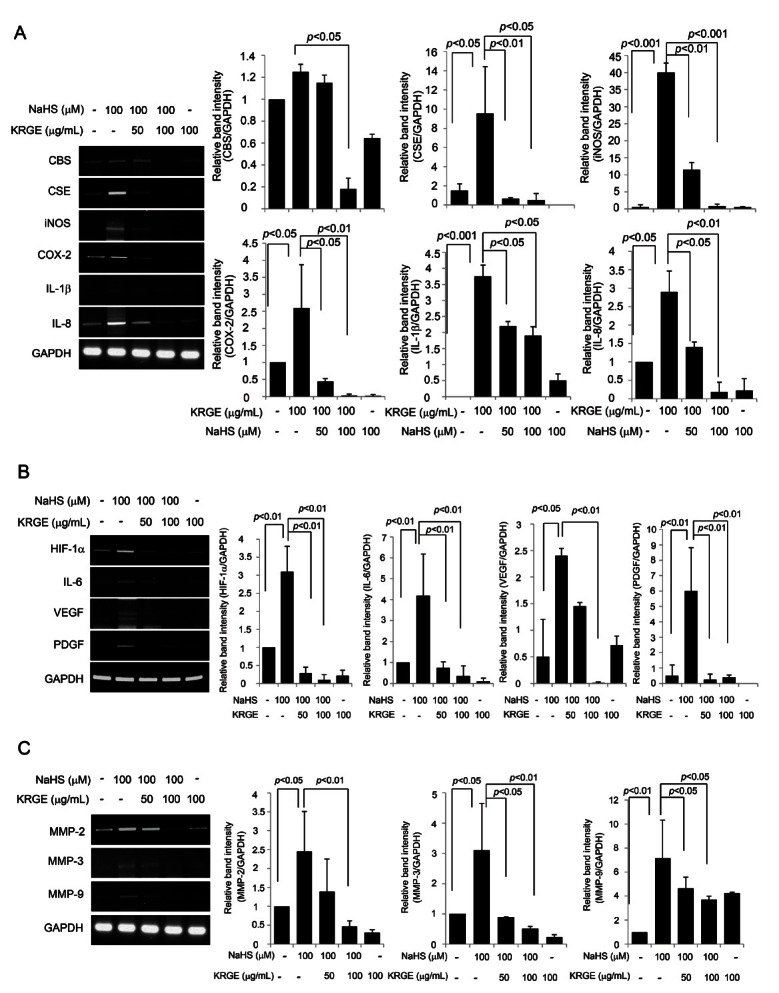
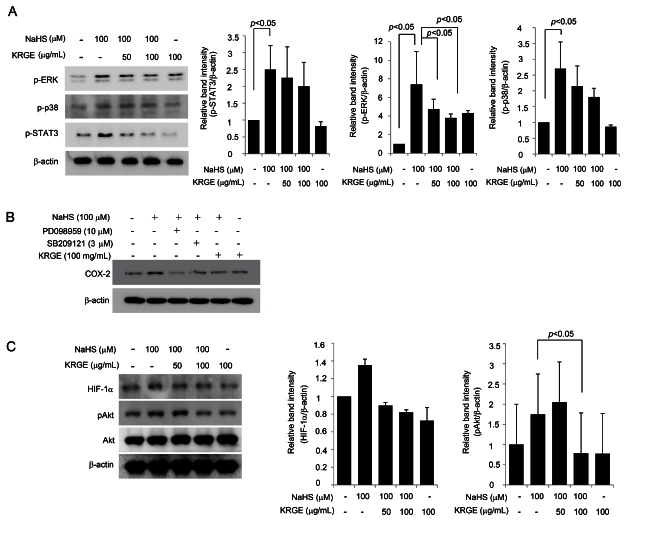
Previously, we reported that Helicobacter pylori-associated gastritis and gastric cancer are closely associated with increased levels of hydrogen sulfide (H2S) and that Korean red ginseng significantly reduced the severity of H. pylori-associated gastric diseases by attenuating H2S generation. Because the incubation of endothelial cells with H2S has been known to enhance their angiogenic activities, we hypothesized that the amelioration of H2S-induced gastric inflammation or angiogenesis in human umbilical vascular endothelial cells (HUVECs) might explain the preventive effect of Korean red ginseng on H. pylori-associated carcinogenesis. The expression of inflammatory mediators, angiogenic growth factors, and angiogenic activities in the absence or presence of Korean red ginseng extracts (KRGE) were evaluated in HUVECs stimulated with the H2S generator sodium hydrogen sulfide (NaHS). KRGE efficiently decreased the expression of cystathionine β-synthase and cystathionine γ-lyase, enzymes that are essential for H2S synthesis. Concomitantly, a significant decrease in the expression of inflammatory mediators, including cyclooxygenase-2 and inducible nitric oxide synthase, and several angiogenic factors, including interleukin (IL)-8, hypoxia inducible factor-1a, vascular endothelial growth factor, IL-6, and matrix metalloproteinases, was observed; all of these factors are normally induced after NaHS. An in vitro angiogenesis assay demonstrated that NaHS significantly increased tube formation in endothelial cells, whereas KRGE pretreatment significantly attenuated tube formation. NaHS activated p38 and Akt, increasing the expression of angiogenic factors and the proliferation of HUVECs, whereas KRGE effectively abrogated this H2S-activated angiogenesis and the increase in inflammatory mediators in vascular endothelial cells. In conclusion, KRGE was able to mitigate H2S-induced angiogenesis, implying that antagonistic action against H2S-induced angiogenesis may be the mechanism underlying the gastric cancer preventive effects of KRGE in H. pylori infection.
先前,我们报道了幽门螺杆菌相关性胃炎和胃癌与硫化氢(H2S)水平升高密切相关,并且韩国红参通过减弱 H2S 的产生显著减轻了幽门螺杆菌相关性胃疾病的严重程度。因为已知内皮细胞孵育 H2S 可以增强其血管生成活性,所以我们假设减轻 H2S 诱导的人脐静脉内皮细胞(HUVEC)中的炎症或血管生成可能解释了韩国红参对幽门螺杆菌相关性致癌作用的预防作用。在 H2S 生成剂硫氢化钠(NaHS)刺激下,评估了 HUVEC 中无或存在韩国红参提取物(KRGE)时炎症介质、血管生成生长因子和血管生成活性的表达。KRGE 有效地降低了胱硫醚β合酶和胱硫醚γ裂解酶的表达,这两种酶对于 H2S 合成至关重要。同时,观察到炎症介质(包括环氧化酶-2 和诱导型一氧化氮合酶)和几种血管生成因子(包括白细胞介素(IL)-8、缺氧诱导因子-1a、血管内皮生长因子、IL-6 和基质金属蛋白酶)的表达显著降低;所有这些因子在 NaHS 后通常都会被诱导。体外血管生成试验表明,NaHS 显著增加了内皮细胞的管状形成,而 KRGE 预处理则显著减弱了管状形成。NaHS 激活了 p38 和 Akt,增加了血管生成因子的表达和 HUVEC 的增殖,而 KRGE 有效地阻断了这种 H2S 激活的血管生成以及血管内皮细胞中炎症介质的增加。总之,KRGE 能够减轻 H2S 诱导的血管生成,这表明拮抗 H2S 诱导的血管生成可能是 KRGE 在幽门螺杆菌感染中预防胃癌作用的机制。