Department of Chemistry, University of Washington, Seattle, Washington, United States of America.
PLoS Pathog. 2013;9(5):e1003375. doi: 10.1371/journal.ppat.1003375. Epub 2013 May 23.
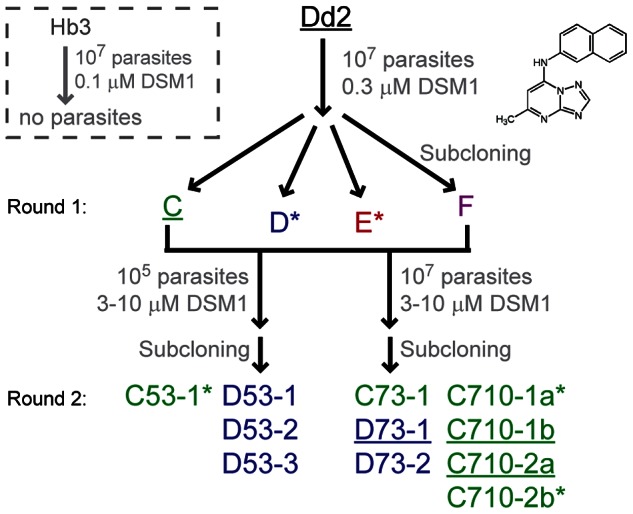
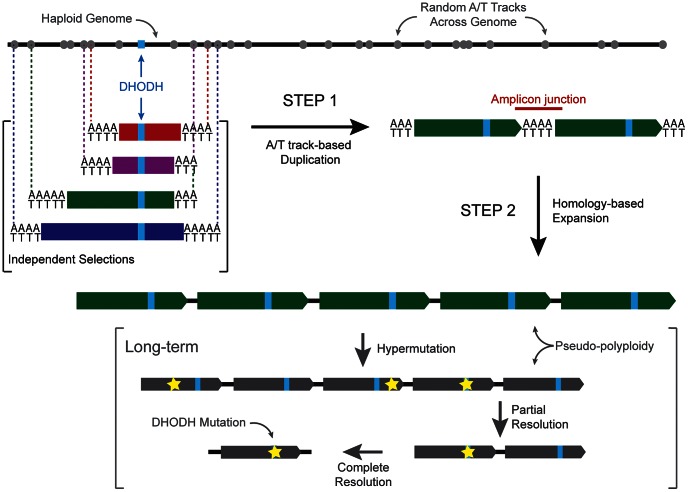
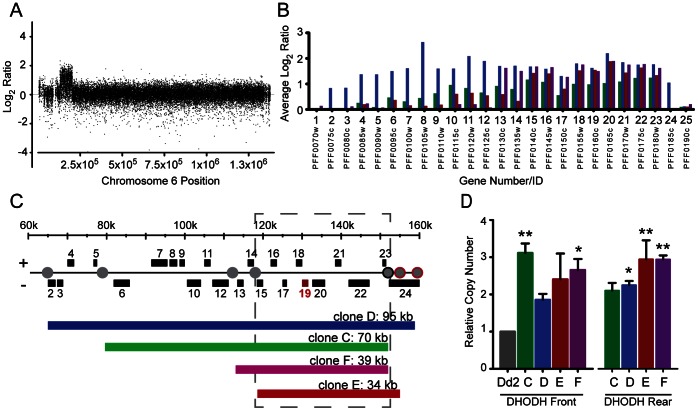
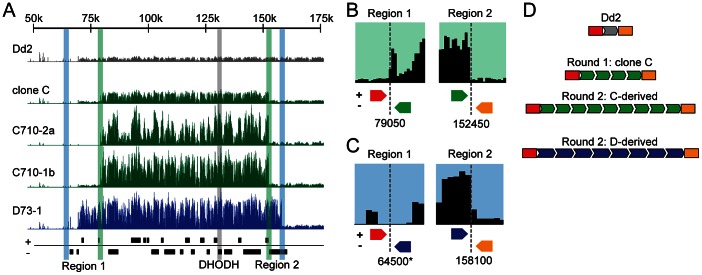
Malaria drug resistance contributes to up to a million annual deaths. Judicious deployment of new antimalarials and vaccines could benefit from an understanding of early molecular events that promote the evolution of parasites. Continuous in vitro challenge of Plasmodium falciparum parasites with a novel dihydroorotate dehydrogenase (DHODH) inhibitor reproducibly selected for resistant parasites. Genome-wide analysis of independently-derived resistant clones revealed a two-step strategy to evolutionary success. Some haploid blood-stage parasites first survive antimalarial pressure through fortuitous DNA duplications that always included the DHODH gene. Independently-selected parasites had different sized amplification units but they were always flanked by distant A/T tracks. Higher level amplification and resistance was attained using a second, more efficient and more accurate, mechanism for head-to-tail expansion of the founder unit. This second homology-based process could faithfully tune DNA copy numbers in either direction, always retaining the unique DNA amplification sequence from the original A/T-mediated duplication for that parasite line. Pseudo-polyploidy at relevant genomic loci sets the stage for gaining additional mutations at the locus of interest. Overall, we reveal a population-based genomic strategy for mutagenesis that operates in human stages of P. falciparum to efficiently yield resistance-causing genetic changes at the correct locus in a successful parasite. Importantly, these founding events arise with precision; no other new amplifications are seen in the resistant haploid blood stage parasite. This minimizes the need for meiotic genetic cleansing that can only occur in sexual stage development of the parasite in mosquitoes.
疟原虫耐药性导致每年多达 100 万人死亡。明智地部署新的抗疟药物和疫苗,可以从了解促进寄生虫进化的早期分子事件中受益。连续用新型二氢乳清酸脱氢酶(DHODH)抑制剂体外挑战恶性疟原虫寄生虫,可重现地选择耐药寄生虫。对独立衍生的耐药克隆进行全基因组分析,揭示了寄生虫进化成功的两步策略。一些单倍体血液阶段寄生虫首先通过偶然的 DNA 重复存活下来,而这些重复总是包含 DHODH 基因。独立选择的寄生虫具有不同大小的扩增单位,但它们总是被遥远的 A/T 轨道包围。通过使用第二个更有效和更准确的从头至尾扩展启动子单元的机制,实现了更高水平的扩增和耐药性。这种第二次同源性过程可以忠实地在任一方向上调整 DNA 拷贝数,始终保留来自原始 A/T 介导的重复的寄生虫系的独特 DNA 扩增序列。相关基因组位点的假多倍体为在感兴趣的基因座获得额外突变奠定了基础。总的来说,我们揭示了一种在人类疟原虫阶段发生的基于群体的基因组诱变策略,该策略能够在正确的寄生虫位置有效地产生导致耐药性的遗传变化。重要的是,这些起始事件具有精确性;在耐药性单倍体血液阶段寄生虫中没有观察到其他新的扩增。这最大限度地减少了减数遗传净化的需要,而减数遗传净化只能在蚊子中寄生虫的有性阶段发育中发生。