Key Laboratory of Coastal Biology & Bioresources Utilization, Yantai Institute of Coastal Zone Research-YIC, Chinese Academy of Sciences-CAS, Yantai, China.
PLoS One. 2013 May 24;8(5):e62100. doi: 10.1371/journal.pone.0062100. Print 2013.
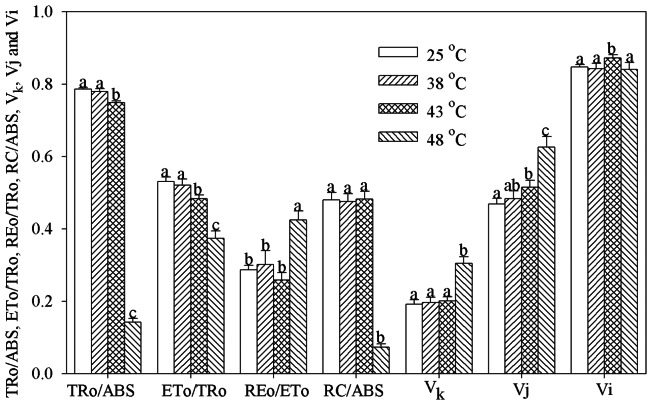
Plant photosynthesis and photosystem II (PSII) are susceptible to high temperature. However, photosynthetic electron transport process under heat stress remains unclear. To reveal this issue, chlorophyll a fluorescence and modulated 820 nm reflection were simultaneously detected in sweet sorghum. At 43°C, J step in the chlorophyll a fluorescence transient was significantly elevated, suggesting that electron transport beyond primary quinone of PSII (Q(A)) (primary quinone electron acceptor of PSII) was inhibited. PSI (Photosystem I) photochemical capacity was not influenced even under severe heat stress at 48°C. Thus, PSI oxidation was prolonged and PSI re-reduction did not reach normal level. The inhibition of electron transport between PSII and PSI can reduce the possibility of PSI photoinhibition under heat stress. PSII function recovered entirely one day after heat stress at 43°C, implying that sweet sorghum has certain self-remediation capacity. When the temperature reached 48°C, the maximum quantum yield for primary photochemistry and the electron transport from PSII donor side were remarkably decreased, which greatly limited the electron flow to PSI, and PSI re-reduction suspended. The efficiency of an electron transferred from the intersystem electron carrier (plastoquinol, PQH₂) to the end electron acceptors at the PSI acceptor side increased significantly at 48°C, and the reason was the greater inhibition of electron transport before PQH₂. Thus, the fragment from Q(A) to PQH₂ is the most heat sensitive in the electron transport chain between PSII and PSI in sweet sorghum.
植物光合作用和光系统 II(PSII)容易受到高温的影响。然而,热胁迫下的光合电子传递过程尚不清楚。为了揭示这个问题,我们在甜高粱中同时检测了叶绿素 a 荧光和调制的 820nm 反射。在 43°C 时,叶绿素 a 荧光瞬变中的 J 步显著升高,表明 PSII 原初醌(Q(A))(PSII 的原初醌电子受体)之后的电子传递受到抑制。即使在 48°C 的严重热胁迫下,PSI(光系统 I)的光化学容量也没有受到影响。因此,PSI 氧化延长,PSI 再还原未达到正常水平。PSII 和 PSI 之间电子传递的抑制可以降低 PSI 在热胁迫下光抑制的可能性。在 43°C 的热胁迫后一天,PSII 功能完全恢复,这表明甜高粱具有一定的自我修复能力。当温度达到 48°C 时,初级光化学的最大量子产率和 PSII 供体侧的电子传递显著降低,这极大地限制了电子流向 PSI,PSI 再还原停止。在 48°C 时,从电子传递体系电子载体(质体醌醇,PQH₂)到 PSI 受体侧最终电子受体的电子转移效率显著增加,原因是 PQH₂ 之前的电子传递受到更大的抑制。因此,在甜高粱 PSII 和 PSI 之间的电子传递链中,从 Q(A)到 PQH₂的片段是对热最敏感的。