Department of Neurology, Henry Ford Hospital, Detroit, Michigan, USA.
PLoS One. 2013 May 22;8(5):e63511. doi: 10.1371/journal.pone.0063511. Print 2013.
Functional recovery after brain injury in animals is improved by marrow stromal cells (MSC) which stimulate neurite reorganization. However, MRI measurement of neurite density changes after injury has not been performed. In this study, we investigate the feasibility of MRI measurement of neurite density in an animal model of traumatic brain injury (TBI) with and without MSC treatment.
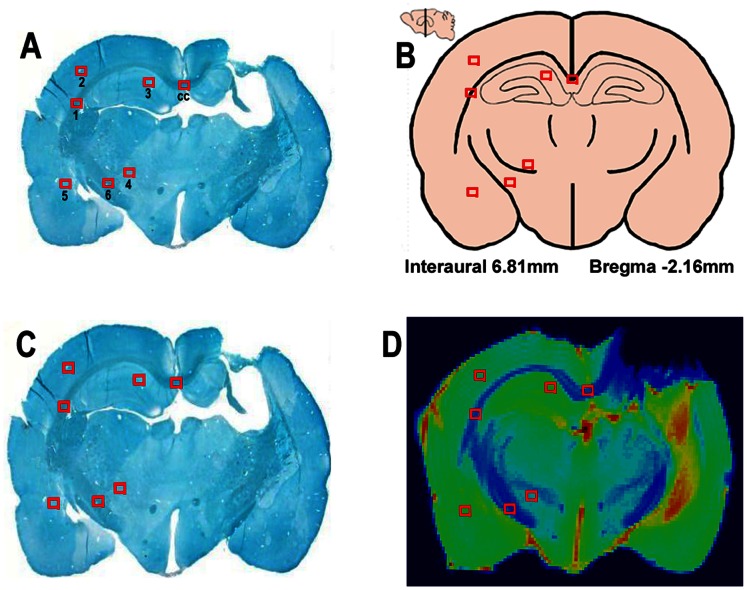
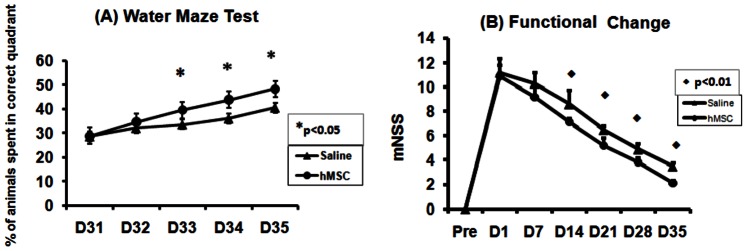
Fifteen male Wistar rats, were treated with saline (n = 6) or MSCs (n = 9) and were sacrificed at 6 weeks after controlled cortical impact (CCI). Healthy non-CCI rats (n = 5), were also employed. Ex-vivo MRI scans were performed two days after the rats were sacrificed. Multiple-shell hybrid diffusion imaging encoding scheme and spherical harmonic expansion of a two-compartment water diffusion displacement model were used to extract neurite related parameters. Bielshowski and Luxol Fast blue was used for staining axons and myelin, respectively. Modified Morris water maze and neurological severity score (mNSS) test were performed for functional evaluation. The treatment effects, the correlations between neurite densities measured by MRI and histology, and the correlations between MRI and functional variables were calculated by repeated measures analysis of variance, the regression correlation analysis tests, and spearman correlation coefficients.
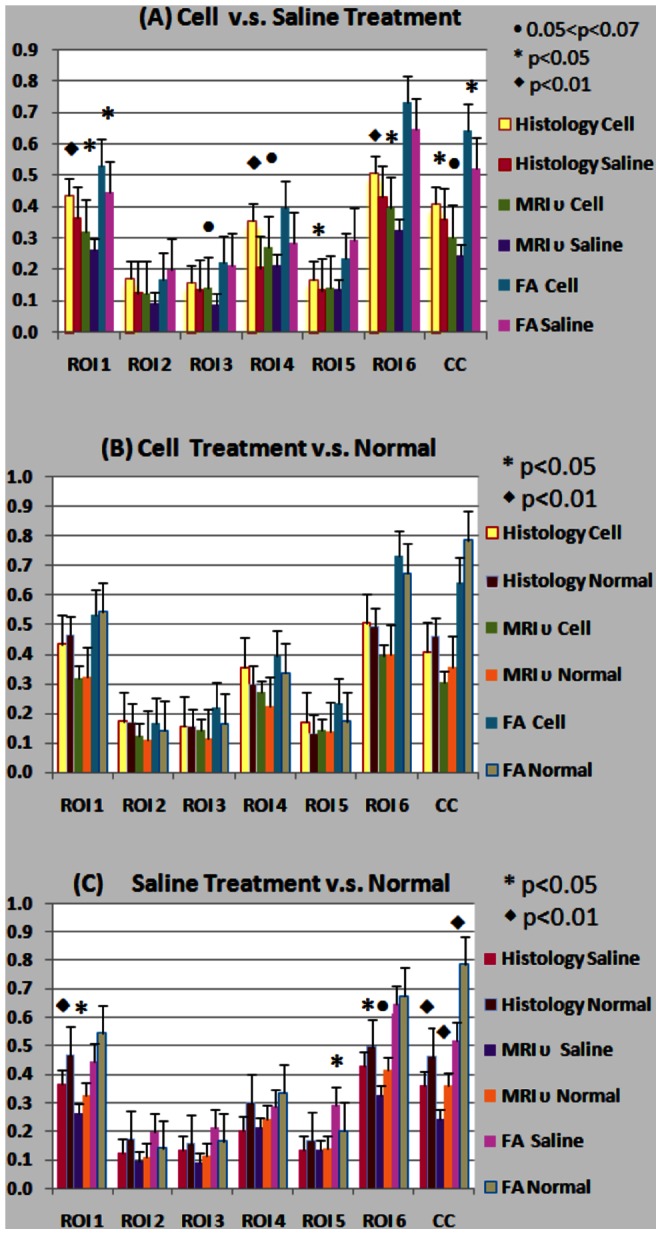
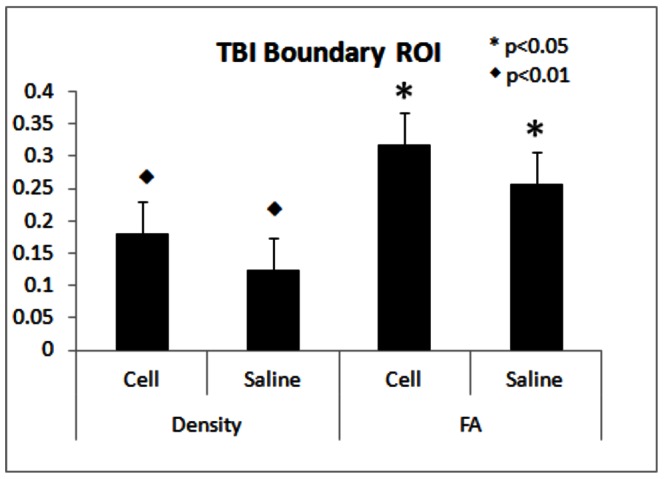
Neurite densities exhibited a significant correlation (R(2)>0.80, p<1E-20) between MRI and immuno-histochemistry measurements with 95% lower bound of the intra-correlation coefficient (ICC) as 0.86. The conventional fractional anisotropy (FA) correlated moderately with histological neurite density (R(2) = 0.59, P<1E-5) with 95% lower bound of ICC as 0.76. MRI data revealed increased neurite reorganization with MSC treatment compared with saline treatment, confirmed by histological data from the same animals. mNSS were significantly correlated with MRI neurite density in the hippocampus region.
The present studies demonstrated that neurite density can be estimated by MRI after TBI and MRI measurement of neurite density is a sensitive marker to MSC treatment response.
骨髓基质细胞(MSC)可刺激轴突重组,从而改善脑损伤后的功能恢复。然而,尚未对损伤后轴突密度变化的 MRI 测量进行研究。在这项研究中,我们探讨了在创伤性脑损伤(TBI)动物模型中使用和不使用 MSC 治疗时,MRI 测量轴突密度的可行性。
15 只雄性 Wistar 大鼠,分别用生理盐水(n=6)或 MSC(n=9)处理,并在皮质撞击(CCI)后 6 周处死。还使用了健康的非 CCI 大鼠(n=5)。大鼠死后两天进行离体 MRI 扫描。使用多壳混合扩散成像编码方案和双室水扩散位移模型的球谐展开来提取与轴突相关的参数。Bielshowski 和 Luxol Fast blue 分别用于轴突和髓鞘的染色。改良 Morris 水迷宫和神经功能严重程度评分(mNSS)测试用于功能评估。通过重复测量方差分析、回归相关分析测试和 Spearman 相关系数,计算治疗效果、MRI 和免疫组织化学测量的轴突密度之间的相关性,以及 MRI 和功能变量之间的相关性。
MRI 与免疫组织化学测量之间的轴突密度呈显著相关性(R(2)>0.80,p<1E-20),内相关系数(ICC)的 95%下限为 0.86。常规各向异性分数(FA)与组织学轴突密度中度相关(R(2)=0.59,P<1E-5),ICC 的 95%下限为 0.76。与生理盐水治疗相比,MSC 治疗后 MRI 数据显示出更多的轴突重组,这与来自同一动物的组织学数据一致。mNSS 与海马区的 MRI 轴突密度显著相关。
本研究表明,TBI 后可通过 MRI 估计轴突密度,MRI 测量的轴突密度是 MSC 治疗反应的敏感标志物。