Kirstenbosch Research Centre, South African National Biodiversity Institute, Cape Town, Western Cape, Republic of South Africa.
PLoS One. 2013 May 23;8(5):e63570. doi: 10.1371/journal.pone.0063570. Print 2013.
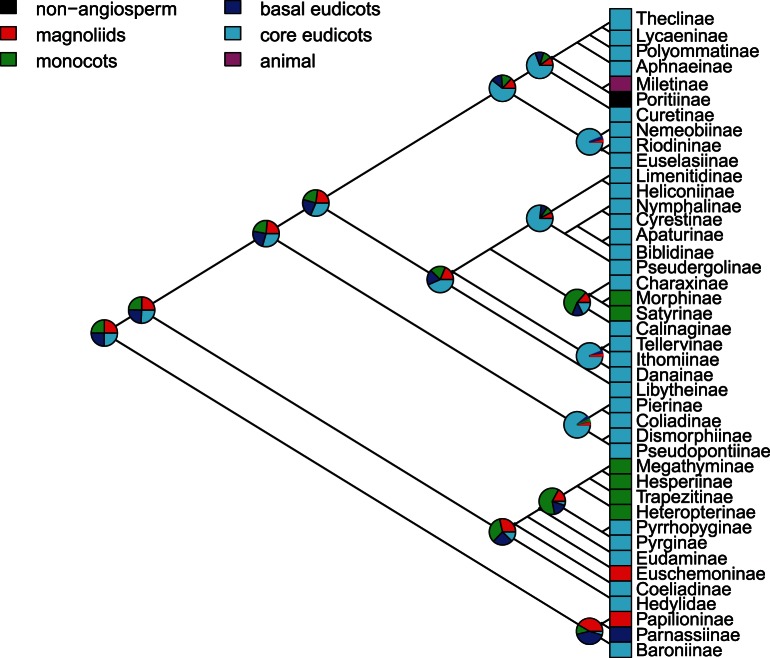
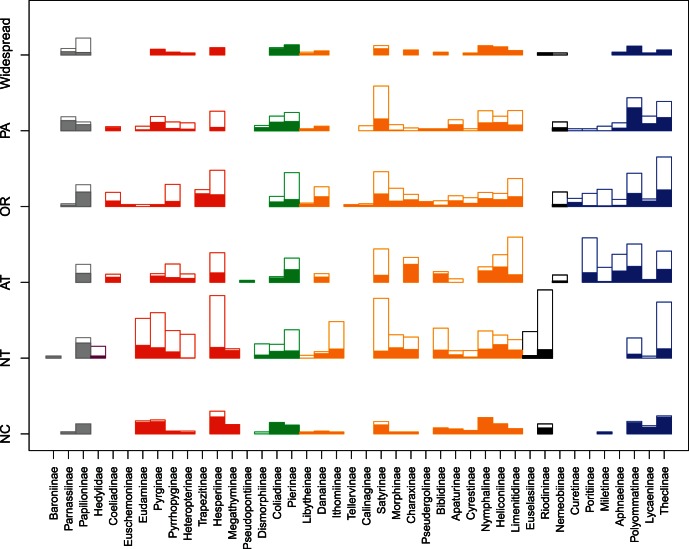
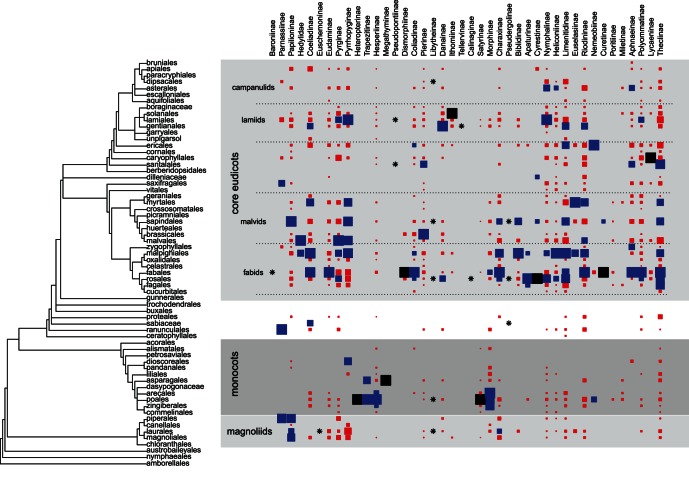
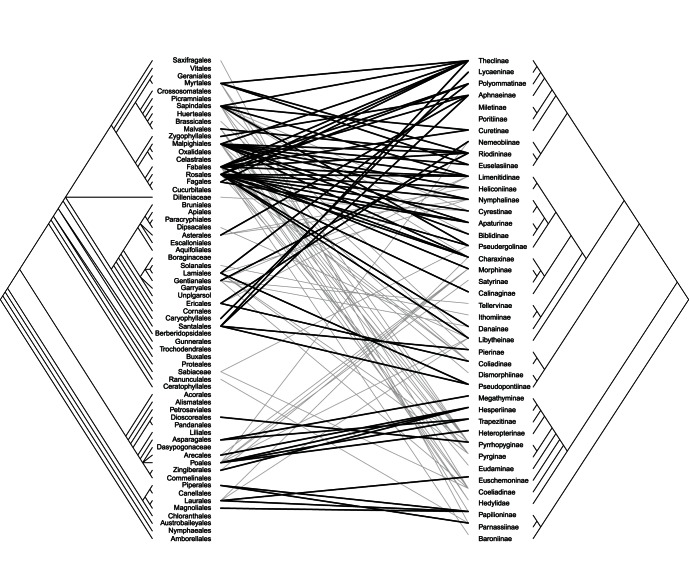
We aggregated data on butterfly-host plant associations from existing sources in order to address the following questions: (1) is there a general correlation between host diversity and butterfly species richness?, (2) has the evolution of host plant use followed consistent patterns across butterfly lineages?, (3) what is the common ancestral host plant for all butterfly lineages? The compilation included 44,148 records from 5,152 butterfly species (28.6% of worldwide species of Papilionoidea) and 1,193 genera (66.3%). The overwhelming majority of butterflies use angiosperms as host plants. Fabales is used by most species (1,007 spp.) from all seven butterfly families and most subfamilies, Poales is the second most frequently used order, but is mostly restricted to two species-rich subfamilies: Hesperiinae (56.5% of all Hesperiidae), and Satyrinae (42.6% of all Nymphalidae). We found a significant and strong correlation between host plant diversity and butterfly species richness. A global test for congruence (Parafit test) was sensitive to uncertainty in the butterfly cladogram, and suggests a mixed system with congruent associations between Papilionidae and magnoliids, Hesperiidae and monocots, and the remaining subfamilies with the eudicots (fabids and malvids), but also numerous random associations. The congruent associations are also recovered as the most probable ancestral states in each node using maximum likelihood methods. The shift from basal groups to eudicots appears to be more likely than the other way around, with the only exception being a Satyrine-clade within the Nymphalidae that feed on monocots. Our analysis contributes to the visualization of the complex pattern of interactions at superfamily level and provides a context to discuss the timing of changes in host plant utilization that might have promoted diversification in some butterfly lineages.
我们汇总了现有来源中有关蝴蝶与寄主植物关系的数据,以回答以下问题:(1) 寄主多样性与蝴蝶物种丰富度之间是否存在普遍相关性?(2) 蝴蝶谱系的寄主植物利用进化是否遵循一致的模式?(3) 所有蝴蝶谱系的共同祖先寄主植物是什么?该汇编包括 5,152 种蝴蝶(鳞翅目蝴蝶的 28.6%)和 1,193 个属(66.3%)的 44,148 个记录。绝大多数蝴蝶以被子植物为寄主植物。Fabales 被来自七个蝴蝶科和大多数亚科的绝大多数物种(1,007 种)使用,Poales 是第二大常用目,但主要限于两个物种丰富的亚科:Hesperiinae(所有 Hesperiidae 的 56.5%)和 Satyrinae(所有 Nymphalidae 的 42.6%)。我们发现寄主植物多样性与蝴蝶物种丰富度之间存在显著且强的相关性。全局一致性检验(Parafit 检验)对蝴蝶系统发育树的不确定性敏感,表明这是一个混合系统,与 Papilionidae 和木兰类植物、Hesperiidae 和单子叶植物以及其余亚科与真双子叶植物(fabids 和 malvids)具有一致的关联,但也存在许多随机关联。使用最大似然法,一致的关联也被恢复为每个节点的最可能祖先状态。从基部类群到真双子叶植物的转变似乎比相反的情况更有可能,唯一的例外是 Nymphalidae 中的一个 Satyrine 分支,它们以单子叶植物为食。我们的分析有助于可视化超级科水平上复杂的相互作用模式,并提供一个讨论可能促进某些蝴蝶谱系多样化的寄主植物利用变化时间的背景。