Sahoo Ranjit Kumar, Warren Andrew D, Collins Steve C, Kodandaramaiah Ullasa
IISER-TVM Centre for Research and Education in Ecology and Evolution (ICREEE), School of Biology, Indian Institute of Science Education and Research, Thiruvananthapuram, Kerala, 695 551, India.
McGuire Center for Lepidoptera and Biodiversity, Florida Museum of Natural History, University of Florida, PO Box 112710, 3215 Hull Rd., UF Cultural Plaza, Gainesville, FL, 32611-2710, USA.
BMC Evol Biol. 2017 Aug 2;17(1):174. doi: 10.1186/s12862-017-1016-x.
Skippers (Family: Hesperiidae) are a large group of butterflies with ca. 4000 species under 567 genera. The lack of a time-calibrated higher-level phylogeny of the group has precluded understanding of its evolutionary past. We here use a 10-gene dataset to reconstruct the most comprehensive time-calibrated phylogeny of the group, and explore factors that affected the diversification of these butterflies.
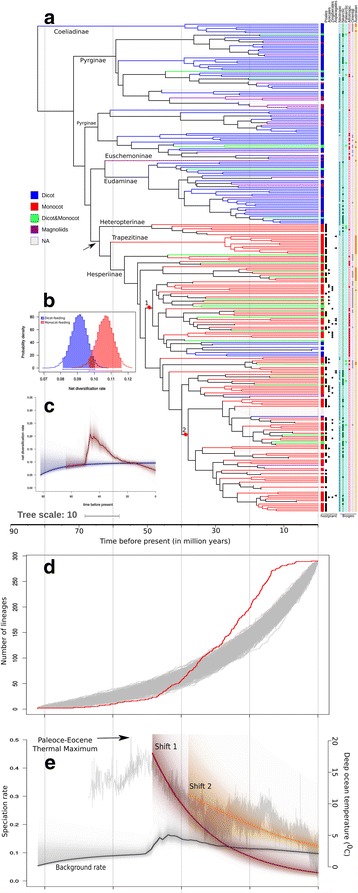
Ancestral state reconstructions show that the early hesperiid lineages utilized dicots as larval hostplants. The ability to feed on monocots evolved once at the K-Pg boundary (ca. 65 million years ago (Mya)), and allowed monocot-feeders to diversify much faster on average than dicot-feeders. The increased diversification rate of the monocot-feeding clade is specifically attributed to rate shifts in two of its descendant lineages. The first rate shift, a four-fold increase compared to background rates, happened ca. 50 Mya, soon after the Paleocene-Eocene thermal maximum, in a lineage of the subfamily Hesperiinae that mostly fed on forest monocots. The second rate shift happened ca. 40 Mya in a grass-feeding lineage of Hesperiinae when open-habitat grasslands appeared in the Neotropics owing to gradual cooling of the atmospheric temperature.
The evolution of monocot feeding strongly influenced diversification of skippers. We hypothesize that although monocot feeding was an intrinsic trait that allowed exploration of novel niches, the lack of extensive availability of monocots comprised an extrinsic limitation for niche exploration. The shifts in diversification rate coincided with paleoclimatic events during which grasses and forest monocots were diversified.
弄蝶(弄蝶科)是一大类蝴蝶,包含约4000个物种,分属于567个属。该类群缺乏经过时间校准的高级系统发育树,这妨碍了我们对其进化历史的理解。我们在此使用一个包含10个基因的数据集来重建该类群最全面的经过时间校准的系统发育树,并探究影响这些蝴蝶多样化的因素。
祖先状态重建表明,早期弄蝶谱系以双子叶植物作为幼虫寄主植物。以单子叶植物为食的能力在白垩纪-古近纪界线(约6500万年前)出现过一次进化,这使得以单子叶植物为食的弄蝶平均比以双子叶植物为食的弄蝶多样化速度更快。以单子叶植物为食的分支多样化速率增加具体归因于其两个后代谱系的速率变化。第一次速率变化是与背景速率相比增加了四倍,发生在约5000万年前,即古新世-始新世极热事件之后不久,发生在弄蝶亚科的一个谱系中,该谱系主要以森林单子叶植物为食。第二次速率变化发生在约4000万年前,在弄蝶亚科的一个以草为食的谱系中,当时由于大气温度逐渐冷却,新热带地区出现了开阔栖息地的草原。
以单子叶植物为食的进化强烈影响了弄蝶的多样化。我们推测,尽管以单子叶植物为食是一种内在特征,有助于开拓新的生态位,但单子叶植物缺乏广泛可得性构成了生态位开拓的外在限制。多样化速率的变化与古气候事件同时发生,在此期间草本植物和森林单子叶植物得以多样化。