Department of Mathematics, University of Scranton, Scranton, Pennsylvania, USA. jason.grahamscranton.edu
PLoS One. 2013 May 22;8(5):e63884. doi: 10.1371/journal.pone.0063884. Print 2013.
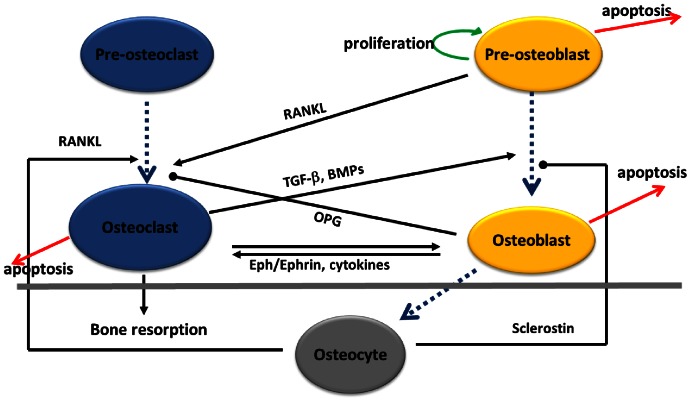
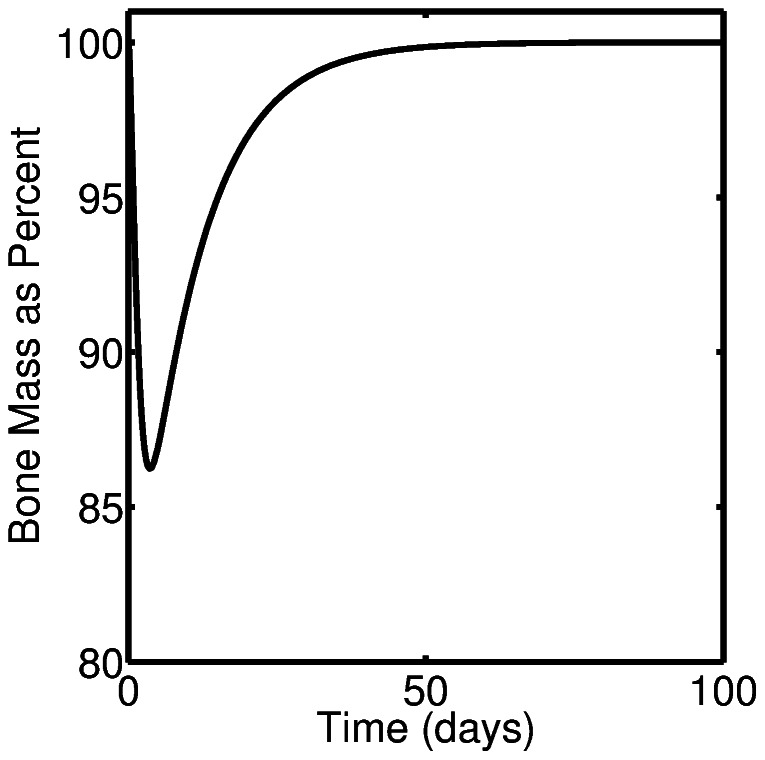
Until recently many studies of bone remodeling at the cellular level have focused on the behavior of mature osteoblasts and osteoclasts, and their respective precursor cells, with the role of osteocytes and bone lining cells left largely unexplored. This is particularly true with respect to the mathematical modeling of bone remodeling. However, there is increasing evidence that osteocytes play important roles in the cycle of targeted bone remodeling, in serving as a significant source of RANKL to support osteoclastogenesis, and in secreting the bone formation inhibitor sclerostin. Moreover, there is also increasing interest in sclerostin, an osteocyte-secreted bone formation inhibitor, and its role in regulating local response to changes in the bone microenvironment. Here we develop a cell population model of bone remodeling that includes the role of osteocytes, sclerostin, and allows for the possibility of RANKL expression by osteocyte cell populations. We have aimed to give a simple, yet still tractable, model that remains faithful to the underlying system based on the known literature. This model extends and complements many of the existing mathematical models for bone remodeling, but can be used to explore aspects of the process of bone remodeling that were previously beyond the scope of prior modeling work. Through numerical simulations we demonstrate that our model can be used to explore theoretically many of the qualitative features of the role of osteocytes in bone biology as presented in recent literature.
直到最近,许多关于细胞水平骨重塑的研究都集中在成熟成骨细胞和破骨细胞及其各自前体细胞的行为上,而骨细胞和骨衬细胞的作用在很大程度上仍未得到探索。这在骨重塑的数学建模方面尤其如此。然而,越来越多的证据表明,骨细胞在有针对性的骨重塑循环中发挥着重要作用,作为支持破骨细胞生成的 RANKL 的重要来源,并分泌骨形成抑制剂骨硬化蛋白。此外,人们对骨细胞分泌的骨形成抑制剂骨硬化蛋白及其在调节骨微环境变化的局部反应中的作用也越来越感兴趣。在这里,我们开发了一种包含骨细胞、骨硬化蛋白作用的骨重塑细胞群体模型,并允许骨细胞群体表达 RANKL 的可能性。我们的目标是提供一个简单但仍然易于处理的模型,该模型仍然忠实于基于已知文献的基础系统。该模型扩展和补充了许多现有的骨重塑数学模型,但可用于探索骨重塑过程中的一些方面,这些方面以前超出了先前建模工作的范围。通过数值模拟,我们证明我们的模型可以用于理论上探索最近文献中提出的骨细胞在骨生物学中的作用的许多定性特征。