Department of Biochemistry, University of Stellenbosch, Matieland, Stellenbosch, Republic of South Africa.
PLoS One. 2013 May 22;8(5):e64831. doi: 10.1371/journal.pone.0064831. Print 2013.
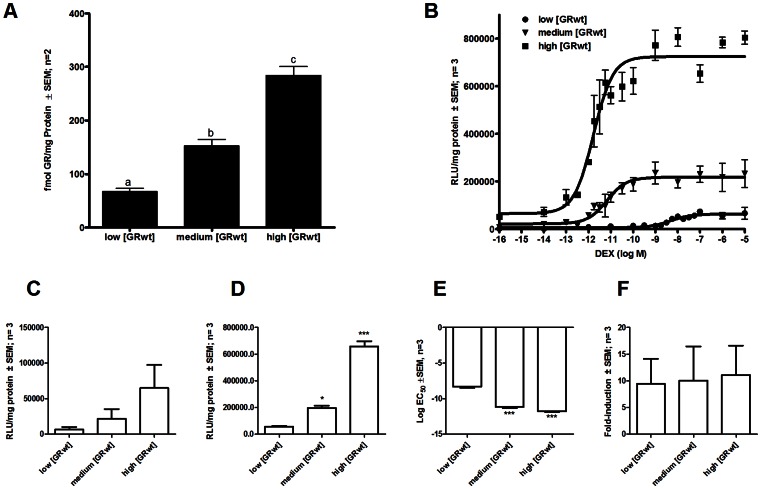
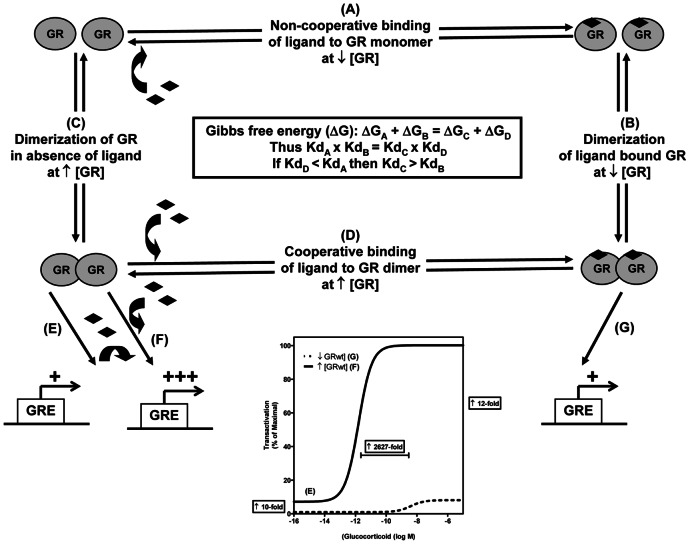
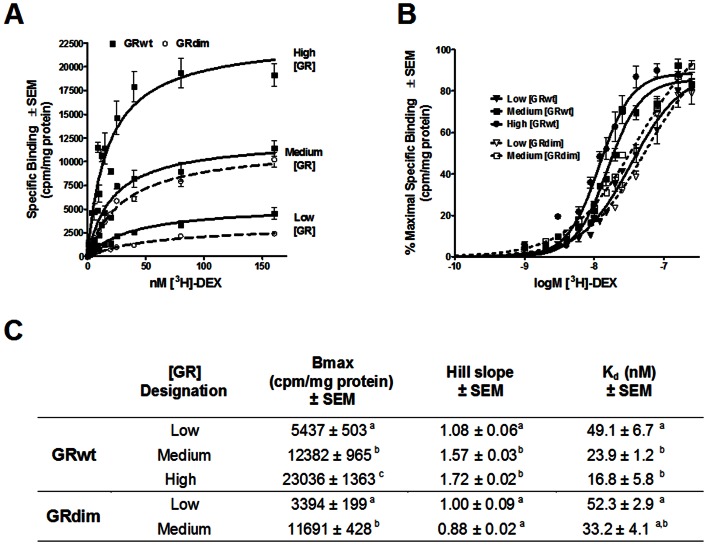
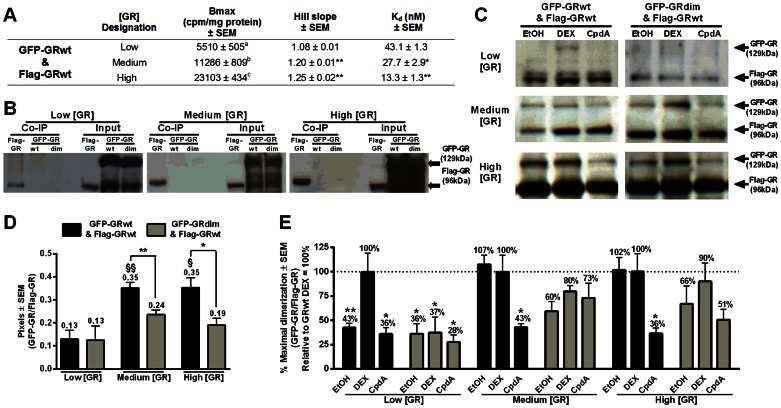
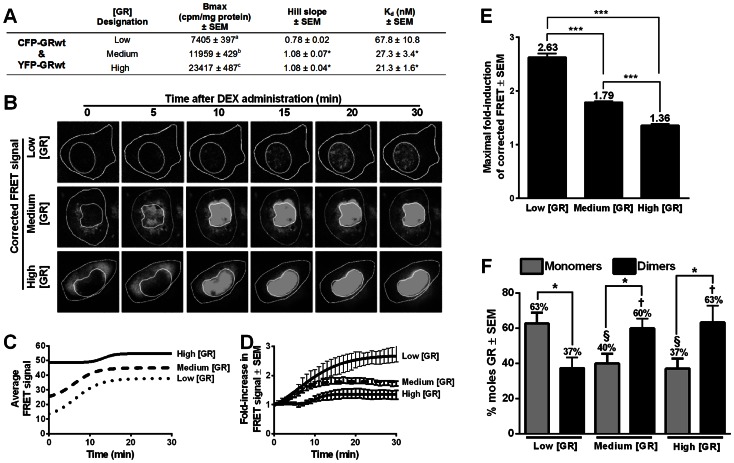
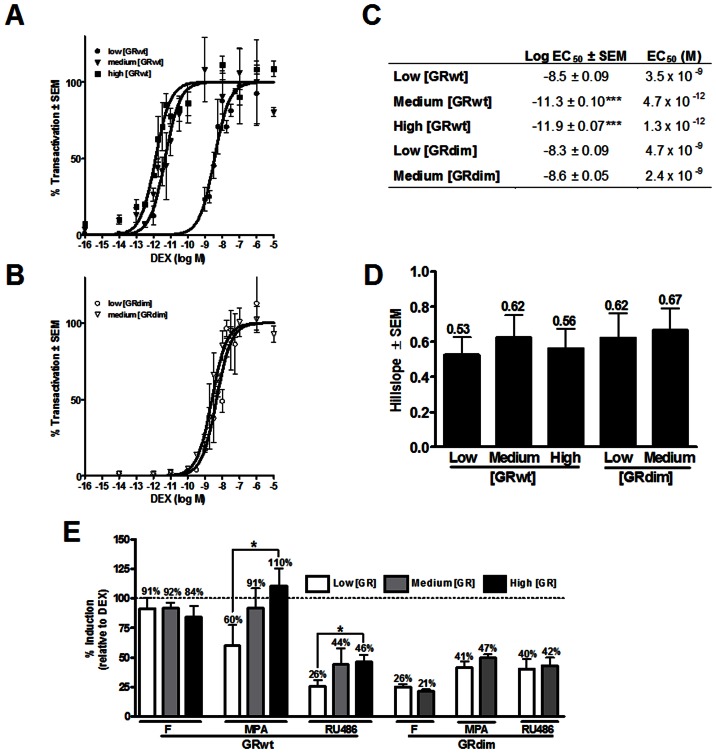
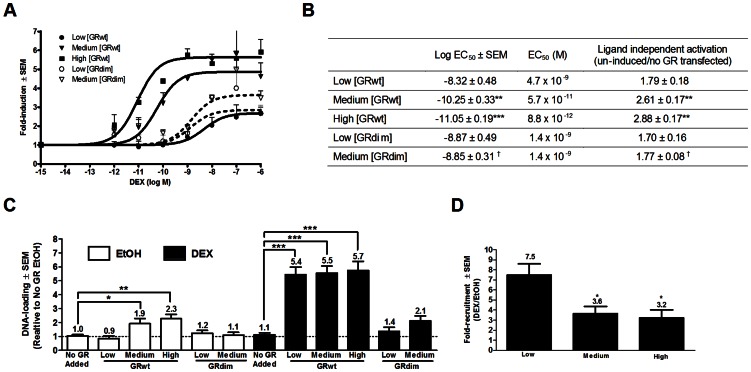
Glucocorticoid receptor (GR) levels vary between tissues and individuals and are altered by physiological and pharmacological effectors. However, the effects and implications of differences in GR concentration have not been fully elucidated. Using three statistically different GR concentrations in transiently transfected COS-1 cells, we demonstrate, using co-immunoprecipitation (CoIP) and fluorescent resonance energy transfer (FRET), that high levels of wild type GR (wtGR), but not of dimerization deficient GR (GRdim), display ligand-independent dimerization. Whole-cell saturation ligand-binding experiments furthermore establish that positive cooperative ligand-binding, with a concomitant increased ligand-binding affinity, is facilitated by ligand-independent dimerization at high concentrations of wtGR, but not GRdim. The down-stream consequences of ligand-independent dimerization at high concentrations of wtGR, but not GRdim, are shown to include basal priming of the system as witnessed by ligand-independent transactivation of both a GRE-containing promoter-reporter and the endogenous glucocorticoid (GC)-responsive gene, GILZ, as well as ligand-independent loading of GR onto the GILZ promoter. Pursuant to the basal priming of the system, addition of ligand results in a significantly greater modulation of transactivation potency than would be expected solely from the increase in ligand-binding affinity. Thus ligand-independent dimerization of the GR at high concentrations primes the system, through ligand-independent DNA loading and transactivation, which together with positive cooperative ligand-binding increases the potency of GR agonists and shifts the bio-character of partial GR agonists. Clearly GR-levels are a major factor in determining the sensitivity to GCs and a critical factor regulating transcriptional programs.
糖皮质激素受体(GR)的水平在组织和个体之间存在差异,并受到生理和药理学效应物的影响。然而,GR 浓度差异的影响和意义尚未完全阐明。我们使用瞬时转染的 COS-1 细胞中的三种统计学上不同的 GR 浓度,通过共免疫沉淀(CoIP)和荧光共振能量转移(FRET)证明,高水平的野生型 GR(wtGR),而不是二聚缺陷型 GR(GRdim),表现出配体非依赖性二聚化。全细胞饱和配体结合实验进一步证实,在 wtGR 的高浓度下,配体非依赖性二聚化促进了正协同配体结合,同时增加了配体结合亲和力,但 GRdim 则不然。wtGR 高浓度下配体非依赖性二聚化的下游后果表明,系统存在基础启动,这表现为包含 GRE 的启动子-报告基因和内源性糖皮质激素(GC)反应基因 GILZ 的配体非依赖性转录激活,以及 GR 配体非依赖性加载到 GILZ 启动子上。由于系统的基础启动,加入配体导致转录激活效力的显著更大调节,超过仅从配体结合亲和力增加所预期的调节。因此,高浓度的 GR 配体非依赖性二聚化通过配体非依赖性 DNA 加载和转录激活来启动系统,这与正协同配体结合一起增加了 GR 激动剂的效力,并改变了部分 GR 激动剂的生物特性。显然,GR 水平是决定对 GCs 敏感性的主要因素,也是调节转录程序的关键因素。