Epidemiology and Biostatistics, CUNY School of Public Health at Hunter College, New York, New York, United States of America.
PLoS One. 2013 May 22;8(5):e64921. doi: 10.1371/journal.pone.0064921. Print 2013.
Epstein-Barr virus (EBV) is a common herpesvirus linked to infectious mononucleosis and multiple cancers. There are no national estimates of EBV seroprevalence in the United States. Our objective was to estimate the overall prevalence and sociodemographic predictors of EBV among U.S. children and adolescents aged 6-19.
We calculated prevalence estimates and prevalence ratios for EBV seroprevalence using data from the 2003-2010 U.S. National Health and Nutrition Examination Survey (NHANES) for children aged 6-19 (n = 8417). Poisson regression was used to calculate multivariable-adjusted prevalence ratios across subgroup categories (sex, race/ethnicity, parental education, household income, household size, foreign-born, BMI, and household smoking).
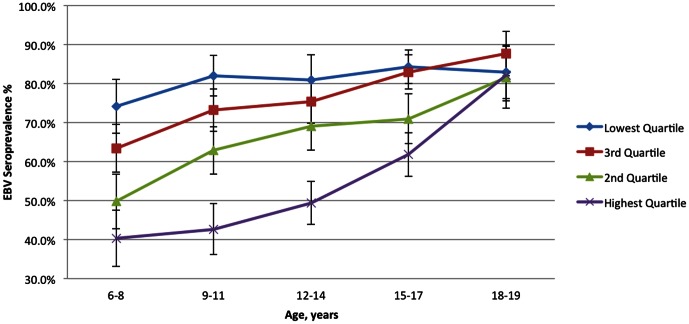
Overall EBV seroprevalence was 66.5% (95% CI 64.3%-68.7%.). Seroprevalence increased with age, ranging from 54.1% (95% CI 50.2%-57.9%) for 6-8 year olds to 82.9% (95% CI 80.0%-85.9%) for 18-19 year olds. Females had slightly higher seroprevalence (68.9%, 95% CI 66.3%-71.6%) compared to males (64.2%, 95% CI 61.7%-66.8%). Seroprevalence was substantially higher for Mexican-Americans (85.4%, 95% CI 83.1%-87.8%) and Non-Hispanic Blacks (83.1%, 95% CI 81.1%-85.1%) than Non-Hispanic Whites (56.9%, 95% CI 54.1%-59.8%). Large differences were also seen by family income, with children in the lowest income quartile having 81.0% (95% CI 77.6%-84.5%) seroprevalence compared to 53.9% (95% CI 50.5%-57.3%) in the highest income quartile, with similar results for parental education level. These results were not explained by household size, BMI, or parental smoking. Among those who were seropositive, EBV antibody titers were significantly higher for females, Non-Hispanic Blacks and Mexican-Americans, with no association found for socioeconomic factors.
In the first nationally representative U.S. estimates, we found substantial socioeconomic and race/ethnic differences in the seroprevalence of EBV across all ages for U.S. children and adolescents. These estimates can help researchers and clinicians identify groups most at risk, inform research on EBV-cancer etiology, and motivate potential vaccine development.
爱泼斯坦-巴尔病毒(EBV)是一种常见的疱疹病毒,与传染性单核细胞增多症和多种癌症有关。在美国,没有 EBV 血清流行率的全国估计数。我们的目的是估计美国 6-19 岁儿童和青少年中 EBV 的总体流行率和社会人口统计学预测因素。
我们使用了 2003-2010 年美国国家健康和营养检查调查(NHANES)中 6-19 岁儿童的数据(n=8417),计算了 EBV 血清流行率的估计值和流行率比。使用泊松回归计算了亚组类别(性别、种族/民族、父母教育程度、家庭收入、家庭规模、外国出生、BMI 和家庭吸烟)的多变量调整后流行率比。
总体 EBV 血清流行率为 66.5%(95%置信区间 64.3%-68.7%)。血清流行率随年龄增长而增加,6-8 岁儿童为 54.1%(95%置信区间 50.2%-57.9%),18-19 岁儿童为 82.9%(95%置信区间 80.0%-85.9%)。女性的血清流行率(68.9%,95%置信区间 66.3%-71.6%)略高于男性(64.2%,95%置信区间 61.7%-66.8%)。墨西哥裔美国人(85.4%,95%置信区间 83.1%-87.8%)和非西班牙裔黑人(83.1%,95%置信区间 81.1%-85.1%)的血清流行率明显高于非西班牙裔白人(56.9%,95%置信区间 54.1%-59.8%)。家庭收入也存在较大差异,收入最低四分位数的儿童血清流行率为 81.0%(95%置信区间 77.6%-84.5%),而收入最高四分位数的儿童血清流行率为 53.9%(95%置信区间 50.5%-57.3%),父母教育程度也存在类似结果。这些结果不能用家庭规模、BMI 或父母吸烟来解释。在 EBV 抗体呈阳性的人群中,女性、非西班牙裔黑人和墨西哥裔美国人的 EBV 抗体滴度明显较高,而社会经济因素与 EBV 抗体滴度无关。
在首次全国代表性的美国估计中,我们发现美国儿童和青少年的 EBV 血清流行率在所有年龄段都存在显著的社会经济和种族/民族差异。这些估计可以帮助研究人员和临床医生确定风险最大的群体,为 EBV-癌症病因学研究提供信息,并为潜在的疫苗开发提供动力。