Programme National de Lutte Contre la Cécité, Ministère de la Santé, Yaoundé, Cameroun.
PLoS Negl Trop Dis. 2013 May 23;7(5):e2240. doi: 10.1371/journal.pntd.0002240. Print 2013.
Cameroon is known to be endemic with trachoma. To appreciate the burden of the disease and facilitate the national planning of trachoma control in the integrated control program for the neglected tropical diseases, an epidemiological mapping of trachoma was conducted in the Far North region in 2010-11.
A cross-sectional, cluster random sampling survey was carried out. The survey focused on two target populations: children aged 1 to 9 years for the prevalence of active trachoma and those aged 15 and over for the prevalence of trichiasis (TT). The sample frame was an exhaustive list of villages and neighborhoods of Health Districts (HDs). The World Health Organization simplified trachoma grading system was used for the recognition and registration of cases of trachoma.
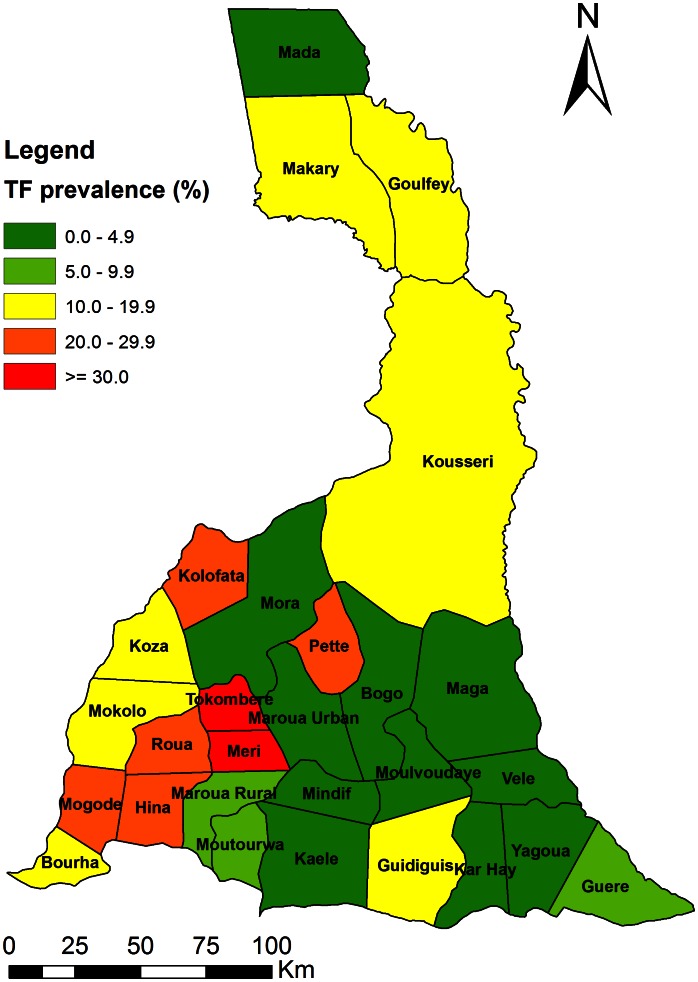
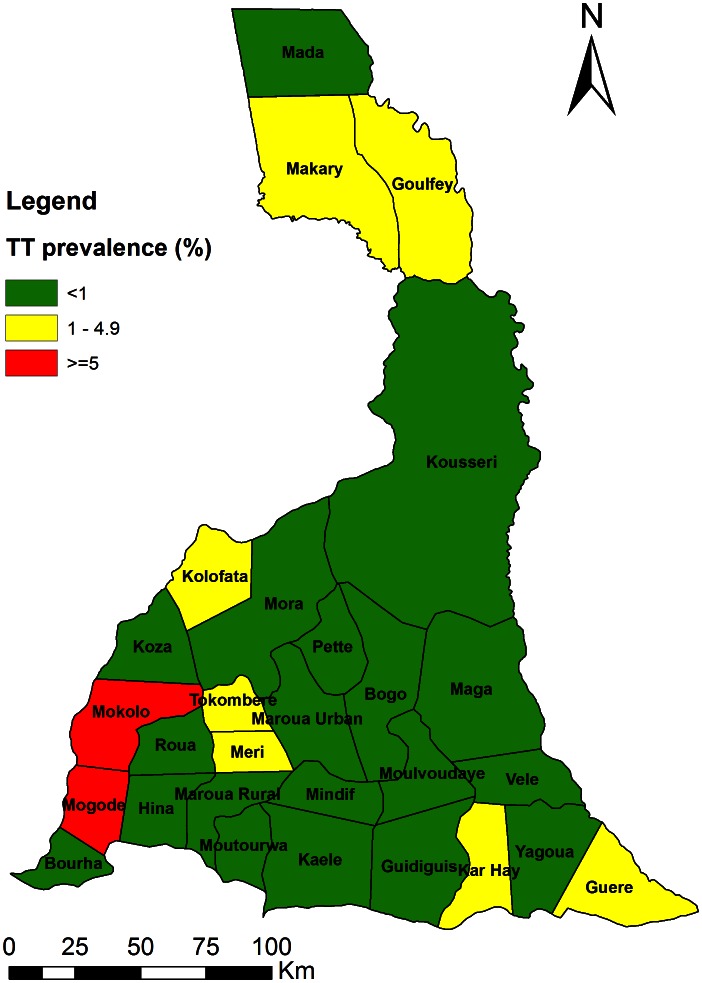
48,844 children aged 1 to 9 years and 41,533 people aged 15 and over were examined. In children aged 1-9 years, the overall prevalence of trachomatous inflammation-follicular (TF) was 11.2% (95% confidence intervals (CI): 11.0-11.5%). More girls were affected than boys (p = 0.003). Thirteen (13) of 27 HDs in the region showed TF prevalence of ≥10%. The overall TT prevalence was 1.0% (95% CI: 0.9-1.1%). There were estimated 17193 (95% CI: 12576-25860) TT cases in the region. The prevalence of blindness was 0.04% (95% CI: 0.03-0.07%) and visual impairment was 0.09% (95% CI: 0.07-0.13%).
CONCLUSIONS/SIGNIFICANCE: The survey confirmed that trachoma is a public health problem in the Far North region with 13 HDs qualified for district-level mass drug administration with azithromycin. It provided a foundation for the national program to plan and implement the SAFE strategy in the region. Effort must be made to find resources to provide the surgical operations to the 17193 TT cases and prevent them from becoming blind.
喀麦隆已知是沙眼流行地区。为了了解疾病的负担,并在被忽视的热带病综合控制规划中促进国家对沙眼控制的规划,2010-2011 年在北部地区进行了沙眼的流行病学绘图。
进行了一项横断面、整群随机抽样调查。调查的重点是两个目标人群:1 至 9 岁的儿童用于调查活动性沙眼的流行率,15 岁及以上的人群用于调查倒睫(TT)的流行率。抽样框架是卫生区(HDs)的村庄和街区的详尽清单。世界卫生组织简化的沙眼分级系统用于识别和登记沙眼病例。
共检查了 48844 名 1 至 9 岁的儿童和 41533 名 15 岁及以上的人群。在 1-9 岁的儿童中,沙眼滤泡性炎症(TF)的总流行率为 11.2%(95%置信区间[CI]:11.0-11.5%)。受影响的女孩多于男孩(p=0.003)。该地区 27 个 HDs 中有 13 个地区的 TF 流行率≥10%。总的 TT 流行率为 1.0%(95%CI:0.9-1.1%)。该地区估计有 17193 例(95%CI:12576-25860)TT 病例。失明的患病率为 0.04%(95%CI:0.03-0.07%),视力障碍的患病率为 0.09%(95%CI:0.07-0.13%)。
结论/意义:调查证实,北部地区存在沙眼公共卫生问题,有 13 个 HDs 符合用阿奇霉素进行区级大规模药物治疗的条件。它为国家规划在该地区实施 SAFE 战略提供了基础。必须努力寻找资源,为 17193 例 TT 病例提供手术,并防止他们失明。