Comprehensive Cancer Center Muenster, University Hospital of Muenster, Albert-Schweitzer-Campus 1, Muenster, 48149, Germany.
BMC Cancer. 2013 May 29;13:264. doi: 10.1186/1471-2407-13-264.
Pancreatic ductal adenocarcinoma (PDAC) is distinguished by rapid dissemination. Thus, genetic and/or epigenetic deregulation of metastasis suppressor genes (MSG) is a likely event during early pancreatic carcinogenesis and a potential diagnostic marker for the disease. We investigated 9 known MSGs for their role in the dissemination of PDAC and examined their promoters for methylation and its use in PDAC detection.
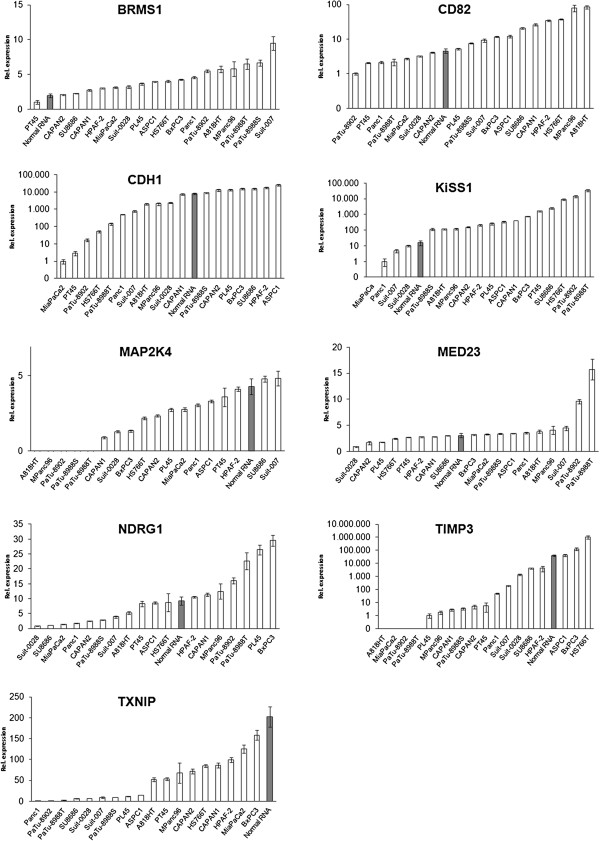
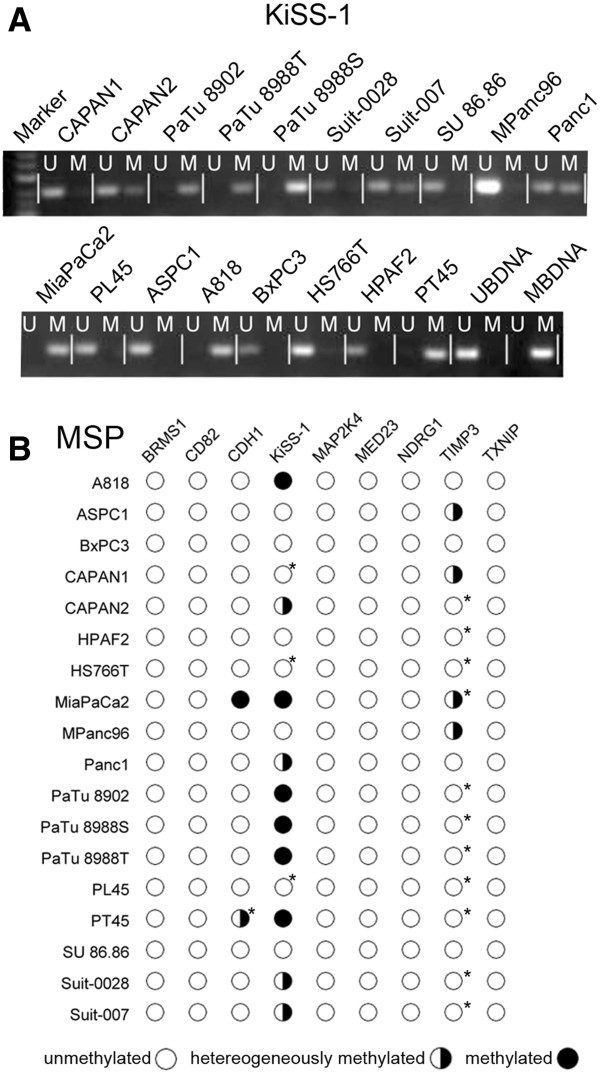
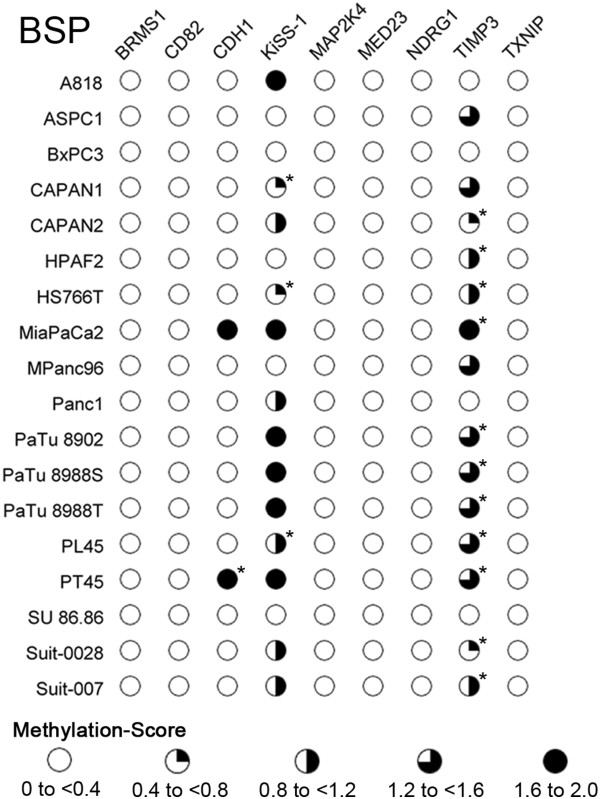
MRNA expression of 9 MSGs was determined in 18 PDAC cell lines by quantitative RT-PCR and promoter methylation was analyzed by Methylation Specific PCR and validated by Bisulfite Sequencing PCR. These data were compared to the cell lines' in vivo metastatic and invasive potential that had been previously established. Statistical analysis was performed with SPSS 20 using 2-tailed Spearman's correlation with P < 0.05 being considered significant.
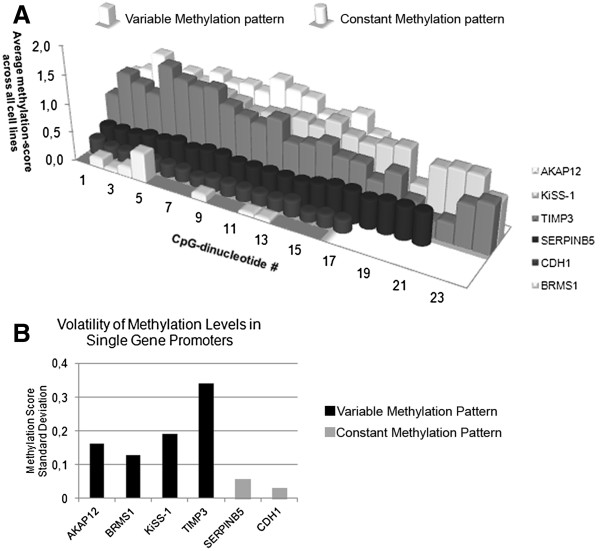
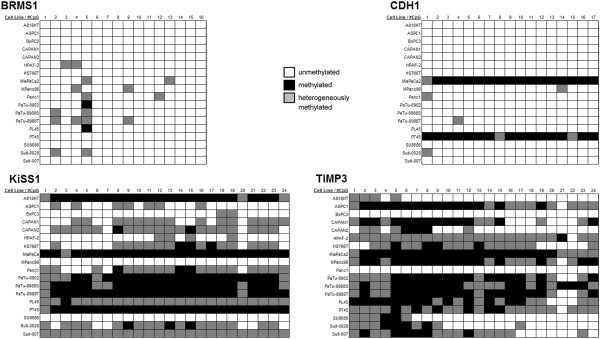
Complete downregulation of MSG-mRNA expression in PDAC cell lines vs. normal pancreatic RNA occurred in only 1 of 9 investigated genes. 3 MSGs (CDH1, TIMP3 and KiSS-1) were significantly methylated. Methylation only correlated to loss of mRNA expression in CDH1 (P < 0.05). Bisulfite Sequencing PCR showed distinct methylation patterns, termed constant and variable methylation, which could distinguish methylation-regulated from non methylation-regulated genes. Higher MSG mRNA-expression did not correlate to less aggressive PDAC-phenotypes (P > 0.14).
Genes with metastasis suppressing functions in other tumor entities did not show evidence of assuming the same role in PDAC. Inactivation of MSGs by promoter methylation was an infrequent event and unsuitable as a diagnostic marker of PDAC. A distinct methylation pattern was identified, that resulted in reduced mRNA expression in all cases. Thus, constant methylation patterns could predict regulatory significance of a promoter's methylation prior to expression analysis and hence present an additional tool during target gene selection.
胰腺导管腺癌(PDAC)的特点是快速扩散。因此,转移抑制基因(MSG)的遗传和/或表观遗传失调很可能发生在胰腺癌变的早期,并且是该疾病的潜在诊断标志物。我们研究了 9 个已知的 MSGs 在 PDAC 扩散中的作用,并检查了它们的启动子是否发生甲基化及其在 PDAC 检测中的用途。
通过定量 RT-PCR 测定 18 种 PDAC 细胞系中 9 个 MSGs 的 m-RNA 表达,并通过甲基化特异性 PCR 分析启动子甲基化,并通过亚硫酸氢盐测序 PCR 进行验证。将这些数据与先前建立的细胞系的体内转移和侵袭潜能进行比较。使用 SPSS 20 进行统计分析,使用双侧 Spearman 相关分析,P < 0.05 被认为具有统计学意义。
仅在 9 个研究基因中的 1 个基因中观察到 PDAC 细胞系与正常胰腺 RNA 相比的 MSG-mRNA 表达完全下调。3 个 MSGs(CDH1、TIMP3 和 KiSS-1)被显著甲基化。甲基化仅与 CDH1 中的 mRNA 表达缺失相关(P < 0.05)。亚硫酸氢盐测序 PCR 显示出不同的甲基化模式,称为恒定和可变甲基化,可以区分受甲基化调节和不受甲基化调节的基因。较高的 MSG m-RNA 表达与侵袭性较弱的 PDAC 表型无关(P > 0.14)。
在其他肿瘤实体中具有转移抑制功能的基因并没有表现出在 PDAC 中具有相同作用的证据。启动子甲基化导致 MSGs 失活是一种罕见事件,不适合作为 PDAC 的诊断标志物。鉴定出一种独特的甲基化模式,导致所有情况下的 mRNA 表达降低。因此,恒定的甲基化模式可以在表达分析之前预测启动子甲基化的调控意义,从而在靶基因选择过程中提供另一种工具。