MMWR Morb Mortal Wkly Rep. 2013 May 31;62(21):423-5.
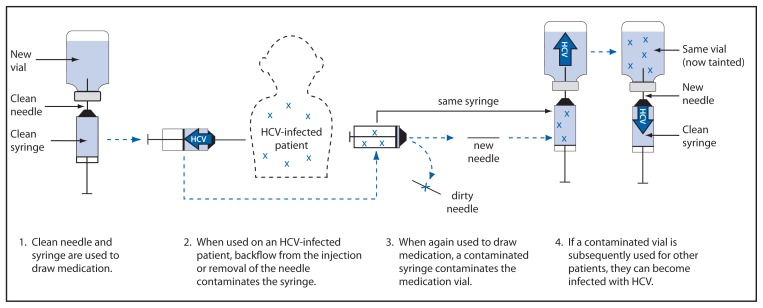
Injectable medicines commonly are used in health-care settings for the prevention, diagnosis, and treatment of various illnesses. Examples include chemotherapy, intravenous antibiotics, vaccinations, and medications used for sedation and anesthesia. Medical injections often are administered in conjunction with surgical procedures, endoscopy, imaging studies, pain control, and cosmetic or complementary and alternative medicine procedures. Safe manufacturing and pharmacy practices are essential because every injection must begin with sterile medication. The appropriate medication must then be safely prepared (typically drawn up in a syringe), then administered in a manner that maintains sterility and minimizes risk for infection. Safe administration depends on adherence to the practices outlined in CDC's evidence-based Standard Precautions guideline. Health-care providers should never 1) administer medications from the same syringe to more than one patient, 2) enter a vial with a used syringe or needle, or 3) administer medications from single-dose vials to multiple patients. They also should maintain aseptic technique at all times and properly dispose of used injection equipment.
注射类药物常用于医疗保健场所,用于预防、诊断和治疗各种疾病。例如化疗、静脉用抗生素、疫苗,以及用于镇静和麻醉的药物。医疗注射通常与手术、内窥镜检查、影像学研究、疼痛控制以及美容或补充和替代医学程序一起进行。安全的生产和药剂实践至关重要,因为每次注射都必须从无菌药物开始。然后,必须安全地准备适当的药物(通常在注射器中抽取),然后以保持无菌和最大程度降低感染风险的方式进行给药。安全给药取决于遵守疾病预防控制中心基于证据的标准预防指南中概述的实践。医疗保健提供者绝不应该 1)将药物从同一注射器注射给多个患者,2)将用过的注射器或针头插入小瓶,或 3)将单剂量小瓶中的药物注射给多个患者。他们还应始终保持无菌技术,并正确处理用过的注射设备。