Parsons Christine E, Young Katherine S, Joensson Morten, Brattico Elvira, Hyam Jonathan A, Stein Alan, Green Alexander L, Aziz Tipu Z, Kringelbach Morten L
University Department of Psychiatry, University of Oxford, Oxford, OX3 7JX, UK, Department of Clinical Medicine, Center of Functionally Integrative Neuroscience, Aarhus University, 8000 Aarhus C, Denmark, Cognitive Brain Research Unit, Institute of Behavioral Sciences, University of Helsinki and Center of Excellence in Interdisciplinary Music Research, University of Jyväskylä, Finland, and Department of Neurosurgery, John Radcliffe Hospital, Oxford, OX3 9DU, UKUniversity Department of Psychiatry, University of Oxford, Oxford, OX3 7JX, UK, Department of Clinical Medicine, Center of Functionally Integrative Neuroscience, Aarhus University, 8000 Aarhus C, Denmark, Cognitive Brain Research Unit, Institute of Behavioral Sciences, University of Helsinki and Center of Excellence in Interdisciplinary Music Research, University of Jyväskylä, Finland, and Department of Neurosurgery, John Radcliffe Hospital, Oxford, OX3 9DU, UK
University Department of Psychiatry, University of Oxford, Oxford, OX3 7JX, UK, Department of Clinical Medicine, Center of Functionally Integrative Neuroscience, Aarhus University, 8000 Aarhus C, Denmark, Cognitive Brain Research Unit, Institute of Behavioral Sciences, University of Helsinki and Center of Excellence in Interdisciplinary Music Research, University of Jyväskylä, Finland, and Department of Neurosurgery, John Radcliffe Hospital, Oxford, OX3 9DU, UKUniversity Department of Psychiatry, University of Oxford, Oxford, OX3 7JX, UK, Department of Clinical Medicine, Center of Functionally Integrative Neuroscience, Aarhus University, 8000 Aarhus C, Denmark, Cognitive Brain Research Unit, Institute of Behavioral Sciences, University of Helsinki and Center of Excellence in Interdisciplinary Music Research, University of Jyväskylä, Finland, and Department of Neurosurgery, John Radcliffe Hospital, Oxford, OX3 9DU, UK.
Soc Cogn Affect Neurosci. 2014 Jul;9(7):977-84. doi: 10.1093/scan/nst076. Epub 2013 May 29.
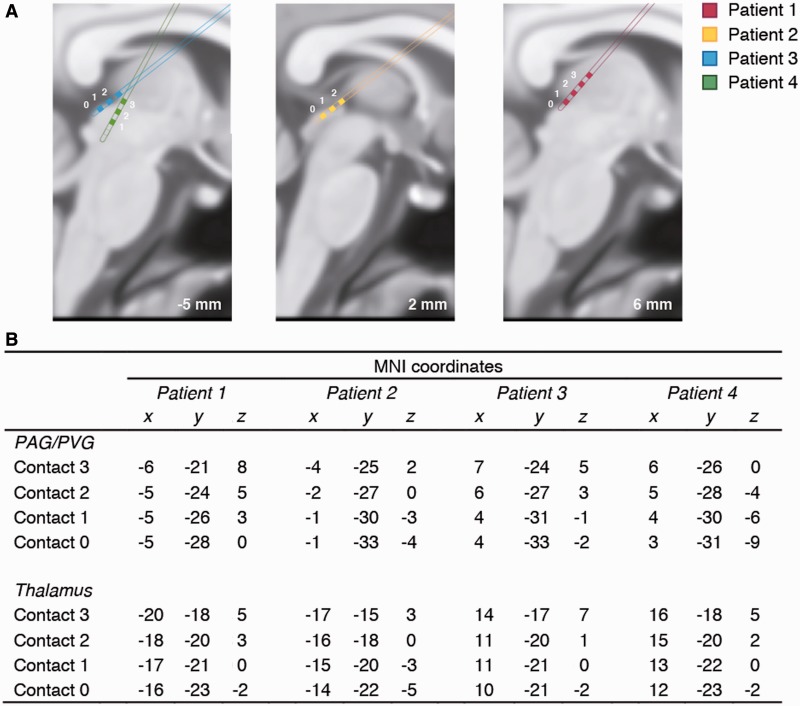
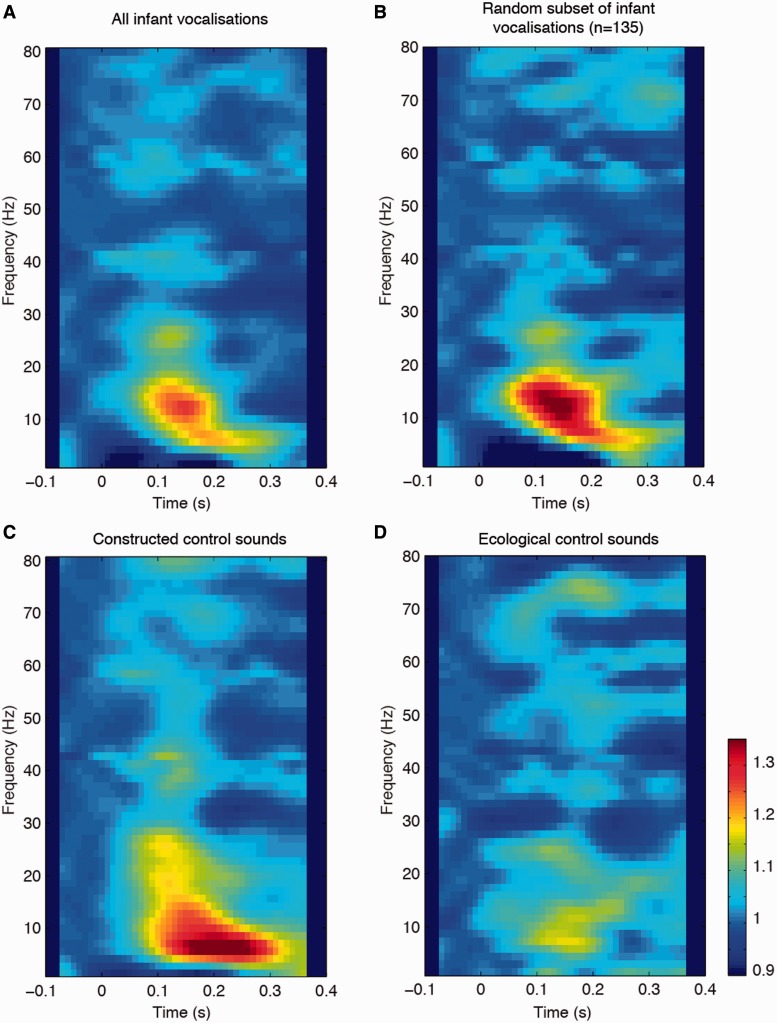
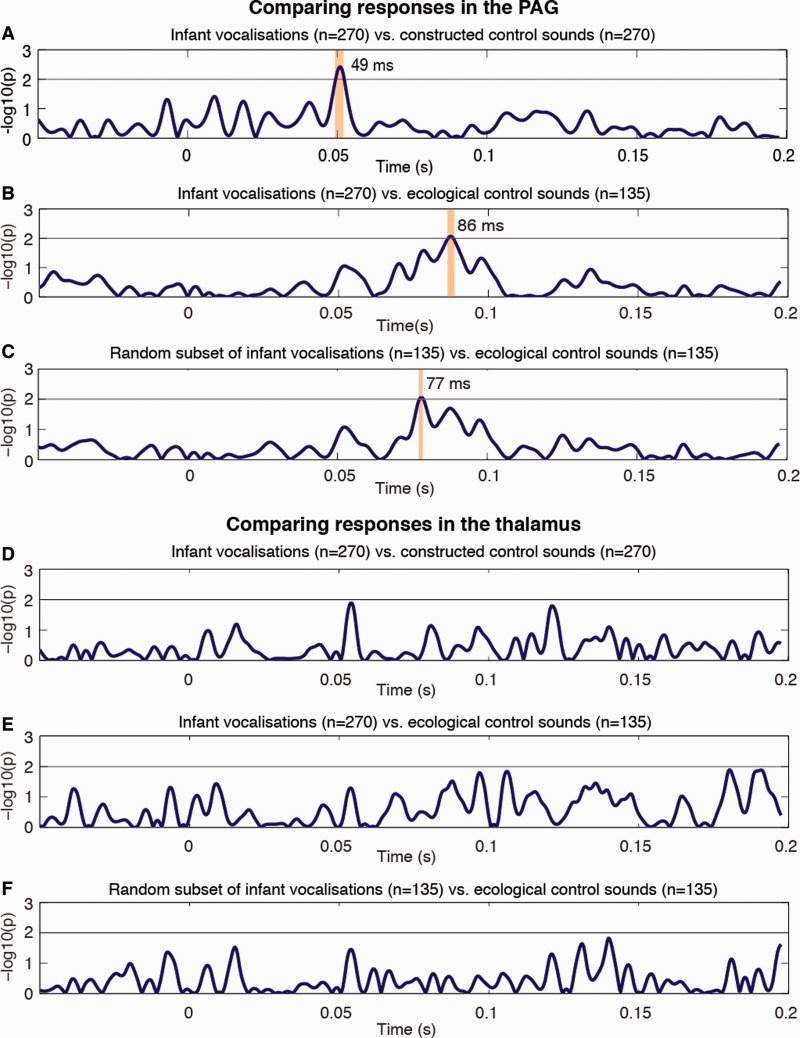
Infant vocalizations are among the most biologically salient sounds in the environment and can draw the listener to the infant rapidly in both times of distress and joy. A region of the midbrain, the periaqueductal gray (PAG), has long been implicated in the control of urgent, survival-related behaviours. To test for PAG involvement in the processing of infant vocalizations, we recorded local field potentials from macroelectrodes implanted in this region in four adults who had undergone deep brain stimulation. We found a significant difference occurring as early as 49 ms after hearing a sound in activity recorded from the PAG in response to infant vocalizations compared with constructed control sounds and adult and animal affective vocalizations. This difference was not present in recordings from thalamic electrodes implanted in three of the patients. Time frequency analyses revealed distinct patterns of activity in the PAG for infant vocalisations, constructed control sounds and adult and animal vocalisations. These results suggest that human infant vocalizations can be discriminated from other emotional or acoustically similar sounds early in the auditory pathway. We propose that this specific, rapid activity in response to infant vocalizations may reflect the initiation of a state of heightened alertness necessary to instigate protective caregiving.
婴儿的发声是环境中最具生物学显著性的声音之一,在婴儿痛苦和喜悦时都能迅速吸引倾听者的注意。中脑的一个区域,即导水管周围灰质(PAG),长期以来一直被认为与控制紧急的、与生存相关的行为有关。为了测试PAG是否参与婴儿发声的处理过程,我们在四名接受深部脑刺激的成年人中,记录了植入该区域的宏观电极的局部场电位。我们发现,与合成控制声音、成人和动物情感发声相比,在听到婴儿发声后,PAG记录的活动中,早在49毫秒就出现了显著差异。在其中三名患者植入的丘脑电极记录中,这种差异并不存在。时频分析揭示了PAG中针对婴儿发声、合成控制声音以及成人和动物发声的不同活动模式。这些结果表明,在听觉通路的早期阶段,人类婴儿发声能够与其他情感性或声学上相似的声音区分开来。我们认为,这种对婴儿发声的特定、快速活动可能反映了引发保护性照料所需的高度警觉状态的启动。