Department of Psychiatry, Yale University School of Medicine, New Haven, Connecticut, United States of America.
PLoS One. 2012;7(5):e36270. doi: 10.1371/journal.pone.0036270. Epub 2012 May 10.
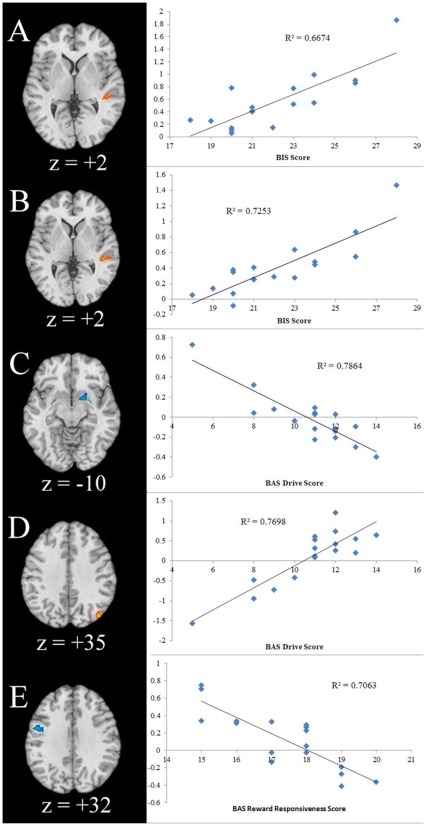
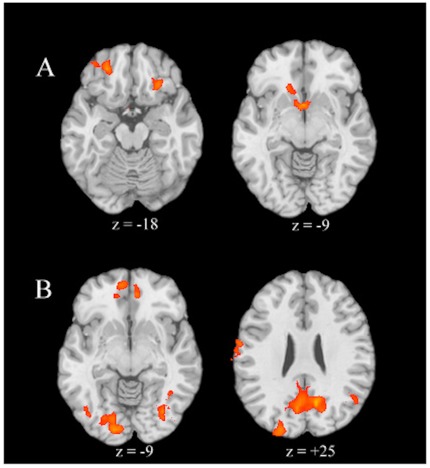
Infant cries and facial expressions influence social interactions and elicit caretaking behaviors from adults. Recent neuroimaging studies suggest that neural responses to infant stimuli involve brain regions that process rewards. However, these studies have yet to investigate individual differences in tendencies to engage or withdraw from motivationally relevant stimuli. To investigate this, we used event-related fMRI to scan 17 nulliparous women. Participants were presented with novel infant cries of two distress levels (low and high) and unknown infant faces of varying affect (happy, sad, and neutral) in a randomized, counter-balanced order. Brain activation was subsequently correlated with scores on the Behavioral Inhibition System/Behavioral Activation System scale. Infant cries activated bilateral superior and middle temporal gyri (STG and MTG) and precentral and postcentral gyri. Activation was greater in bilateral temporal cortices for low- relative to high-distress cries. Happy relative to neutral faces activated the ventral striatum, caudate, ventromedial prefrontal, and orbitofrontal cortices. Sad versus neutral faces activated the precuneus, cuneus, and posterior cingulate cortex, and behavioral activation drive correlated with occipital cortical activations in this contrast. Behavioral inhibition correlated with activation in the right STG for high- and low-distress cries relative to pink noise. Behavioral drive correlated inversely with putamen, caudate, and thalamic activations for the comparison of high-distress cries to pink noise. Reward-responsiveness correlated with activation in the left precentral gyrus during the perception of low-distress cries relative to pink noise. Our findings indicate that infant cry stimuli elicit activations in areas implicated in auditory processing and social cognition. Happy infant faces may be encoded as rewarding, whereas sad faces activate regions associated with empathic processing. Differences in motivational tendencies may modulate neural responses to infant cues.
婴儿的哭声和面部表情会影响社交互动,并引起成年人的照顾行为。最近的神经影像学研究表明,对婴儿刺激的神经反应涉及到处理奖励的大脑区域。然而,这些研究尚未调查个体在参与或回避与动机相关刺激的倾向方面的差异。为了研究这一点,我们使用事件相关 fMRI 扫描了 17 名未生育的女性。参与者以随机、平衡的顺序呈现了两种不同紧张程度(低和高)的新生儿哭声和不同情绪(快乐、悲伤和中性)的未知婴儿面孔。随后,将大脑激活与行为抑制系统/行为激活系统量表的得分相关联。婴儿的哭声激活了双侧颞上回(STG 和 MTG)和中央前回和中央后回。与高紧张度哭声相比,低紧张度哭声在双侧颞叶皮质的激活更强。与中性面孔相比,快乐面孔激活了腹侧纹状体、尾状核、腹内侧前额叶和眶额皮质。与中性面孔相比,悲伤面孔激活了楔前叶、楔叶和后扣带回皮质,而行为激活与这一对比中的枕叶皮质激活呈正相关。行为抑制与高、低紧张度哭声相对于粉红噪声时右颞上回的激活相关。行为驱动与高紧张度哭声相对于粉红噪声时纹状体、尾状核和丘脑的激活呈负相关。与粉红噪声相比,在感知低紧张度哭声时,奖励反应性与左中央前回的激活相关。我们的研究结果表明,婴儿哭声刺激会引起听觉处理和社会认知相关区域的激活。快乐婴儿的面孔可能被编码为奖励,而悲伤的面孔则激活了与共情处理相关的区域。动机倾向的差异可能会调节对婴儿线索的神经反应。