Department of Respiratory Medicine, Second Affiliated Hospital of Jilin University, 18 Ziqiang Street, Changchun, Jilin 130041, China.
World J Surg Oncol. 2013 May 31;11:123. doi: 10.1186/1477-7819-11-123.
RBM5 (RNA-binding motif protein 5, also named H37/LUCA-15) gene from chromosome 3p21.3 has been demonstrated to be a tumor suppressor. Current researches in vitro confirm that RBM5 can suppress the growth of lung adenocarcinoma cells by inducing apoptosis. There is still no effective model in vivo, however, that thoroughly investigates the effect and molecular mechanism of RBM5 on lung adenocarcinoma.
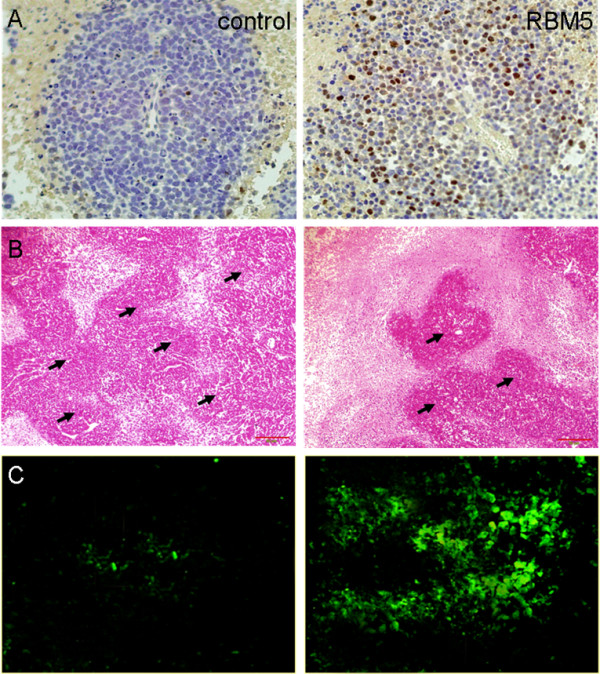
We established the transplanted tumor model on BALB/c nude mice using the A549 cell line. The mice were treated with the recombinant plasmids carried by attenuated Salmonella to induce the overexpression of RBM5 in tumor tissues. RBM5 overexpression was confirmed by immunohistochemistry staining. H&E staining was performed to observe the histological performance on plasmids-treated A549 xenografts. Apoptosis was assessed by TUNEL staining with a TUNEL detection kit. Apoptosis-regulated genes were detected by Western blot.
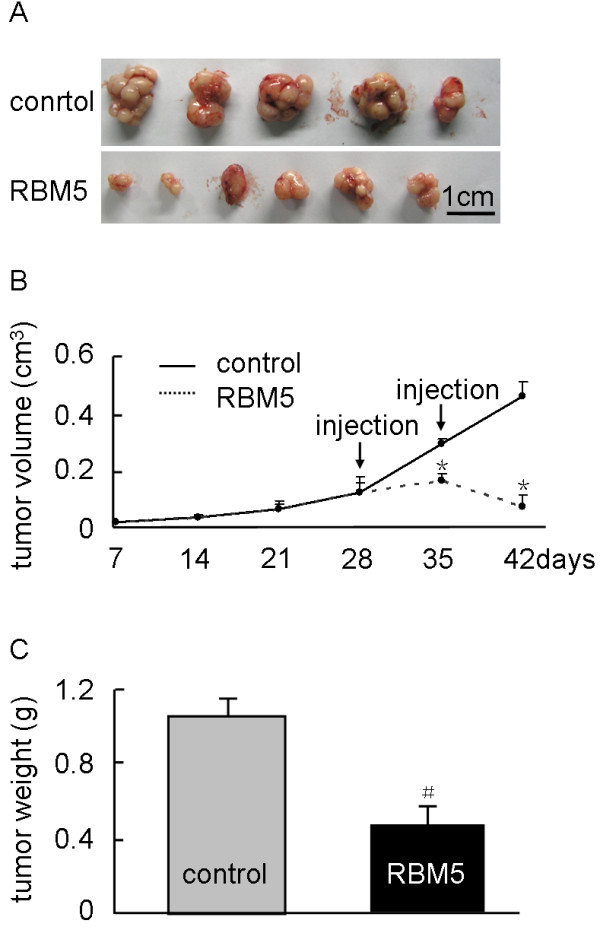
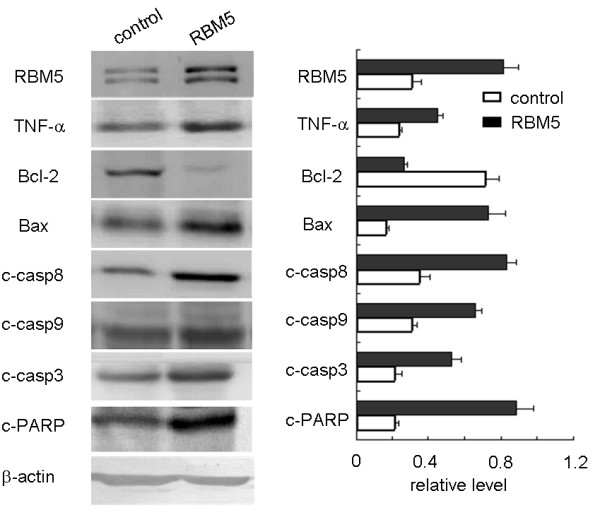
We successful established the lung adenocarcinoma animal model in vivo. The growth of tumor xenografts was significantly retarded on the mice treated with pcDNA3.1-RBM5 carried by attenuated Salmonella compared to that on mice treated with pcDNA3.1. Overexpression of RBM5 enhanced the apoptosis in tumor xenografts. Furthermore, the expression of Bcl-2 protein was decreased significantly, while the expression of BAX, TNF-α, cleaved caspase-3, cleaved caspase-8, cleaved caspase-9 and cleaved PARP proteins was significantly increased in the pcDNA3.1-RBM5-treated mice as compared to that in the control mice.
In this study, we established a novel animal model to determine RBM5 function in vivo, and concluded that RBM5 inhibited tumor growth in mice by inducing apoptosis. The study suggests that although RBM5's involvement in the death receptor-mediated apoptotic pathway is still to be investigated, RBM5-mediated growth suppression, at least in part, employs regulation of the mitochondrial apoptotic pathways.
位于 3p21.3 染色体上的 RNA 结合基序蛋白 5(RNA-binding motif protein 5,也称为 H37/LUCA-15)基因已被证实是一种肿瘤抑制基因。目前的体外研究证实,RBM5 通过诱导细胞凋亡来抑制肺腺癌细胞的生长。然而,目前还没有一种有效的体内模型能够全面研究 RBM5 对肺腺癌的作用和分子机制。
我们使用 A549 细胞系在 BALB/c 裸鼠上建立移植瘤模型。用减毒沙门氏菌携带的重组质粒处理小鼠,以诱导肿瘤组织中 RBM5 的过表达。通过免疫组化染色证实 RBM5 的过表达。对质粒处理的 A549 异种移植瘤进行 H&E 染色以观察组织学表现。用 TUNEL 检测试剂盒进行 TUNEL 染色评估细胞凋亡。用 Western blot 检测凋亡调节基因。
我们成功地在体内建立了肺腺癌动物模型。与 pcDNA3.1 组相比,用携带 pcDNA3.1-RBM5 的减毒沙门氏菌处理的小鼠,肿瘤异种移植的生长明显受到抑制。RBM5 的过表达增强了肿瘤异种移植中的细胞凋亡。此外,与对照组相比,pcDNA3.1-RBM5 处理组的 Bcl-2 蛋白表达显著降低,而 BAX、TNF-α、cleaved caspase-3、cleaved caspase-8、cleaved caspase-9 和 cleaved PARP 蛋白的表达显著增加。
在这项研究中,我们建立了一种新的动物模型来确定 RBM5 在体内的功能,并得出结论,RBM5 通过诱导细胞凋亡抑制小鼠肿瘤生长。研究表明,尽管 RBM5 参与死亡受体介导的凋亡途径仍有待研究,但 RBM5 介导的生长抑制至少部分是通过调节线粒体凋亡途径实现的。