Dpto. de Estomatología (Postgrado de Periodoncia), Facultad de Medicina y Odontología UPV/EHU, Barrio Sarriena s/n 48940 Leioa. Vizcaya,
Med Oral Patol Oral Cir Bucal. 2013 Sep 1;18(5):e786-92. doi: 10.4317/medoral.19136.
To evaluate bone loss around implants placed in patients with a history of treated chronic periodontitis and who did or did not attend supportive periodontal therapy, after one year in function. Furthermore, the influence of periodontal biotype and level of plaque was also evaluated.
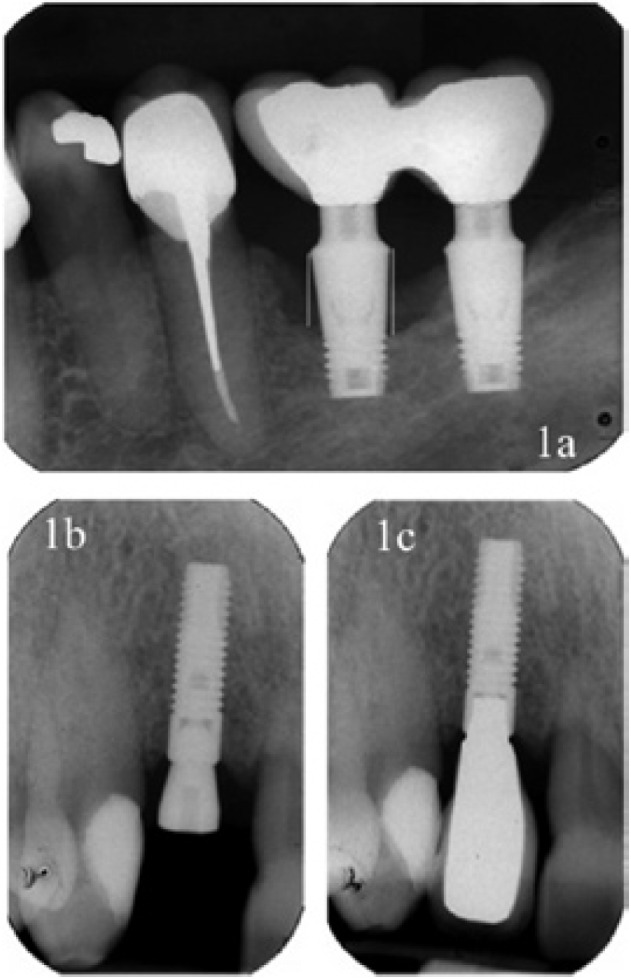
Forty-nine patients participated voluntarily in the study. All subjects had a history of chronic periodontitis, which had been previously treated. After the active treatment, 27 patients attended supportive periodontal therapy (SPT) and the rest did not (No SPT). The O'Leary plaque index and periodontal biotype were recorded for each subject and 246 Astra Tech® OsseospeedTM implants were radiographically analysed (123 placed in SPT patients and 123 in No SPT patients) at the time of loading and one year later, measuring marginal bone loss with the program Dental Studio NX 6.0®. The statistical analysis was performed with Windows SPSS, applying Pearson's correlation index and the Kruskal-Wallis and U-Mann Whitney non-parametric tests.
Six patients were found to have periimplantitis and sixteen mucositis. The survival rate was 99.59% (100% SPT and 99.18% No SPT). Mean bone loss was 0.39 mm (range [-0.71 - 8.05]). Among SPT patients, 95% of the implants had losses less than or equal to the mean (mean bone loss of 0.16 mm) compared to 53.7% for the No SPT group (mean bone loss of 0.62 mm). A statistically significant relationship was demonstrated between bone loss around the implant and the patient's periodontal biotype and plaque index.
The marginal bone loss around implants in patients with treated chronic periodontitis is minimal if they are in a controlled SPT programme and there is individual control of plaque index. Moreover, the presence of a thin periodontal biotype represents a risk factor for additional bone loss.
评估患有治疗后慢性牙周炎病史的患者在植入物植入后一年的功能状态下,是否接受支持性牙周治疗(SPT)对种植体周围骨丧失的影响。此外,还评估了牙周生物型和菌斑水平的影响。
49 名患者自愿参与本研究。所有患者均有慢性牙周炎病史,且已接受过治疗。在积极治疗后,27 名患者接受了支持性牙周治疗(SPT),其余患者未接受(非 SPT)。记录每位患者的 O'Leary 菌斑指数和牙周生物型,并对 246 颗 Astra Tech® OsseospeedTM 种植体进行放射学分析(123 颗植入 SPT 患者,123 颗植入非 SPT 患者),在负荷时和一年后,使用 Dental Studio NX 6.0®程序测量边缘骨丢失量。统计分析采用 Windows SPSS,应用 Pearson 相关指数和 Kruskal-Wallis 和 U-Mann Whitney 非参数检验。
发现 6 例患者患有种植体周围炎,16 例患有黏膜炎。存活率为 99.59%(SPT 为 100%,非 SPT 为 99.18%)。平均骨丢失量为 0.39mm(范围为-0.71-8.05)。在 SPT 患者中,95%的种植体的骨丢失量小于或等于平均值(平均骨丢失量为 0.16mm),而非 SPT 组为 53.7%(平均骨丢失量为 0.62mm)。植入物周围骨丢失与患者牙周生物型和菌斑指数之间存在显著的统计学关系。
对于经过治疗的慢性牙周炎患者,如果他们接受了控制良好的 SPT 方案,并且能够单独控制菌斑指数,那么植入物周围的边缘骨丢失是最小的。此外,薄型牙周生物型的存在是额外骨丢失的危险因素。