Zanaboni Paolo, Landolina Maurizio, Marzegalli Maurizio, Lunati Maurizio, Perego Giovanni B, Guenzati Giuseppe, Curnis Antonio, Valsecchi Sergio, Borghetti Francesca, Borghi Gabriella, Masella Cristina
Norwegian Centre for Integrated Care and Telemedicine, University Hospital of North Norway, Tromsø, Norway.
J Med Internet Res. 2013 May 30;15(5):e106. doi: 10.2196/jmir.2587.
Heart failure patients with implantable defibrillators place a significant burden on health care systems. Remote monitoring allows assessment of device function and heart failure parameters, and may represent a safe, effective, and cost-saving method compared to conventional in-office follow-up.
We hypothesized that remote device monitoring represents a cost-effective approach. This paper summarizes the economic evaluation of the Evolution of Management Strategies of Heart Failure Patients With Implantable Defibrillators (EVOLVO) study, a multicenter clinical trial aimed at measuring the benefits of remote monitoring for heart failure patients with implantable defibrillators.
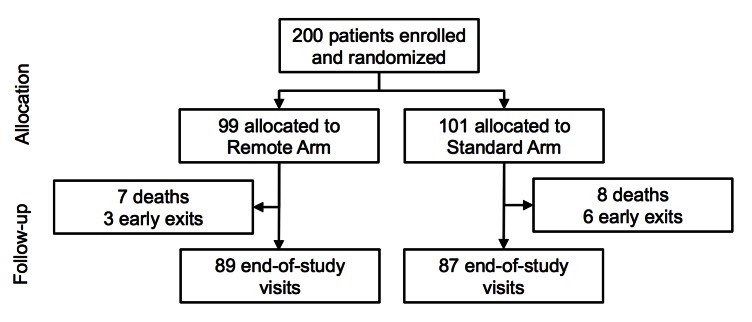
Two hundred patients implanted with a wireless transmission-enabled implantable defibrillator were randomized to receive either remote monitoring or the conventional method of in-person evaluations. Patients were followed for 16 months with a protocol of scheduled in-office and remote follow-ups. The economic evaluation of the intervention was conducted from the perspectives of the health care system and the patient. A cost-utility analysis was performed to measure whether the intervention was cost-effective in terms of cost per quality-adjusted life year (QALY) gained.
Overall, remote monitoring did not show significant annual cost savings for the health care system (€1962.78 versus €2130.01; P=.80). There was a significant reduction of the annual cost for the patients in the remote arm in comparison to the standard arm (€291.36 versus €381.34; P=.01). Cost-utility analysis was performed for 180 patients for whom QALYs were available. The patients in the remote arm gained 0.065 QALYs more than those in the standard arm over 16 months, with a cost savings of €888.10 per patient. Results from the cost-utility analysis of the EVOLVO study show that remote monitoring is a cost-effective and dominant solution.
Remote management of heart failure patients with implantable defibrillators appears to be cost-effective compared to the conventional method of in-person evaluations.
ClinicalTrials.gov NCT00873899; http://clinicaltrials.gov/show/NCT00873899 (Archived by WebCite at http://www.webcitation.org/6H0BOA29f).
植入式除颤器的心力衰竭患者给医疗保健系统带来了沉重负担。远程监测可评估设备功能和心力衰竭参数,与传统的门诊随访相比,可能是一种安全、有效且节省成本的方法。
我们假设远程设备监测是一种具有成本效益的方法。本文总结了植入式除颤器心力衰竭患者管理策略演变(EVOLVO)研究的经济评估,这是一项多中心临床试验,旨在衡量远程监测对植入式除颤器心力衰竭患者的益处。
200例植入具有无线传输功能的植入式除颤器的患者被随机分为接受远程监测或传统的面对面评估方法。按照预定的门诊和远程随访方案对患者进行了16个月的随访。从医疗保健系统和患者的角度对干预措施进行了经济评估。进行了成本效用分析,以衡量该干预措施在每获得一个质量调整生命年(QALY)的成本方面是否具有成本效益。
总体而言,远程监测并未显示出医疗保健系统每年有显著的成本节省(1962.78欧元对2130.01欧元;P = 0.80)。与标准组相比,远程组患者的年度成本显著降低(291.36欧元对381.34欧元;P = 0.01)。对180例可获得QALY的患者进行了成本效用分析。在16个月内,远程组患者比标准组患者多获得0.065个QALY,每位患者节省成本888.10欧元。EVOLVO研究的成本效用分析结果表明,远程监测是一种具有成本效益且占优的解决方案。
与传统的面对面评估方法相比,对植入式除颤器的心力衰竭患者进行远程管理似乎具有成本效益。
ClinicalTrials.gov NCT00873899;http://clinicaltrials.gov/show/NCT00873899(由WebCite存档于http://www.webcitation.org/6H0BOA29f)