Department of Emergency Medicine, Tri-Service General Hospital, National Defense Medical Center, Taipei, Taiwan.
PLoS One. 2013 May 28;8(5):e64476. doi: 10.1371/journal.pone.0064476. Print 2013.
To assess whether chronic glycemic control and stress-induced hyperglycemia, determined by the gap between admission glucose levels and A1C-derived average glucose (ADAG) levels adversely affects outcomes in diabetic patients with pyogenic liver abscess (PLA).
Clinical, laboratory, and multi-detector computed tomography (MDCT) findings of 329 PLA patients (2004-2010) were retrospectively reviewed. HbA1C levels were used to determine long-term glycemic control status, which were then converted to estimated average glucose values. For the gap between admission glucose levels and ADAG levels, we used receiver operating characteristic (ROC) curve to determine the optimal cut-off values predicting adverse outcomes. Univariate and multivariate logistic regressions were used to identify predictors of adverse outcomes.
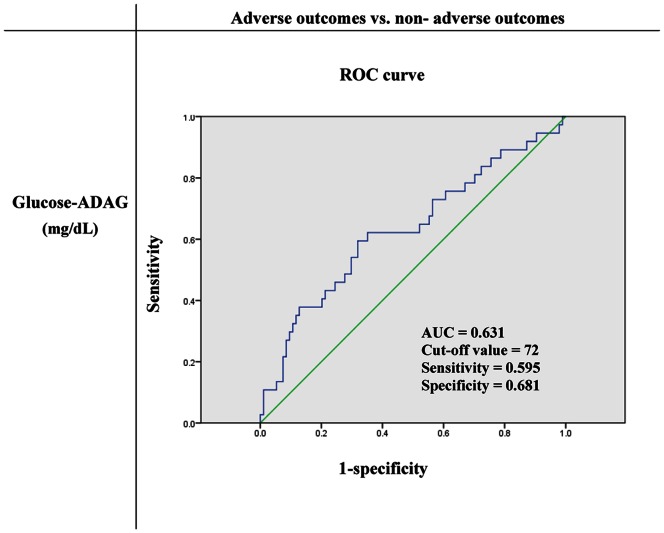
Diabetic PLA patients with poorer glycemic control had significantly higher Klebsiella pneumoniae (KP) infection rates, lower albumin levels, and longer hospital stays than those with suboptimal and good glycemic control. The ROC curve showed that a glycemic gap of 72 mg/dL was the optimal cut-off value for predicting adverse outcomes and showed a 22.3% relative increase in adverse outcomes compared with a glycemic gap<72 mg/dL. Multivariate analysis revealed that an elevated glycemic gap≥72 mg/dL was important predictor of adverse outcomes.
A glycemic gap≥72 mg/dL, rather than admission hyperglycemia or chronic glycemic control, was significantly correlated with adverse outcomes in diabetic PLA patients. Poorer chronic glycemic control in diabetic PLA patients is associated with high incidence of KP infection, hypoalbuminemia and longer hospital stay.
评估入院时血糖水平与糖化血红蛋白(HbA1C)衍生平均血糖(ADAG)水平之间的差异(即血糖差距)是否会对糖尿病合并细菌性肝脓肿(PLA)患者的预后产生不利影响。
回顾性分析了 2004 年至 2010 年间 329 例 PLA 患者的临床、实验室和多排螺旋 CT(MDCT)资料。采用 HbA1C 水平评估长期血糖控制情况,并将其转换为估计平均血糖值。应用受试者工作特征(ROC)曲线确定预测不良预后的最佳血糖差距截断值。采用单因素和多因素逻辑回归分析确定不良预后的预测因素。
血糖控制较差的糖尿病合并 PLA 患者中,肺炎克雷伯菌(KP)感染率显著高于血糖控制不理想和良好的患者,白蛋白水平更低,住院时间更长。ROC 曲线显示,血糖差距为 72mg/dL 时预测不良预后的最佳截断值,与血糖差距<72mg/dL 相比,不良预后的相对风险增加 22.3%。多因素分析显示,血糖差距≥72mg/dL 是不良预后的重要预测因素。
血糖差距≥72mg/dL 与糖尿病合并 PLA 患者的不良预后显著相关,而不是入院时的高血糖或慢性血糖控制。糖尿病合并 PLA 患者的慢性血糖控制较差与 KP 感染发生率高、低白蛋白血症和住院时间延长有关。