Section on Endocrinology and Metabolism, Department of Internal Medicine, Wake Forest School of Medicine, Winston-Salem, North Carolina, United States of America.
PLoS One. 2013 May 28;8(5):e65303. doi: 10.1371/journal.pone.0065303. Print 2013.
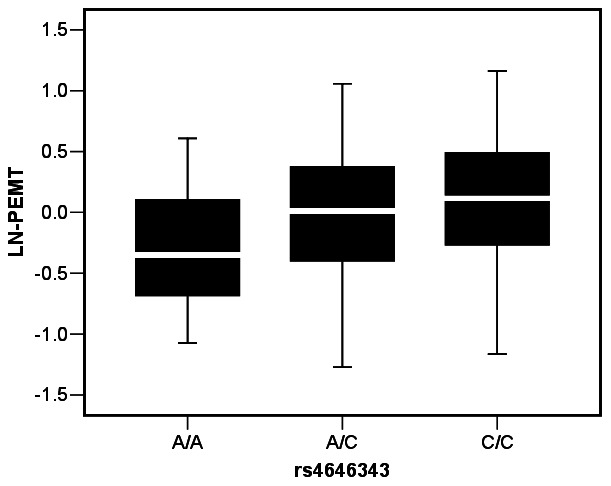
Recent studies have identified links between phospholipid composition and altered cellular functions in animal models of obesity, but the involvement of phospholipid biosynthesis genes in human obesity are not well understood. We analyzed the transcript of four phospholipid biosynthesis genes in adipose and muscle from 170 subjects. We examined publicly available genome-wide association data from the GIANT and MAGIC cohorts to investigate the association of SNPs in these genes with obesity and glucose homeostasis traits, respectively. Trait-associated SNPs were genotyped to evaluate their roles in regulating expression in adipose. In adipose tissue, expression of PEMT, PCYT1A, and PTDSS2 were positively correlated and PCYT2 was negatively correlated with percent fat mass and body mass index (BMI). Among the polymorphisms in these genes, SNP rs4646404 in PEMT showed the strongest association (p = 3.07E-06) with waist-to-hip ratio (WHR) adjusted for BMI. The WHR-associated intronic SNP rs4646343 in the PEMT gene showed the strongest association with its expression in adipose. Allele "C" of this SNP was associated with higher WHR (p = 2.47E-05) and with higher expression (p = 4.10E-04). Our study shows that the expression of PEMT gene is high in obese insulin-resistant subjects. Intronic cis-regulatory polymorphisms may increase the genetic risk of obesity by modulating PEMT expression.
最近的研究已经确定了磷脂组成与肥胖动物模型中细胞功能改变之间的联系,但磷脂生物合成基因在人类肥胖中的作用还不是很清楚。我们分析了 170 名受试者脂肪和肌肉中四个磷脂生物合成基因的转录本。我们分别检查了 GIANT 和 MAGIC 队列中公开的全基因组关联数据,以研究这些基因中的 SNP 与肥胖和葡萄糖稳态特征之间的关联。对与性状相关的 SNP 进行基因分型,以评估它们在调节脂肪中表达的作用。在脂肪组织中,PEMT、PCYT1A 和 PTDSS2 的表达呈正相关,而 PCYT2 与体脂肪百分比和体重指数(BMI)呈负相关。在这些基因中的多态性中,PEMT 基因中的 SNP rs4646404 与 BMI 调整后的腰臀比(WHR)相关性最强(p = 3.07E-06)。PEMT 基因内含子中的 WHR 相关 SNP rs4646343 与脂肪中的表达相关性最强。该 SNP 的等位基因“C”与较高的 WHR(p = 2.47E-05)和较高的表达(p = 4.10E-04)相关。我们的研究表明,在肥胖和胰岛素抵抗的受试者中,PEMT 基因的表达较高。内含子顺式调控多态性可能通过调节 PEMT 表达增加肥胖的遗传风险。