Murphy Kevin, Gawchik Sandra, Bernstein David, Andersen Jens, Pedersen Martin Rud
J Negat Results Biomed. 2013 Jun 1;12:10. doi: 10.1186/1477-5751-12-10.
Design and execution of immunotherapy trials for seasonal allergies may be complicated by numerous factors including variable allergy testing methods, pollen levels, and timing and intensity of other seasonal allergens. We evaluated grass allergy immunotherapy tablet (AIT) treatment in North American adults with grass pollen-induced allergic rhinitis with or without conjunctivitis (AR/C), with/without asthma.
Subjects age 18-65 with clinical history of grass pollen-induced AR/C, with/without asthma were randomized 1:1 to once-daily 2800 BAU Timothy grass AIT (oral lyophilisate, Phleum pratense, 75,000 SQ-T, containing approximately 15 μg of Phl p 5) or placebo. The AR/C symptom and medication scores were recorded daily. The primary end point was the average AR/C daily symptom score (DSS) during the entire grass pollen season (GPS). Ranked key secondary end points were Rhinoconjunctivitis Quality of Life Questionnaire (RQLQ) score, daily medication score (DMS), and percentage of well days, all over entire GPS. Safety was monitored through adverse event reporting.
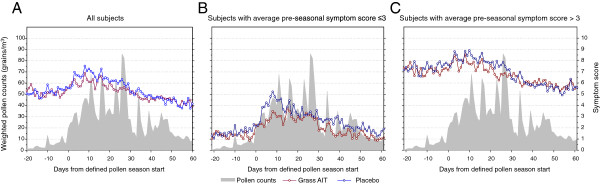
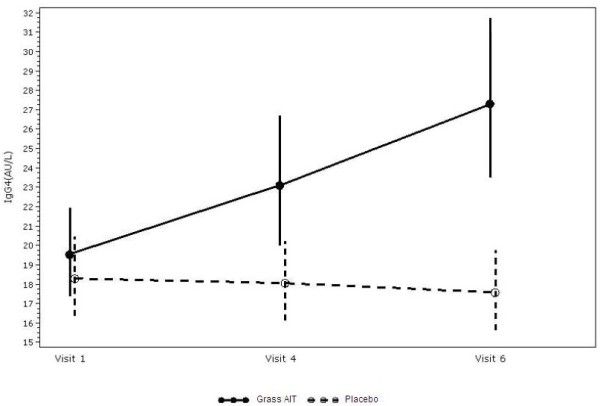
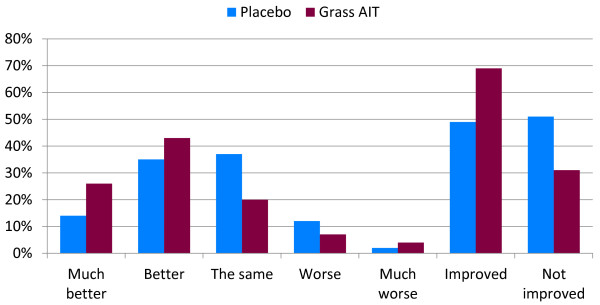
Efficacy analysis included 289 subjects. Over the entire GPS, mean DSS was 6% lower with AIT versus placebo (5.69 vs. 6.06), but this difference was not statistically significant (p = 0.3475) despite significantly higher immunological response in the grass AIT group. No significant between-group differences were seen for key secondary end points. In general, DSS was high before GPS began and no clear relationship between DSS and grass pollen counts was seen during GPS. In post hoc analysis of subjects with pre-seasonal DSS ≤3, mean DSS and DMS were both significantly lower with grass AIT versus placebo (27%; p = 0.0327 and 68%; p = 0.0060, respectively). In this subgroup a relationship between DSS and grass pollen counts was observed. Grass AIT was generally well tolerated, with no events of anaphylactic shock or respiratory compromise.
In this trial, 2800 BAU grass AIT did not demonstrate significant symptom improvement versus placebo. Lack of relationship between pollen count and symptom score in the study population, and post hoc findings among subjects with low pre-seasonal symptoms, suggest that the symptoms reported in this study were not primarily reflective of the effects of grass pollen exposure.
NCT00421655.
季节性过敏免疫治疗试验的设计和实施可能因多种因素而变得复杂,包括过敏检测方法的差异、花粉水平以及其他季节性过敏原的时间和强度。我们评估了草过敏免疫治疗片剂(AIT)对患有或不患有结膜炎(AR/C)、伴有或不伴有哮喘的北美成年草花粉诱导性过敏性鼻炎患者的治疗效果。
年龄在18 - 65岁、有草花粉诱导性AR/C临床病史、伴有或不伴有哮喘的受试者按1:1随机分组,分别接受每日一次2800 BAU的梯牧草AIT(口服冻干制剂,早熟禾属,75,000 SQ-T,含约15μg的Phl p 5)或安慰剂治疗。每天记录AR/C症状和药物评分。主要终点是整个草花粉季节(GPS)期间AR/C的每日平均症状评分(DSS)。排序后的关键次要终点是鼻结膜炎生活质量问卷(RQLQ)评分、每日药物评分(DMS)以及整个GPS期间的良好天数百分比。通过不良事件报告监测安全性。
疗效分析纳入了289名受试者。在整个GPS期间,AIT组的平均DSS比安慰剂组低6%(5.69对6.06),但尽管草AIT组的免疫反应显著更高,该差异无统计学意义(p = 0.3475)。关键次要终点在组间未观察到显著差异。总体而言,在GPS开始前DSS较高,且在GPS期间未观察到DSS与草花粉计数之间有明确关系。在对季节性前DSS≤3的受试者进行的事后分析中,草AIT组的平均DSS和DMS均显著低于安慰剂组(分别为27%;p = 0.0327和68%;p = 0.0060)。在该亚组中观察到了DSS与草花粉计数之间的关系。草AIT总体耐受性良好,未发生过敏性休克或呼吸功能不全事件。
在本试验中,2800 BAU的草AIT与安慰剂相比未显示出显著的症状改善。研究人群中花粉计数与症状评分之间缺乏关联,以及季节性前症状较轻的受试者的事后分析结果表明,本研究中报告的症状并非主要反映草花粉暴露的影响。
NCT00421655。