Department of Pediatrics, Emory University, Atlanta, GA.
J Pediatr. 2013 Oct;163(4):961-7.e3. doi: 10.1016/j.jpeds.2013.04.034. Epub 2013 May 30.
Candida remains an important cause of late-onset infection in preterm infants. Mortality and neurodevelopmental outcome of extremely low birth weight (ELBW) infants enrolled in the Candida study were evaluated based on infection status.
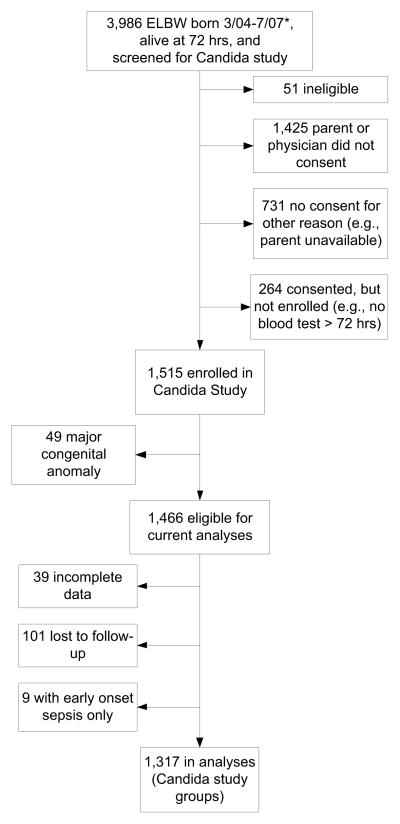
ELBW infants born at Eunice Kennedy Shriver National Institute of Child Health and Human Development Neonatal Research Network (NRN) centers between March 2004 and July 2007 who were screened for suspected sepsis were eligible for inclusion in the Candida study. Primary outcome data for neurodevelopmental impairment (NDI) or death were available for 1317 of the 1515 infants (87%) enrolled in the Candida study. The Bayley Scales of Infant Development-II or -III was administered at 18 months' adjusted age. A secondary comparison was performed with 864 infants enrolled in the NRN Generic Database during the same cohort who were never screened for sepsis and therefore not eligible for the Candida study.
Among ELBW infants enrolled in the Candida study, 31% with Candida and 31% with late-onset non-Candida sepsis had NDI at 18 months. Infants with Candida sepsis and/or meningitis had an increased risk of death and were more likely to have the composite outcome of death and/or NDI compared with uninfected infants in adjusted analysis. Compared with infants in the NRN registry never screened for sepsis, overall risk for death were similar but those with Candida infection were more likely to have NDI (OR 1.83, 95% CI 1.01-3.33, P = .047).
In this cohort of ELBW infants, those with infection and/or meningitis were at increased risk for death and/or NDI. This risk was highest among those with Candida sepsis and/or meningitis.
假丝酵母菌仍然是早产儿迟发性感染的重要病因。根据感染状况,评估了参与假丝酵母菌研究的极低出生体重(ELBW)婴儿的死亡率和神经发育结局。
2004 年 3 月至 2007 年 7 月期间,Eunice Kennedy Shriver 国家儿童健康与人类发展研究所新生儿研究网络(NRN)中心出生的疑似败血症筛查的 ELBW 婴儿有资格参加假丝酵母菌研究。1515 名参与假丝酵母菌研究的婴儿中有 1317 名(87%)有神经发育障碍(NDI)或死亡的主要结局数据。在 18 个月的校正年龄时,采用贝利婴幼儿发育量表第二版或第三版进行评估。还对同一队列中从未接受过败血症筛查、因此不符合假丝酵母菌研究条件的 864 名 NRN 通用数据库婴儿进行了二次比较。
在参与假丝酵母菌研究的 ELBW 婴儿中,31%的假丝酵母菌组和 31%的晚发性非假丝酵母菌败血症组在 18 个月时有 NDI。在调整分析中,与未感染婴儿相比,假丝酵母菌败血症和/或脑膜炎的婴儿死亡风险增加,且更有可能出现死亡和/或 NDI 的复合结局。与 NRN 登记处从未接受过败血症筛查的婴儿相比,总的死亡风险相似,但感染假丝酵母菌的婴儿更有可能出现 NDI(比值比 1.83,95%置信区间 1.01-3.33,P =.047)。
在这一 ELBW 婴儿队列中,感染和/或脑膜炎的婴儿死亡和/或 NDI 的风险增加。在假丝酵母菌败血症和/或脑膜炎的婴儿中,这种风险最高。