
REV-ERBs 通过抑制增强子指导的转录来抑制巨噬细胞基因表达。
Rev-Erbs repress macrophage gene expression by inhibiting enhancer-directed transcription.
机构信息
Department of Cellular and Molecular Medicine, University of California, San Diego, 9500 Gilman Drive, La Jolla, California 92093, USA.
出版信息
Nature. 2013 Jun 27;498(7455):511-5. doi: 10.1038/nature12209. Epub 2013 Jun 2.
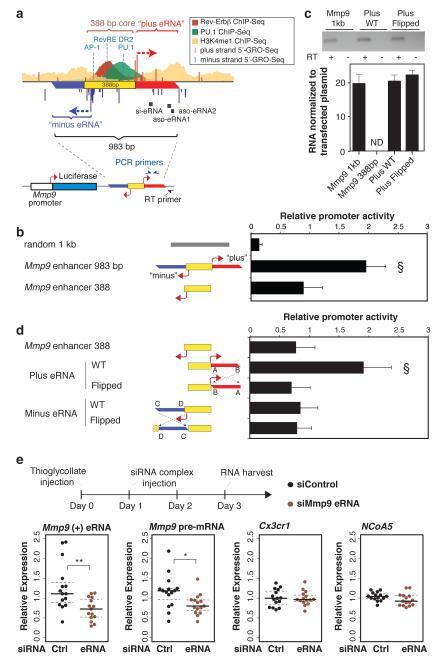
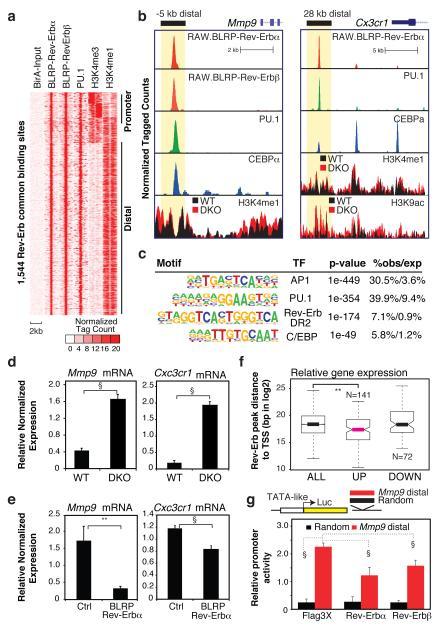
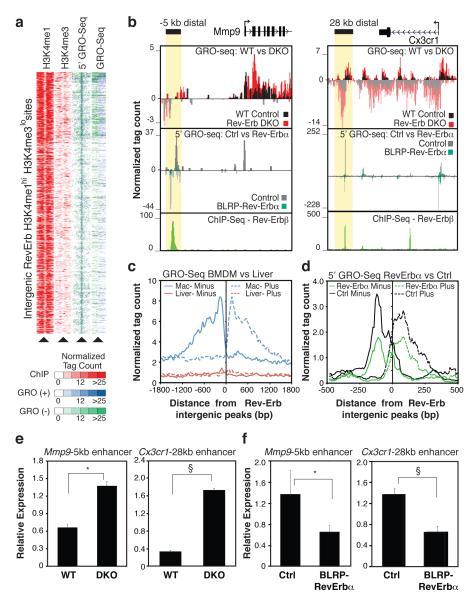
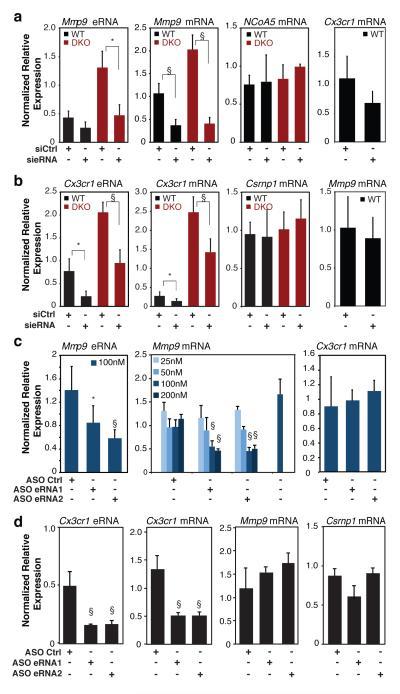
Rev-Erb-α and Rev-Erb-β are nuclear receptors that regulate the expression of genes involved in the control of circadian rhythm, metabolism and inflammatory responses. Rev-Erbs function as transcriptional repressors by recruiting nuclear receptor co-repressor (NCoR)-HDAC3 complexes to Rev-Erb response elements in enhancers and promoters of target genes, but the molecular basis for cell-specific programs of repression is not known. Here we present evidence that in mouse macrophages Rev-Erbs regulate target gene expression by inhibiting the functions of distal enhancers that are selected by macrophage-lineage-determining factors, thereby establishing a macrophage-specific program of repression. Remarkably, the repressive functions of Rev-Erbs are associated with their ability to inhibit the transcription of enhancer-derived RNAs (eRNAs). Furthermore, targeted degradation of eRNAs at two enhancers subject to negative regulation by Rev-Erbs resulted in reduced expression of nearby messenger RNAs, suggesting a direct role of these eRNAs in enhancer function. By precisely defining eRNA start sites using a modified form of global run-on sequencing that quantifies nascent 5' ends, we show that transfer of full enhancer activity to a target promoter requires both the sequences mediating transcription-factor binding and the specific sequences encoding the eRNA transcript. These studies provide evidence for a direct role of eRNAs in contributing to enhancer functions and suggest that Rev-Erbs act to suppress gene expression at a distance by repressing eRNA transcription.
REV-ERB-α 和 REV-ERB-β 是核受体,可调节参与昼夜节律、代谢和炎症反应控制的基因表达。REV-Erbs 通过招募核受体共抑制因子(NCoR)-HDAC3 复合物到靶基因增强子和启动子中的 REV-Erb 反应元件,作为转录抑制剂发挥作用,但细胞特异性抑制程序的分子基础尚不清楚。在这里,我们提供的证据表明,在小鼠巨噬细胞中,REV-Erbs 通过抑制由巨噬细胞谱系决定因子选择的远端增强子的功能来调节靶基因表达,从而建立了巨噬细胞特异性的抑制程序。值得注意的是,REV-Erbs 的抑制功能与其抑制增强子衍生 RNA(eRNA)转录的能力有关。此外,针对两个受 REV-Erb 负调控的增强子的 eRNA 的靶向降解导致附近信使 RNA 的表达减少,这表明这些 eRNA 在增强子功能中具有直接作用。通过使用定量新生 5' 末端的改良形式的全局运行测序来精确定义 eRNA 起始位点,我们表明,将完整的增强子活性转移到靶启动子需要介导转录因子结合的序列和编码 eRNA 转录本的特定序列。这些研究为 eRNA 在增强子功能中的直接作用提供了证据,并表明 REV-Erbs 通过抑制 eRNA 转录来抑制远距离基因表达。
 Zotero 插件