Sun Yulong, Jiang Wenjiao, Horng Tiffany
School of Life Sciences and Technology, ShanghaiTech University, Shanghai 201210, China.
Life Metab. 2022 Dec 9;1(3):224-233. doi: 10.1093/lifemeta/loac037. eCollection 2022 Dec.
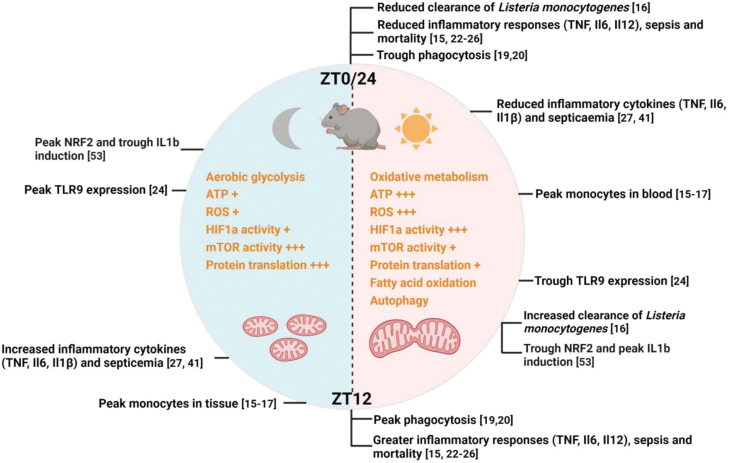
Macrophages are an integral part of the innate immune system and coordinate host defense to microbial infections, as well as shaping the remodeling response after tissue injury. Metabolism is now appreciated to be a powerful and pervasive regulator of the identity and function of macrophages. Upon exposure to microbial ligands, macrophage inflammatory activation and the associated induction of phagocytosis, inflammatory responses, and other host defense activities are supported by dynamic changes to cellular metabolism. Of note, metabolic activity is robustly regulated in a circadian fashion, with many metabolic processes displaying peak activity in one phase of the circadian cycle and trough activity in an antiphase manner. Here, we review recent findings suggesting that circadian metabolism influences macrophage activities and particularly the inflammatory response. First, we summarize macrophage activities known to display time-of-day-dependent variation and their mechanistic basis. Second, we review metabolic processes that have been shown to be rhythmically regulated in macrophages and discuss how such circadian metabolism affects or is likely to affect macrophage activities. Third, we discuss the concept of entrainment of the macrophage clock, and consider how loss of rhythmic regulation of macrophage activities may contribute to pathophysiological conditions like shift work, obesity, and aging. Finally, we propose that circadian metabolism can be used to understand the rationale and mechanistic basis of dynamic regulation of inflammatory responses during infection.
巨噬细胞是固有免疫系统的重要组成部分,可协调机体对微生物感染的防御反应,并在组织损伤后塑造重塑反应。如今,代谢被认为是巨噬细胞身份和功能的强大且普遍的调节因子。在接触微生物配体后,细胞代谢的动态变化支持巨噬细胞的炎症激活以及相关的吞噬作用、炎症反应和其他宿主防御活动。值得注意的是,代谢活动以昼夜节律的方式受到严格调节,许多代谢过程在昼夜周期的一个阶段表现出峰值活动,而在反相阶段表现出低谷活动。在此,我们综述了近期的研究结果,这些结果表明昼夜节律代谢会影响巨噬细胞的活动,尤其是炎症反应。首先,我们总结了已知表现出昼夜依赖性变化的巨噬细胞活动及其机制基础。其次,我们回顾了已被证明在巨噬细胞中有节律地调节的代谢过程,并讨论这种昼夜节律代谢如何影响或可能影响巨噬细胞的活动。第三,我们讨论巨噬细胞生物钟的同步化概念,并考虑巨噬细胞活动节律调节的丧失如何可能导致诸如轮班工作、肥胖和衰老等病理生理状况。最后,我们提出昼夜节律代谢可用于理解感染期间炎症反应动态调节的原理和机制基础。