Department of Experimental Therapeutics, BC Cancer Agency, Vancouver, British Columbia, Canada.
J Pathol. 2013 Aug;230(4):350-5. doi: 10.1002/path.4218.
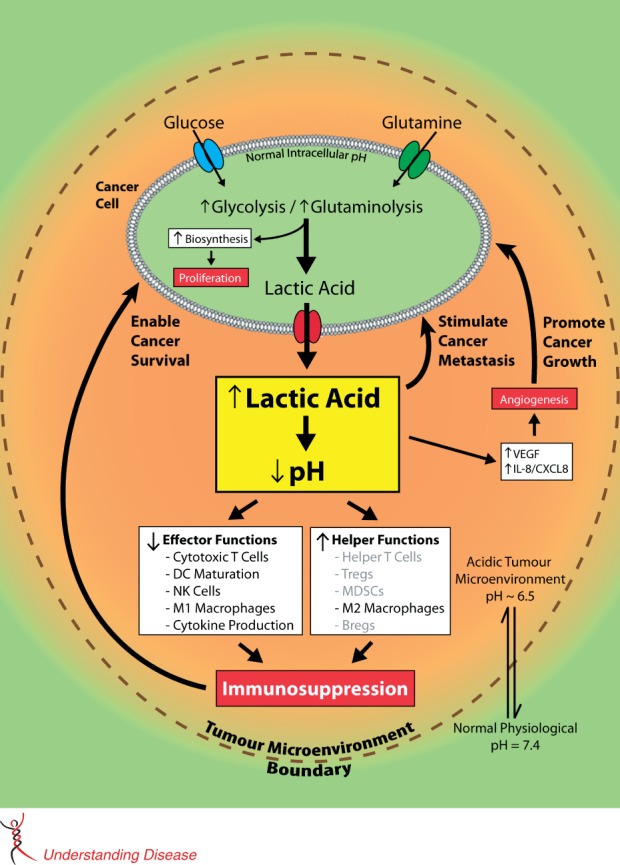
The common preference of cancers for lactic acid-generating metabolic energy pathways has led to proposals that their reprogrammed metabolism confers growth advantages such as decreased susceptibility to hypoxic stress. Recent observations, however, suggest that it generates a novel way for cancer survival. There is increasing evidence that cancers can escape immune destruction by suppressing the anti-cancer immune response through maintaining a relatively low pH in their micro-environment. Tumours achieve this by regulating lactic acid secretion via modification of glucose/glutamine metabolisms. We propose that the maintenance by cancers of a relatively low pH in their micro-environment, via regulation of their lactic acid secretion through selective modification of their energy metabolism, is another major mechanism by which cancers can suppress the anti-cancer immune response. Cancer-generated lactic acid could thus be viewed as a critical, immunosuppressive metabolite in the tumour micro-environment rather than a 'waste product'. This paradigm shift can have major impact on therapeutic strategy development.
癌症对产生乳酸的代谢能量途径的普遍偏好,导致了这样的提议,即它们重编程的代谢赋予了生长优势,例如降低对缺氧应激的敏感性。然而,最近的观察结果表明,它为癌症的存活提供了一种新的方式。越来越多的证据表明,癌症可以通过在微环境中保持相对较低的 pH 值来抑制抗肿瘤免疫反应,从而逃避免疫破坏。肿瘤通过调节葡萄糖/谷氨酰胺代谢来实现这一点,从而调节乳酸的分泌。我们提出,通过选择性修饰能量代谢来调节癌细胞的乳酸分泌,从而维持其微环境中相对较低的 pH 值,是癌症抑制抗肿瘤免疫反应的另一个主要机制。因此,癌细胞产生的乳酸可以被视为肿瘤微环境中一种关键的、免疫抑制性代谢物,而不是“废物产物”。这种范式转变可能对治疗策略的发展产生重大影响。