Department of Psychology, Centre for Speech, Language and the Brain, University of Cambridge Cambridge, UK.
Front Psychol. 2013 May 17;4:271. doi: 10.3389/fpsyg.2013.00271. eCollection 2013.
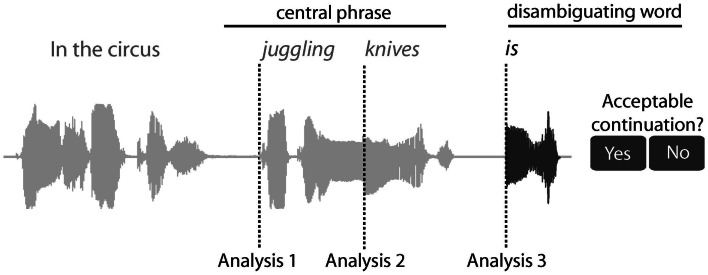
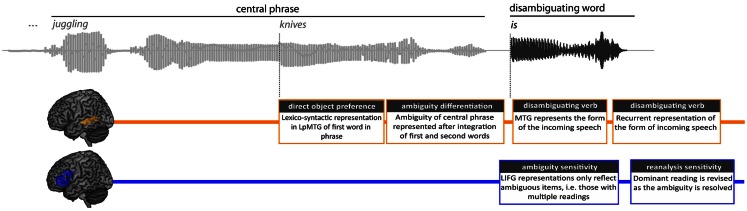
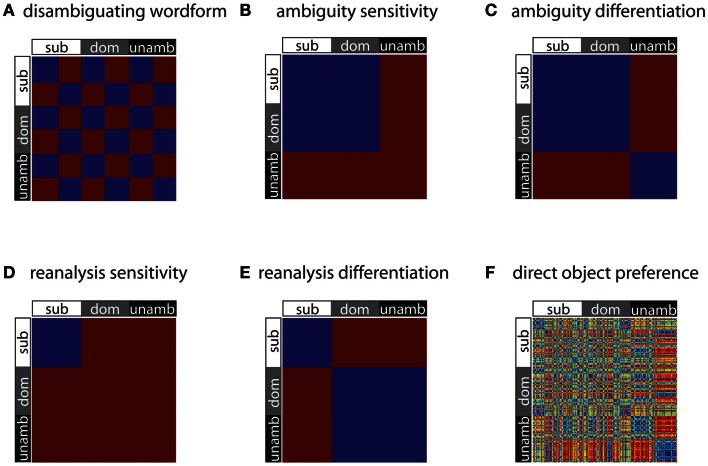
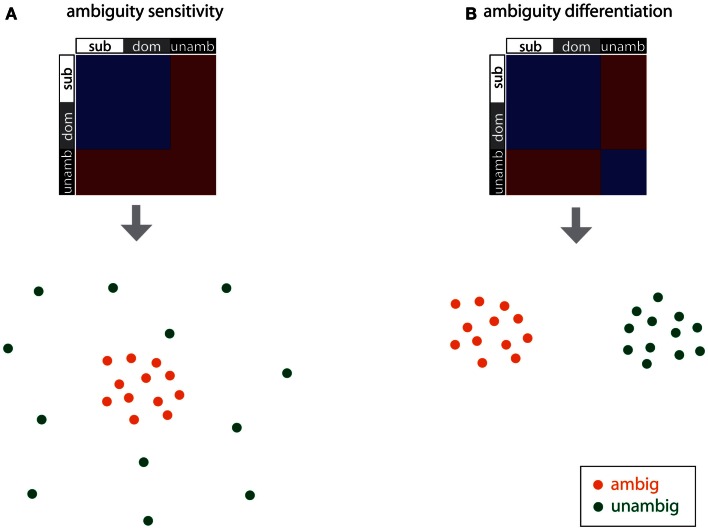
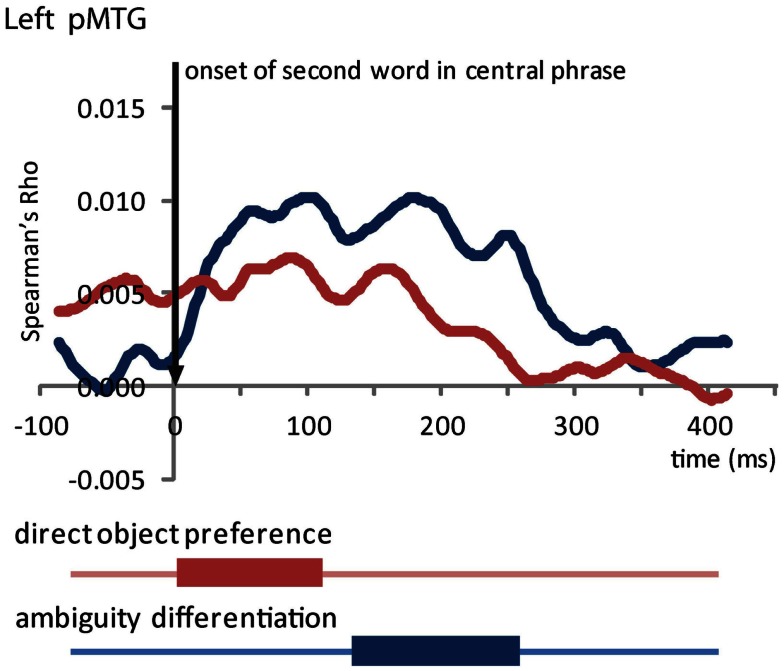
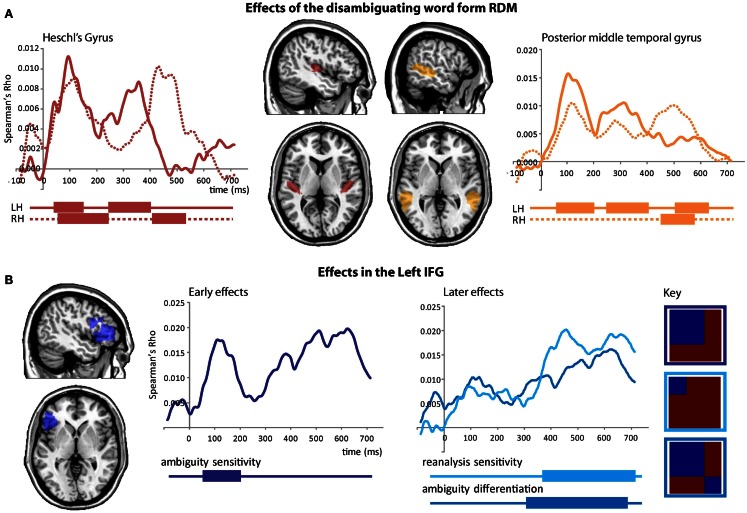
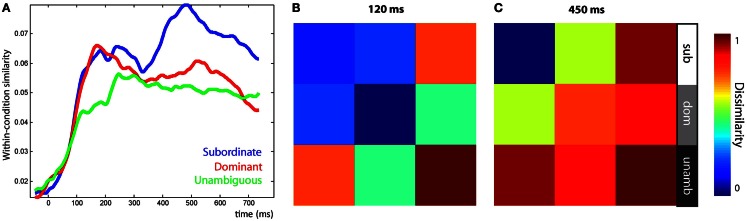
The core human capacity of syntactic analysis involves a left hemisphere network involving left inferior frontal gyrus (LIFG) and posterior middle temporal gyrus (LMTG) and the anatomical connections between them. Here we use magnetoencephalography (MEG) to determine the spatio-temporal properties of syntactic computations in this network. Listeners heard spoken sentences containing a local syntactic ambiguity (e.g., "… landing planes …"), at the offset of which they heard a disambiguating verb and decided whether it was an acceptable/unacceptable continuation of the sentence. We charted the time-course of processing and resolving syntactic ambiguity by measuring MEG responses from the onset of each word in the ambiguous phrase and the disambiguating word. We used representational similarity analysis (RSA) to characterize syntactic information represented in the LIFG and left posterior middle temporal gyrus (LpMTG) over time and to investigate their relationship to each other. Testing a variety of lexico-syntactic and ambiguity models against the MEG data, our results suggest early lexico-syntactic responses in the LpMTG and later effects of ambiguity in the LIFG, pointing to a clear differentiation in the functional roles of these two regions. Our results suggest the LpMTG represents and transmits lexical information to the LIFG, which responds to and resolves the ambiguity.
句法分析的核心人类能力涉及一个左半球网络,该网络涉及左额下回(LIFG)和后中颞回(LMTG)以及它们之间的解剖连接。在这里,我们使用脑磁图(MEG)来确定该网络中句法计算的时空特性。听众听到包含局部句法歧义的口语句子(例如,“...landing planes...”),在其偏移处,他们听到一个消除歧义的动词,并决定它是否是句子的可接受/不可接受的延续。我们通过测量模糊短语和消除歧义词中每个单词的起始时的 MEG 响应,来描绘处理和解决句法歧义的时间过程。我们使用表示相似性分析(RSA)来描述 LIFG 和左后中颞回(LpMTG)中随时间表示的句法信息,并研究它们之间的关系。通过对 MEG 数据进行各种词汇句法和歧义模型的测试,我们的结果表明 LpMTG 中存在早期的词汇句法反应,而 LIFG 中存在后期的歧义效应,这表明这两个区域的功能作用明显不同。我们的结果表明,LpMTG 代表并传递词汇信息到 LIFG,LIFG 对其进行响应并解决歧义。