Department of Applied Mathematics and Statistics, Stony Brook University, Stony Brook, NY 11794, USA.
Biology (Basel). 2012 Aug 20;1(2):311-38. doi: 10.3390/biology1020311.
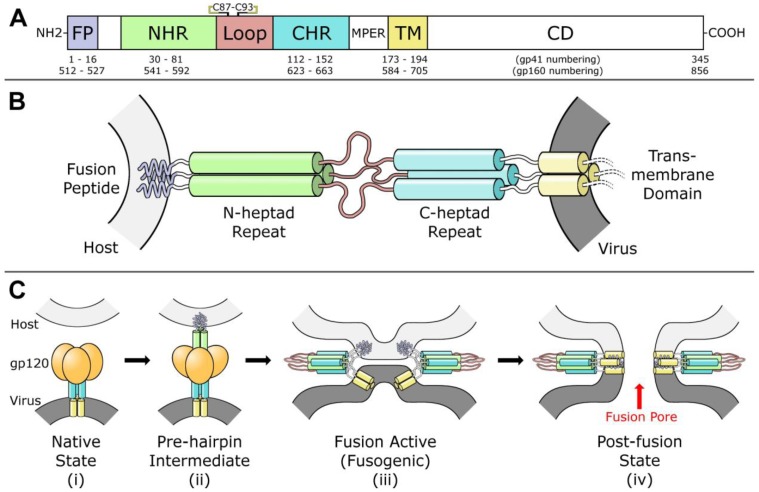
Virus-cell fusion is the primary means by which the human immunodeficiency virus-1 (HIV) delivers its genetic material into the human T-cell host. Fusion is mediated in large part by the viral glycoprotein 41 (gp41) which advances through four distinct conformational states: (i) native, (ii) pre-hairpin intermediate, (iii) fusion active (fusogenic), and (iv) post-fusion. The pre-hairpin intermediate is a particularly attractive step for therapeutic intervention given that gp41 N-terminal heptad repeat (NHR) and C-terminal heptad repeat (CHR) domains are transiently exposed prior to the formation of a six-helix bundle required for fusion. Most peptide-based inhibitors, including the FDA-approved drug T20, target the intermediate and there are significant efforts to develop small molecule alternatives. Here, we review current approaches to studying interactions of inhibitors with gp41 with an emphasis on atomic-level computer modeling methods including molecular dynamics, free energy analysis, and docking. Atomistic modeling yields a unique level of structural and energetic detail, complementary to experimental approaches, which will be important for the design of improved next generation anti-HIV drugs.
病毒-细胞融合是人类免疫缺陷病毒-1(HIV)将其遗传物质递送入人类 T 细胞宿主的主要方式。融合在很大程度上由病毒糖蛋白 41(gp41)介导,其经历四个不同的构象状态:(i)天然状态,(ii)发夹前中间体,(iii)融合活性(融合),和(iv)融合后。鉴于 gp41 N 端七肽重复(NHR)和 C 端七肽重复(CHR)结构域在形成融合所需的六螺旋束形成之前短暂暴露,发夹前中间体是治疗干预的特别有吸引力的步骤。大多数基于肽的抑制剂,包括 FDA 批准的药物 T20,都靶向于中间体,并且有很大的努力来开发小分子替代品。在这里,我们综述了当前研究抑制剂与 gp41 相互作用的方法,重点是原子级计算机建模方法,包括分子动力学、自由能分析和对接。原子建模提供了独特的结构和能量细节水平,与实验方法互补,这对于设计改进的下一代抗 HIV 药物将是重要的。