Komatsu Seiji, Yamada Kiyoshi, Yamashita Shuji, Sugiyama Narushi, Tokuyama Eijiro, Matsumoto Kumiko, Takara Ayumi, Kimata Yoshihiro
Department of Plastic and Reconstructive Surgery, Okayama University Hospital, Okayama, Japan.
Arch Plast Surg. 2013 May;40(3):214-9. doi: 10.5999/aps.2013.40.3.214. Epub 2013 May 16.
We established the Microvascular Research Center Training Program (MRCP) to help trainee surgeons acquire and develop microsurgical skills. Medical students were recruited to undergo the MRCP to assess the effectiveness of the MRCP for trainee surgeons.
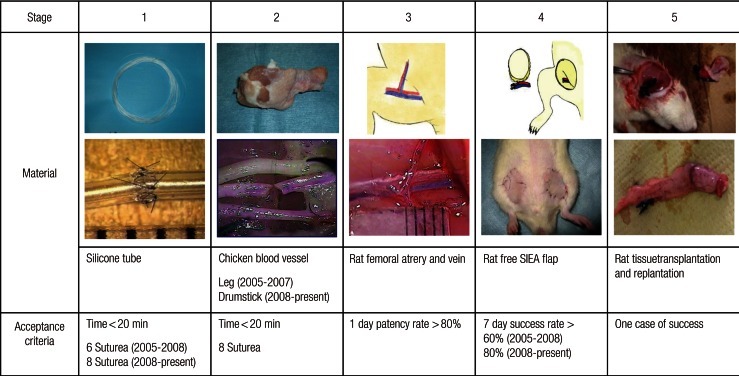
Twenty-two medical students with no prior microsurgical experience, who completed the course from 2005 to 2012, were included. The MRCP comprises 5 stages of training, each with specific passing requirements. Stages 1 and 2 involve anastomosing silicone tubes and blood vessels of chicken carcasses, respectively, within 20 minutes. Stage 3 involves anastomosing the femoral artery and vein of live rats with a 1-day patency rate of >80%. Stage 4 requires replantation of free superficial inferior epigastric artery flaps in rats with a 7-day success rate of >80%. Stage 5 involves successful completion of one case of rat replantation/transplantation. We calculated the passing rate for each stage and recorded the number of anastomoses required to pass stages 3 and 4.
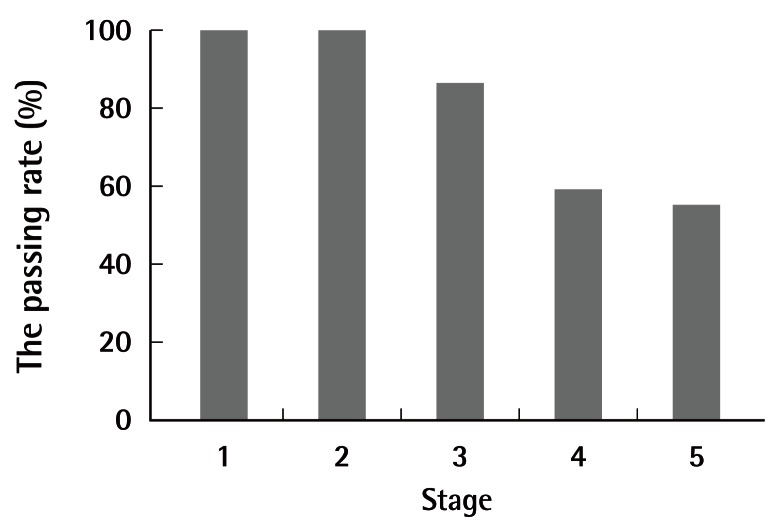
The passing rates were 100% (22/22) for stages 1 and 2, 86.4% (19/22) for stage 3, 59.1% (13/22) for stage 4, and 55.0% (11/20) for stage 5. The number of anastomoses performed was 17.2±12.2 in stage 3 and 11.3±8.1 in stage 4.
Majority of the medical students who undertook the MRCP acquired basic microsurgical skills. Thus, we conclude that the MRCP is an effective microsurgery training program for trainee surgeons.
我们设立了微血管研究中心培训项目(MRCP),以帮助实习外科医生掌握并提升显微外科技术。招募医学生参加MRCP,以评估该项目对实习外科医生的有效性。
纳入2005年至2012年期间完成课程且此前无显微外科经验的22名医学生。MRCP包括5个培训阶段,每个阶段都有特定的通过要求。第1阶段和第2阶段分别要求在20分钟内完成硅胶管吻合以及鸡尸体血管吻合。第3阶段要求吻合活鼠的股动脉和静脉,1天通畅率>80%。第4阶段要求在大鼠身上进行游离腹壁浅动脉皮瓣再植,7天成功率>80%。第5阶段要求成功完成1例大鼠再植/移植病例。我们计算了每个阶段的通过率,并记录了通过第3阶段和第4阶段所需的吻合次数。
第1阶段和第2阶段的通过率为100%(22/22),第3阶段为86.4%(19/22),第4阶段为59.1%(13/22),第5阶段为55.0%(11/20)。第3阶段进行的吻合次数为17.2±12.2次,第4阶段为11.3±8.1次。
参加MRCP的大多数医学生掌握了基本的显微外科技术。因此,我们得出结论,MRCP是一个对外科实习医生有效的显微外科培训项目。