Department of Chemistry and ‡Department of Biology, Massachusetts Institute of Technology , 77 Massachusetts Avenue, Cambridge, Massachusetts 02139, United States.
Acc Chem Res. 2013 Nov 19;46(11):2524-35. doi: 10.1021/ar4000407. Epub 2013 Jun 4.
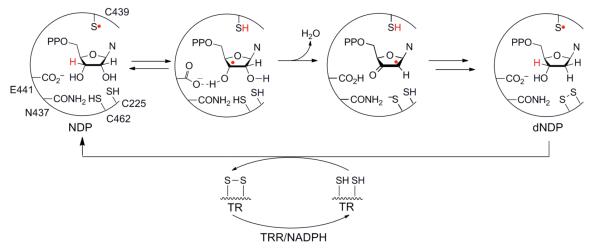
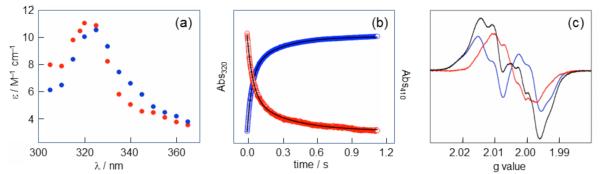
Ribonucleotide reductases (RNRs) catalyze the conversionof nucleotides to 2'-deoxynucleotides and are classified on the basis of the metallo-cofactor used to conduct this chemistry. The class Ia RNRs initiate nucleotide reduction when a stable diferric-tyrosyl radical (Y•, t1/2 of 4 days at 4 °C) cofactor in the β2 subunit transiently oxidizes a cysteine to a thiyl radical (S•) in the active site of the α2 subunit. In the active α2β2 complex of the class Ia RNR from E. coli , researchers have proposed that radical hopping occurs reversibly over 35 Å along a specific pathway comprised of redox-active aromatic amino acids: Y122• ↔ [W48?] ↔ Y356 in β2 to Y731 ↔ Y730 ↔ C439 in α2. Each step necessitates a proton-coupled electron transfer (PCET). Protein conformational changes constitute the rate-limiting step in the overall catalytic scheme and kinetically mask the detailed chemistry of the PCET steps. Technology has evolved to allow the site-selective replacement of the four pathway tyrosines with unnatural tyrosine analogues. Rapid kinetic techniques combined with multifrequency electron paramagnetic resonance, pulsed electron-electron double resonance, and electron nuclear double resonance spectroscopies have facilitated the analysis of stable and transient radical intermediates in these mutants. These studies are beginning to reveal the mechanistic underpinnings of the radical transfer (RT) process. This Account summarizes recent mechanistic studies on mutant E. coli RNRs containing the following tyrosine analogues: 3,4-dihydroxyphenylalanine (DOPA) or 3-aminotyrosine (NH2Y), both thermodynamic radical traps; 3-nitrotyrosine (NO2Y), a thermodynamic barrier and probe of local environmental perturbations to the phenolic pKa; and fluorotyrosines (FnYs, n = 2 or 3), dual reporters on local pKas and reduction potentials. These studies have established the existence of a specific pathway spanning 35 Å within a globular α2β2 complex that involves one stable (position 122) and three transient (positions 356, 730, and 731) Y•s. Our results also support that RT occurs by an orthogonal PCET mechanism within β2, with Y122• reduction accompanied by proton transfer from an Fe1-bound water in the diferric cluster and Y356 oxidation coupled to an off-pathway proton transfer likely involving E350. In α2, RT likely occurs by a co-linear PCET mechanism, based on studies of light-initiated radical propagation from photopeptides that mimic the β2 subunit to the intact α2 subunit and on [(2)H]-ENDOR spectroscopic analysis of the hydrogen-bonding environment surrounding a stabilized NH2Y• formed at position 730. Additionally, studies on the thermodynamics of the RT pathway reveal that the relative reduction potentials decrease according to Y122 < Y356 < Y731 ≈ Y730 ≤ C439, and that the pathway in the forward direction is thermodynamically unfavorable. C439 oxidation is likely driven by rapid, irreversible loss of water during the nucleotide reduction process. Kinetic studies of radical intermediates reveal that RT is gated by conformational changes that occur on the order of >100 s(-1) in addition to the changes that are rate-limiting in the wild-type enzyme (∼10 s(-1)). The rate constant of one of the PCET steps is ∼10(5) s(-1), as measured in photoinitiated experiments.
核糖核苷酸还原酶(RNRs)催化核苷酸转化为 2'-脱氧核苷酸,并根据用于进行该化学转化的金属辅因子进行分类。Ia 类 RNRs 在β2 亚基中的稳定双核铁-酪氨酸自由基(在 4°C 下 4 天的半衰期)暂时将活性位点中的半胱氨酸氧化为硫自由基(S•)时,启动核苷酸还原。在大肠杆菌 Ia 类 RNR 的活性 α2β2 复合物中,研究人员提出,自由基跳跃沿由氧化还原活性芳香族氨基酸组成的特定途径可逆地发生 35Å:β2 中的 Y122•↔[W48?]↔Y356 到α2 中的 Y731↔Y730↔C439。每一步都需要质子偶联电子转移(PCET)。蛋白质构象变化构成了整体催化方案中的限速步骤,并在动力学上掩盖了 PCET 步骤的详细化学性质。技术已经发展到允许用非天然酪氨酸类似物选择性取代途径中的四个酪氨酸。快速动力学技术与多频电子顺磁共振、脉冲电子-电子双共振和电子-核双共振波谱学相结合,促进了这些突变体中稳定和瞬态自由基中间体的分析。这些研究开始揭示自由基转移(RT)过程的机制基础。本综述总结了最近关于含有以下酪氨酸类似物的突变大肠杆菌 RNR 的机制研究:3,4-二羟基苯丙氨酸(DOPA)或 3-氨基酪氨酸(NH2Y),均为热力学自由基陷阱;3-硝基酪氨酸(NO2Y),热力学障碍和对酚 pKa 局部环境扰动的探针;以及氟代酪氨酸(FnYs,n=2 或 3),局部 pKas 和还原电位的双重报告。这些研究确立了在球形α2β2 复合物内跨越 35Å 的特定途径的存在,该途径涉及一个稳定(位置 122)和三个瞬态(位置 356、730 和 731)Y•s。我们的结果还支持 RT 通过β2 内的正交 PCET 机制发生,其中 Y122•的还原伴随着来自二铁簇中 Fe1 结合水的质子转移,而 Y356 的氧化与可能涉及 E350 的路径外质子转移偶联。在α2 中,基于模拟β2 亚基到完整α2 亚基的光引发自由基传播的光肽研究以及对在位置 730 形成的稳定 NH2Y•的氢键环境的[(2)H]-ENDOR 光谱分析,RT 可能通过共线性 PCET 机制发生。此外,对 RT 途径热力学的研究表明,相对还原电位按 Y122<Y356<Y731≈Y730≤C439 降低,并且正向途径热力学上不利。C439 的氧化可能是由核苷酸还原过程中快速不可逆的水损失驱动的。自由基中间体的动力学研究表明,RT 由构象变化控制,这些变化的发生速度超过 100 s-1,除了野生型酶中的限速变化(约 10 s-1)。在光引发实验中,测量到一个 PCET 步骤的速率常数约为 10(5) s-1。