Department of Infectious, Parasitic and Immuno-mediated Diseases, Istituto Superiore di Sanità, viale Regina Elena, 299, Rome, Italy.
BMC Infect Dis. 2013 Jun 3;13:258. doi: 10.1186/1471-2334-13-258.
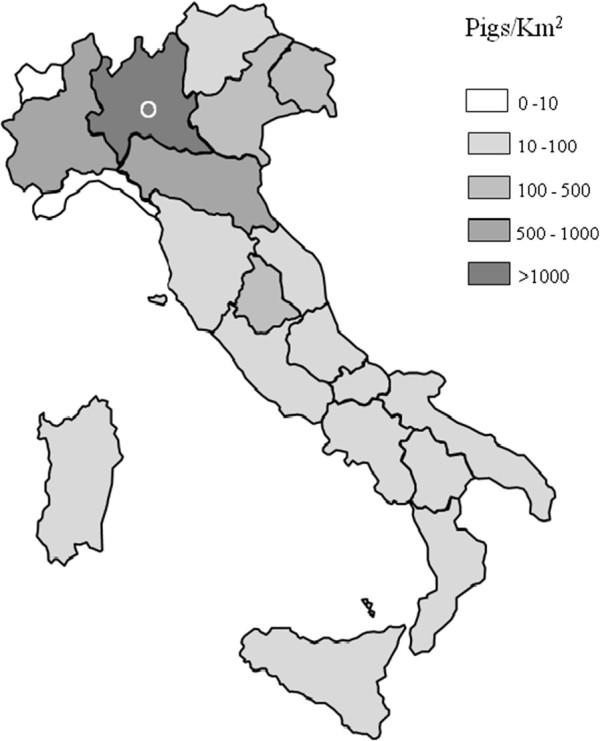
Livestock-Associated MRSA (LA-MRSA) belonging to ST398 lineage, common among pigs and other animals, emerged in Central and Northern Europe, becoming a new risk factor for MRSA among farm workers. Strains belonging to ST398 can be responsible for human colonization and infection, mainly in areas with high livestock-farming. The aim of this study was to investigate the occurrence of livestock-associated methicillin-resistant Staphylococcus aureus (LA-MRSA) human colonization and infections in an area of the Lombardy Region (Italy), the Italian region with the highest density of pig farming.
In the period March-April 2010, 879 nasal swabs were taken from subjects at admission to a local hospital serving an area of the Lombardy Region devoted to agriculture and farming. In the period March 2010-February 2011, all MRSA strains from community-acquired infection (CAI) observed in the same hospital, were collected. Molecular characterization of the isolates included SCCmec typing, spa typing and multilocus sequence typing (MLST).
Out of 879 nasal swabs examined, 9 (1%) yielded MRSA. Five strains were assigned to sequence type (ST)398 (spa t899, 3 isolates; t108 and t2922, 1 isolate each) and were therefore categorized as LA-MRSA. The other 4 isolates were likely of hospital origin. No strains were positive for Panton-Valentine Leukocidin genes. Twenty MRSA isolates were detected from CAI, 17 were from skin and soft-tissue infections and 3 from other infections. An MRSA isolate from otitis externa was t899/ST398 and PVL-negative, hence categorized as LA-MRSA. Four isolates were assigned to t127/ST1. Eight strains were PVL-positive community acquired (CA)-MRSA and belonged to different clones, the most frequent being ST8.
In an area of Italy with high density of pig farming, LA-MRSA is able to colonize the population and rarely to produce infections. Typical CA-MRSA is more common than LA-MRSA among CAI.
属于 ST398 谱系的与牲畜相关的耐甲氧西林金黄色葡萄球菌(LA-MRSA)在中欧和北欧流行,成为农场工人中耐甲氧西林金黄色葡萄球菌的新危险因素。属于 ST398 的菌株可能导致人类定植和感染,主要发生在高牲畜养殖区。本研究旨在调查意大利伦巴第地区(意大利)一个地区的牲畜相关耐甲氧西林金黄色葡萄球菌(LA-MRSA)人类定植和感染的发生情况,该地区是养猪密度最高的意大利地区。
在 2010 年 3 月至 4 月期间,从伦巴第地区一家医院就诊的 879 名患者采集鼻拭子。在 2010 年 3 月至 2011 年 2 月期间,收集了同一医院观察到的所有社区获得性感染(CAI)的耐甲氧西林金黄色葡萄球菌菌株。分离株的分子特征包括 SCCmec 分型、spa 分型和多位点序列分型(MLST)。
在 879 份鼻拭子中,有 9 份(1%)检出耐甲氧西林金黄色葡萄球菌。5 株被分配到序列型(ST)398(spa t899,3 株;t108 和 t2922,1 株),因此被归类为 LA-MRSA。其他 4 株可能来自医院。没有菌株对 Panton-Valentine 白细胞毒素基因呈阳性。从 CAI 中检测到 20 株耐甲氧西林金黄色葡萄球菌,17 株来自皮肤和软组织感染,3 株来自其他感染。一株来自外耳炎的耐甲氧西林金黄色葡萄球菌为 t899/ST398,且对 Panton-Valentine 白细胞毒素呈阴性,因此被归类为 LA-MRSA。4 株被分配到 t127/ST1。8 株为 PVL 阳性的社区获得性(CA)-MRSA,属于不同的克隆,最常见的是 ST8。
在意大利一个养猪密度很高的地区,LA-MRSA 能够定植人群并很少引起感染。在 CAI 中,典型的 CA-MRSA 比 LA-MRSA 更为常见。