Visual Attention Lab, Brigham and Women's Hospital, Harvard Medical School, Cambridge, Massachusetts, USA.
PLoS One. 2013 May 30;8(5):e64366. doi: 10.1371/journal.pone.0064366. Print 2013.
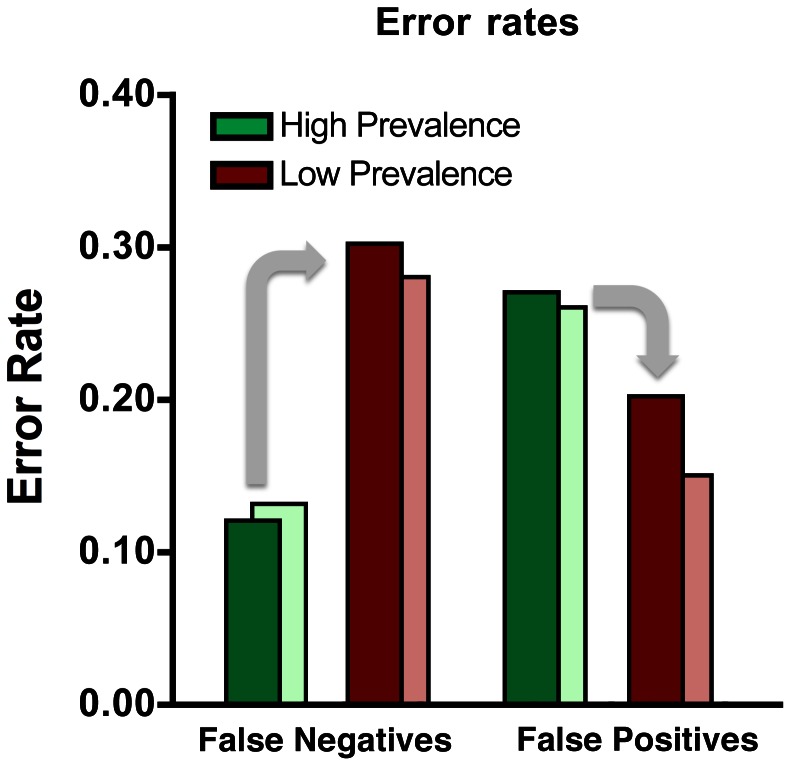
Mammography is an important tool in the early detection of breast cancer. However, the perceptual task is difficult and a significant proportion of cancers are missed. Visual search experiments show that miss (false negative) errors are elevated when targets are rare (low prevalence) but it is unknown if low prevalence is a significant factor under real world, clinical conditions. Here we show that expert mammographers in a real, low-prevalence, clinical setting, miss a much higher percentage of cancers than are missed when the mammographers search for the same cancers under high prevalence conditions. We inserted 50 positive and 50 negative cases into the normal workflow of the breast cancer screening service of an urban hospital over the course of nine months. This rate was slow enough not to markedly raise disease prevalence in the radiologists' daily practice. Six radiologists subsequently reviewed all 100 cases in a session where the prevalence of disease was 50%. In the clinical setting, participants missed 30% of the cancers. In the high prevalence setting, participants missed just 12% of the same cancers. Under most circumstances, this low prevalence effect is probably adaptive. It is usually wise to be conservative about reporting events with very low base rates (Was that a flying saucer? Probably not.). However, while this response to low prevalence appears to be strongly engrained in human visual search mechanisms, it may not be as adaptive in socially important, low prevalence tasks like medical screening. While the results of any one study must be interpreted cautiously, these data are consistent with the conclusion that this behavioral response to low prevalence could be a substantial contributor to miss errors in breast cancer screening.
乳腺 X 线摄影是早期发现乳腺癌的重要工具。然而,这种感知任务非常困难,相当一部分癌症会被漏诊。视觉搜索实验表明,当目标很少(低患病率)时,漏诊(假阴性)错误会增加,但目前尚不清楚在现实世界的临床环境中,低患病率是否是一个重要因素。在这里,我们发现,在真实的、低患病率的临床环境中,专家乳腺 X 线摄影师漏诊的癌症比例远高于在高患病率条件下搜索相同癌症时的漏诊比例。我们在九个月的时间里,将 50 个阳性和 50 个阴性病例插入到一家城市医院乳腺癌筛查服务的正常工作流程中。这种插入病例的速度非常缓慢,不会明显提高放射科医生日常工作中的疾病患病率。随后,六名放射科医生在一个疾病患病率为 50%的病例中对所有 100 个病例进行了复查。在临床环境中,参与者漏诊了 30%的癌症。而在高患病率环境中,参与者仅漏诊了相同癌症的 12%。在大多数情况下,这种低患病率效应可能是适应性的。对于低患病率的事件,保守报告通常是明智的(那是飞碟吗?可能不是。)。然而,尽管人类视觉搜索机制中存在这种对低患病率的反应,但在医学筛查等具有重要社会意义的低患病率任务中,这种反应可能并不适应。虽然任何一项研究的结果都必须谨慎解释,但这些数据与以下结论一致,即这种对低患病率的行为反应可能是乳腺癌筛查中漏诊的一个重要因素。