Caswell Hal, Salguero-Gómez Roberto
Biology Department MS-34, Woods Hole Oceanographic Institution Woods Hole, MA, 02543, USA ; Max Planck Institute for Demographic Research Rostock, 18057, Germany.
J Ecol. 2013 May;101(3):585-595. doi: 10.1111/1365-2745.12088. Epub 2013 Apr 24.
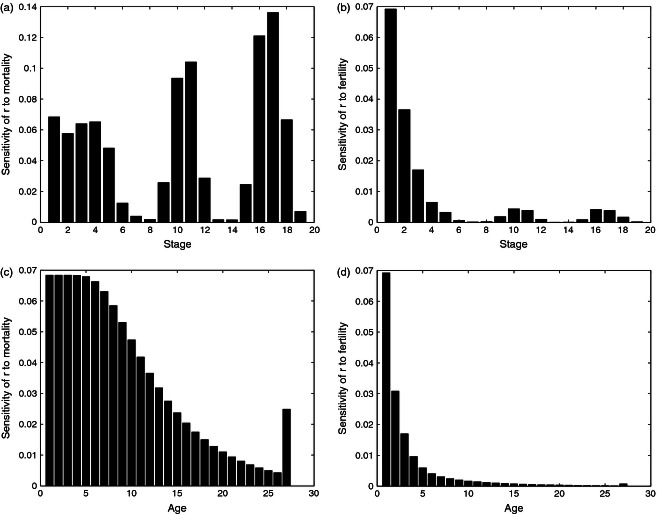
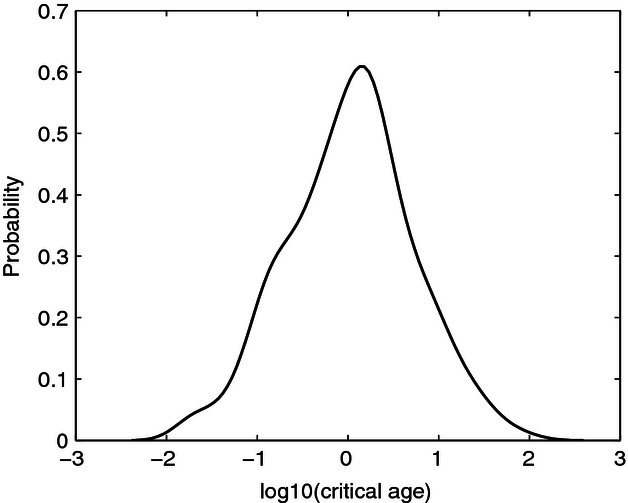
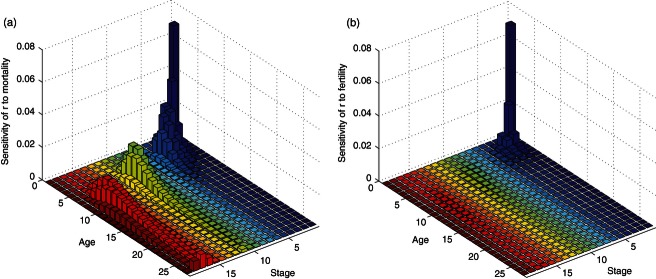
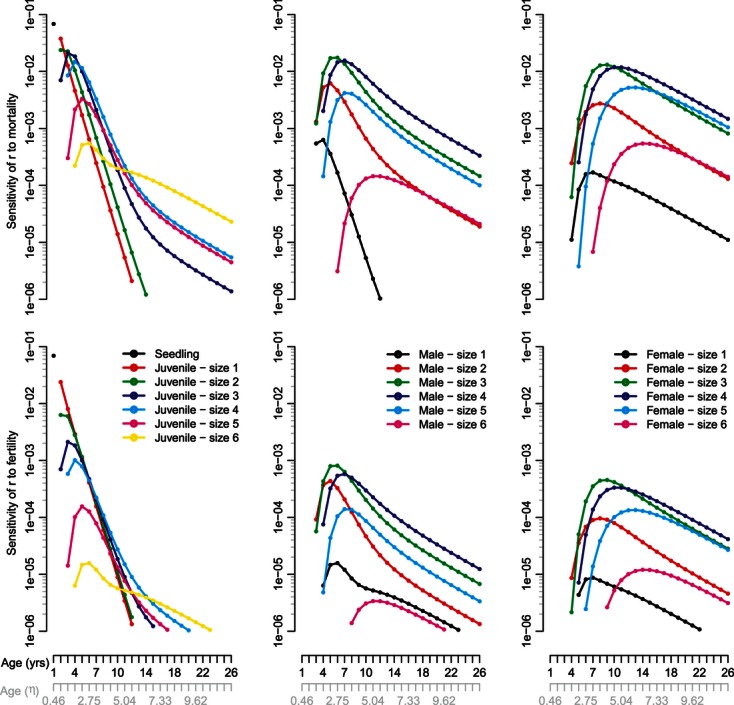
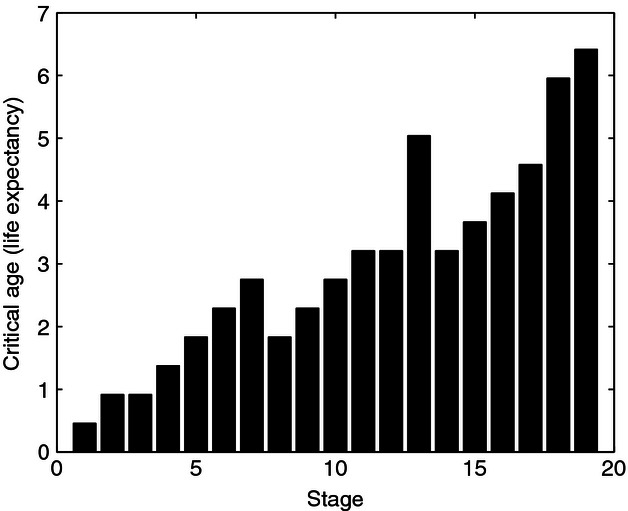
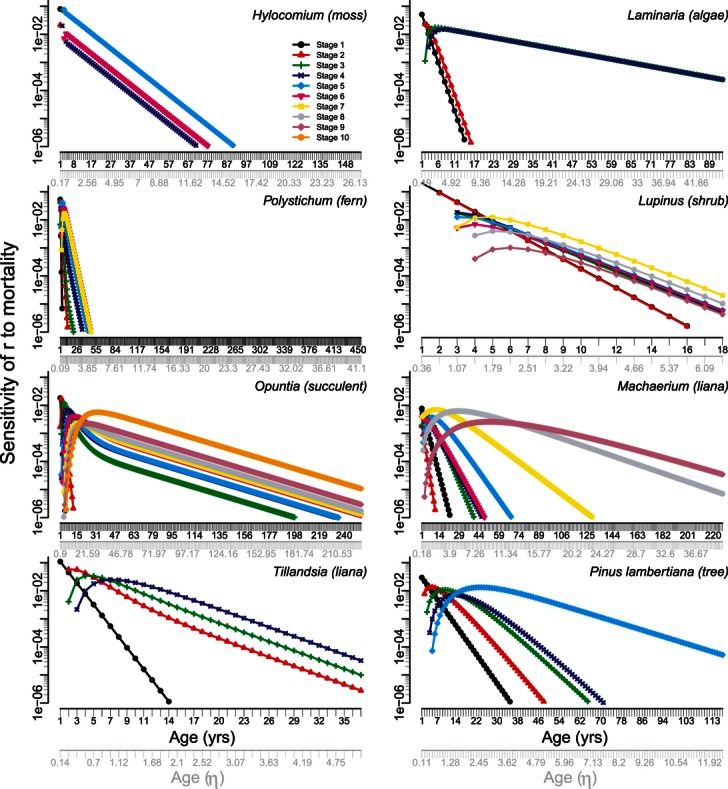
Senescence (an increase in the mortality rate or force of mortality, or a decrease in fertility, with increasing age) is a widespread phenomenon. Theories about the evolution of senescence have long focused on the age trajectories of the selection gradients on mortality and fertility. In purely age-classified models, these selection gradients are non-increasing with age, implying that traits expressed early in life have a greater impact on fitness than traits expressed later in life. This pattern leads inevitably to the evolution of senescence if there are trade-offs between early and late performance. It has long been suspected that the stage- or size-dependent demography typical of plants might change these conclusions. In this paper, we develop a model that includes both stage- and age-dependence and derive the age-dependent, stage-dependent and age×stage-dependent selection gradients on mortality and fertility. We applied this model to stage-classified population projection matrices for 36 species of plants, from a wide variety of growth forms (from mosses to trees) and habitats. We found that the age-specific selection gradients within a life cycle stage can exhibit increases with age (we call these selection gradients). In later stages, often large size classes in plant demography, the duration of these contra-senescent gradients can exceed the life expectancy by several fold. . The interaction of age- and stage-dependence in plants leads to selection pressures on senescence fundamentally different from those found in previous, age-classified theories. This result may explain the observation that large plants seem less subject to senescence than most kinds of animals. The methods presented here can lead to improved analysis of both age-dependent and stage-dependent demographic properties of plant populations.
衰老(即随着年龄增长死亡率或死亡力增加,或繁殖力下降)是一种普遍现象。关于衰老进化的理论长期以来一直聚焦于死亡率和繁殖力选择梯度的年龄轨迹。在纯年龄分类模型中,这些选择梯度不会随着年龄增长而增加,这意味着生命早期表达的性状对适合度的影响大于生命后期表达的性状。如果生命早期和后期表现之间存在权衡,这种模式必然会导致衰老的进化。长期以来,人们一直怀疑植物典型的阶段或大小依赖型种群统计学特征可能会改变这些结论。在本文中,我们构建了一个同时包含阶段和年龄依赖性的模型,并推导出死亡率和繁殖力的年龄依赖性、阶段依赖性以及年龄×阶段依赖性选择梯度。我们将这个模型应用于36种植物的阶段分类种群预测矩阵,这些植物具有广泛的生长形式(从苔藓到树木)和栖息地。我们发现,在一个生命周期阶段内,特定年龄的选择梯度可能会随着年龄增长而增加(我们将这些称为反衰老梯度)。在后期阶段,通常是植物种群统计学中的大型大小类,这些反衰老梯度的持续时间可能会超过预期寿命几倍。植物中年龄和阶段依赖性的相互作用导致了对衰老的选择压力,这与之前年龄分类理论中的选择压力根本不同。这一结果可能解释了大型植物似乎比大多数动物更不易衰老这一观察结果。本文提出的方法可以改进对植物种群年龄依赖性和阶段依赖性种群统计学特征的分析。