Institute for Diabetes and Obesity, Helmholtz Center Munich and Division of Metabolic Diseases, Department of Medicine, Technical University Munich, Munich, Germany.
Nat Commun. 2013;4:1968. doi: 10.1038/ncomms2968.
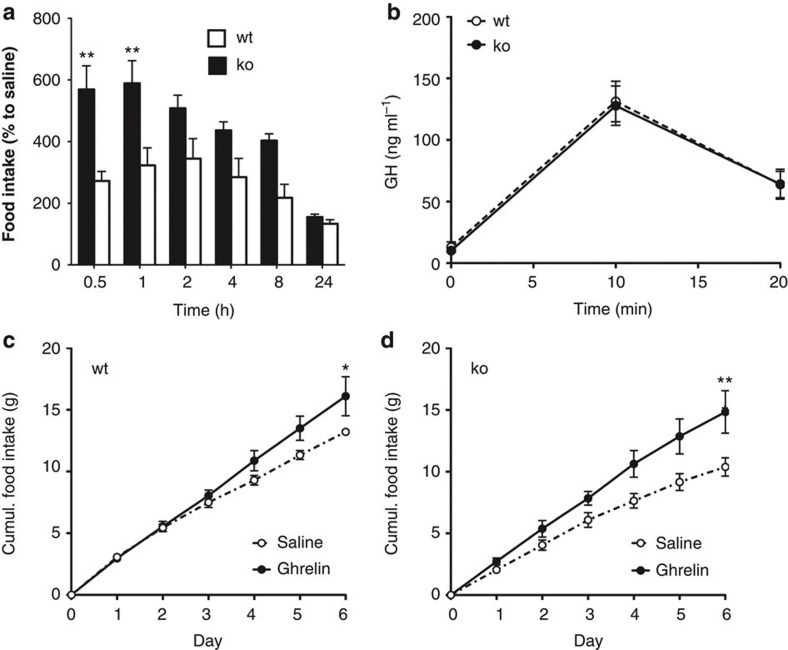
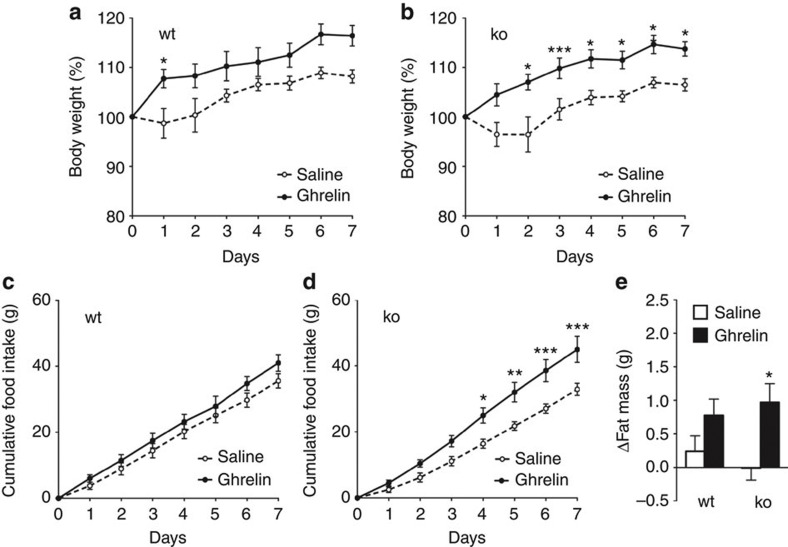
The G protein-coupled receptor 83 (Gpr83) is widely expressed in brain regions regulating energy metabolism. Here we report that hypothalamic expression of Gpr83 is regulated in response to nutrient availability and is decreased in obese mice compared with lean mice. In the arcuate nucleus, Gpr83 colocalizes with the ghrelin receptor (Ghsr1a) and the agouti-related protein. In vitro analyses show heterodimerization of Gpr83 with Ghsr1a diminishes activation of Ghsr1a by acyl-ghrelin. The orexigenic and adipogenic effect of ghrelin is accordingly potentiated in Gpr83-deficient mice. Interestingly, Gpr83 knock-out mice have normal body weight and glucose tolerance when fed a regular chow diet, but are protected from obesity and glucose intolerance when challenged with a high-fat diet, despite hyperphagia and increased hypothalamic expression of agouti-related protein, Npy, Hcrt and Ghsr1a. Together, our data suggest that Gpr83 modulates ghrelin action but also indicate that Gpr83 regulates systemic metabolism through other ghrelin-independent pathways.
G 蛋白偶联受体 83(Gpr83)广泛表达于调节能量代谢的脑区。我们发现,Gpr83 在脑内的表达受营养物质供应的调控,且在肥胖小鼠中较瘦小鼠降低。在弓状核中,Gpr83 与生长激素释放肽受体 1a(Ghsr1a)和刺鼠相关蛋白共表达。体外分析显示 Gpr83 与 Ghsr1a 形成异源二聚体,减弱了酰基-生长激素释放肽对 Ghsr1a 的激活。因此,在 Gpr83 缺失小鼠中,生长激素释放肽的食欲刺激和脂肪生成作用增强。有趣的是,Gpr83 敲除小鼠在正常饮食时体重和葡萄糖耐量正常,但在高脂肪饮食挑战时可免受肥胖和葡萄糖不耐受的影响,尽管它们表现出过度摄食和下丘脑刺鼠相关蛋白、神经肽 Y、食欲素和 Ghsr1a 表达增加。综上,我们的数据表明 Gpr83 调节生长激素释放肽的作用,但也提示 Gpr83 通过其他与生长激素释放肽无关的途径调节全身代谢。