Oxford Glycobiology Institute, University of Oxford, South Parks Road, Oxford OX1 3QU, United Kingdom.
J Am Chem Soc. 2013 Jul 3;135(26):9723-32. doi: 10.1021/ja4014375. Epub 2013 Jun 25.
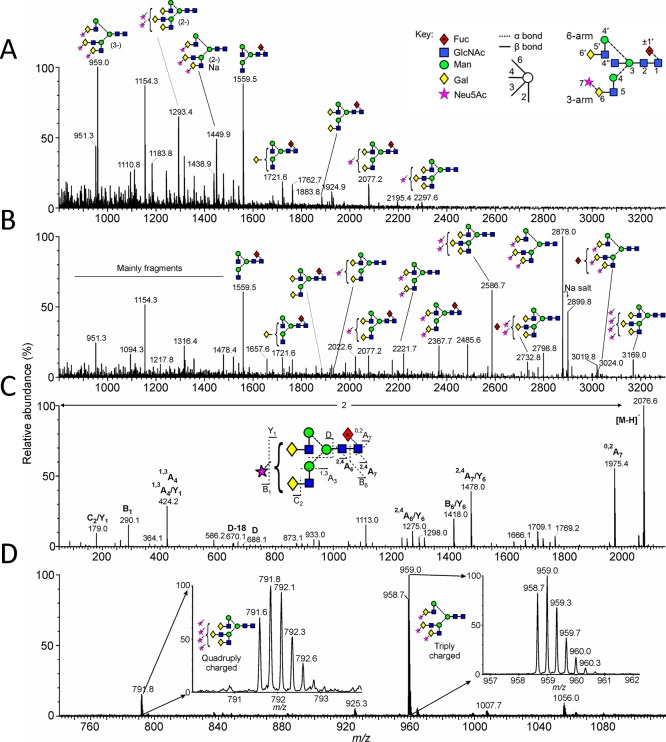
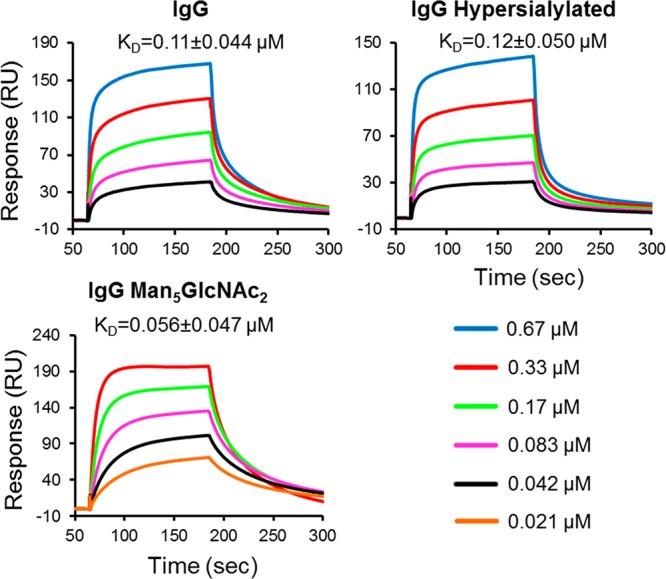
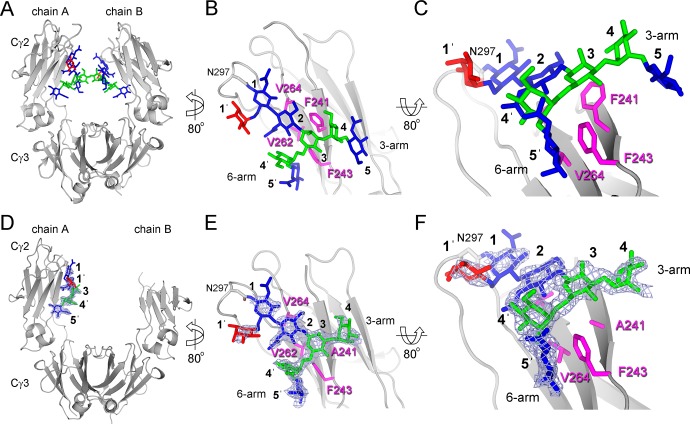
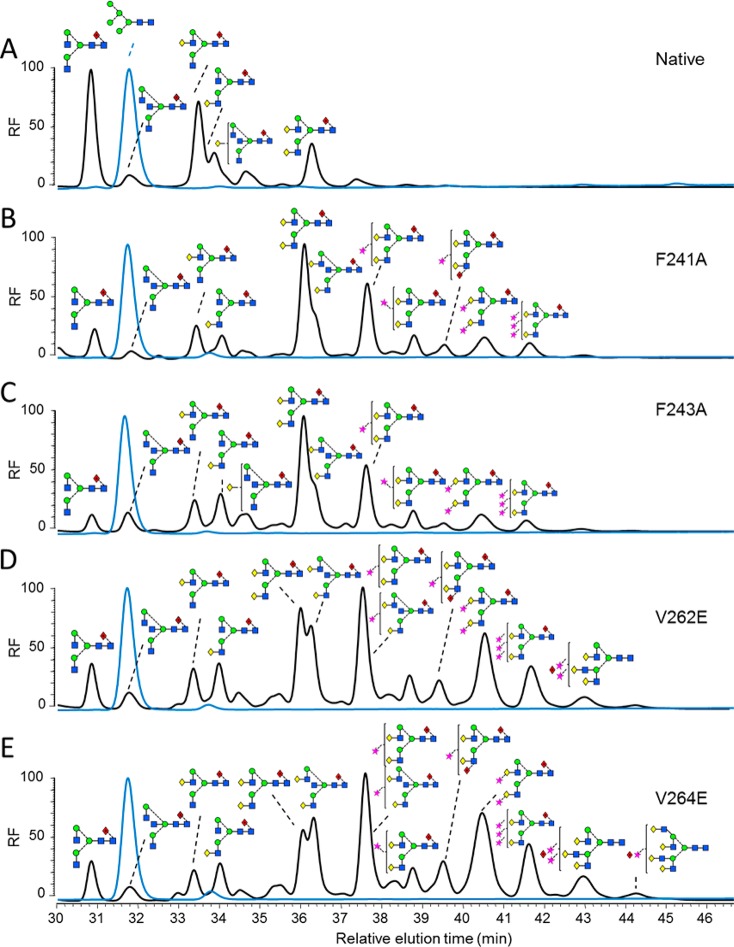
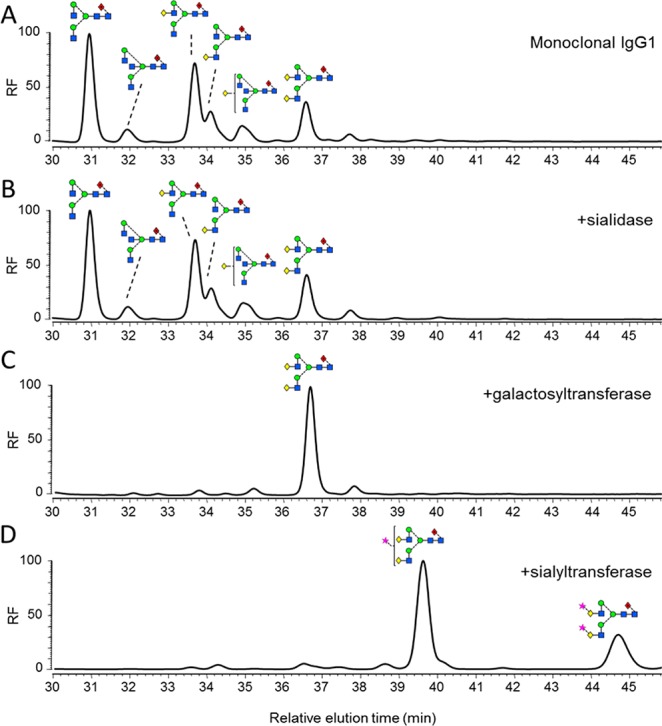
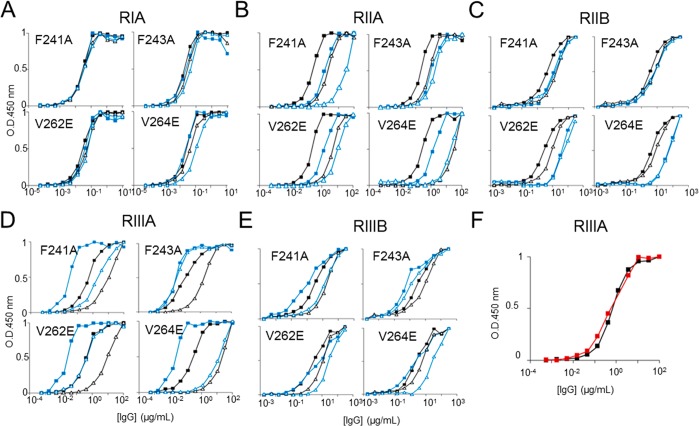
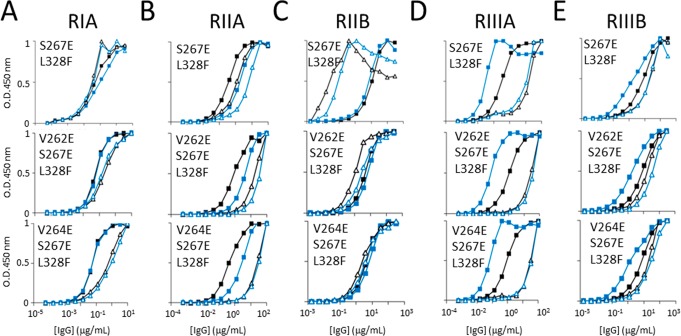
Biologically active conformations of the IgG1 Fc homodimer are maintained by multiple hydrophobic interactions between the protein surface and the N-glycan. The Fc glycan modulates biological effector functions, including antibody-dependent cellular cytotoxicity (ADCC) which is mediated in part through the activatory Fc receptor, FcγRIIIA. Consistent with previous reports, we found that site-directed mutations disrupting the protein-carbohydrate interface (F241A, F243A, V262E, and V264E) increased galactosylation and sialylation of the Fc and, concomitantly, reduced the affinity for FcγRIIIA. We rationalized this effect by crystallographic analysis of the IgG1 Fc F241A mutant, determined here to a resolution of 1.9 Å, which revealed localized destabilization of this glycan-protein interface. Given that sialylation of Fc glycans decreases ADCC, one explanation for the effect of these mutants on FcγRIIIA binding is their increased sialylation. However, a glycan-engineered IgG1 with hypergalactosylated and hypersialylated glycans exhibited unchanged binding affinity to FcγRIIIA. Moreover, when we expressed these mutants as a chemically uniform (Man5GlcNAc2) glycoform, the individual effect of each mutation on FcγRIIIA affinity was preserved. This effect was broadly recapitulated for other Fc receptors (FcγRI, FcγRIIA, FcγRIIB, and FcγRIIIB). These data indicate that destabilization of the glycan-protein interactions, rather than increased galactosylation and sialylation, modifies the Fc conformation(s) relevant for FcγR binding. Engineering of the protein-carbohydrate interface thus provides an independent parameter in the engineering of Fc effector functions and a route to the synthesis of new classes of Fc domain with novel combinations of affinities for activatory and inhibitory Fc receptors.
IgG1 Fc 同二聚体的生物活性构象由蛋白质表面和 N-糖基之间的多种疏水相互作用维持。Fc 聚糖调节生物效应功能,包括抗体依赖的细胞毒性(ADCC),部分通过激活 Fc 受体 FcγRIIIA 介导。与先前的报道一致,我们发现破坏蛋白-碳水化合物界面的定点突变(F241A、F243A、V262E 和 V264E)增加了 Fc 的半乳糖基化和唾液酸化,并且同时降低了与 FcγRIIIA 的亲和力。我们通过此处确定的分辨率为 1.9Å 的 IgG1 Fc F241A 突变体的晶体学分析来合理化这种效应,该分析揭示了该糖蛋白界面的局部失稳。鉴于 Fc 聚糖的唾液酸化降低了 ADCC,这些突变体对 FcγRIIIA 结合的影响的一种解释是它们增加的唾液酸化。然而,具有高半乳糖基化和高唾液酸化聚糖的糖工程化 IgG1 表现出对 FcγRIIIA 的结合亲和力不变。此外,当我们将这些突变体作为化学均匀的(Man5GlcNAc2)糖型表达时,每个突变对 FcγRIIIA 亲和力的个体影响得以保留。对于其他 Fc 受体(FcγRI、FcγRIIA、FcγRIIB 和 FcγRIIIB)也广泛再现了这种效应。这些数据表明,糖蛋白相互作用的不稳定,而不是增加的半乳糖基化和唾液酸化,改变了与 FcγR 结合相关的 Fc 构象。因此,蛋白质-碳水化合物界面的工程提供了 Fc 效应功能工程中的一个独立参数,并为具有新型 Fc 受体激活和抑制亲和力组合的新型 Fc 结构域的合成提供了一种途径。