Oghumu Steve, Satoskar Abhay R
Department of Pathology; The Ohio State University Medical Center; Columbus, OH USA ; Department of Oral Biology; The Ohio State University College of Dentistry; Columbus, OH USA.
Commun Integr Biol. 2013 Mar 1;6(2):e23360. doi: 10.4161/cib.23360.
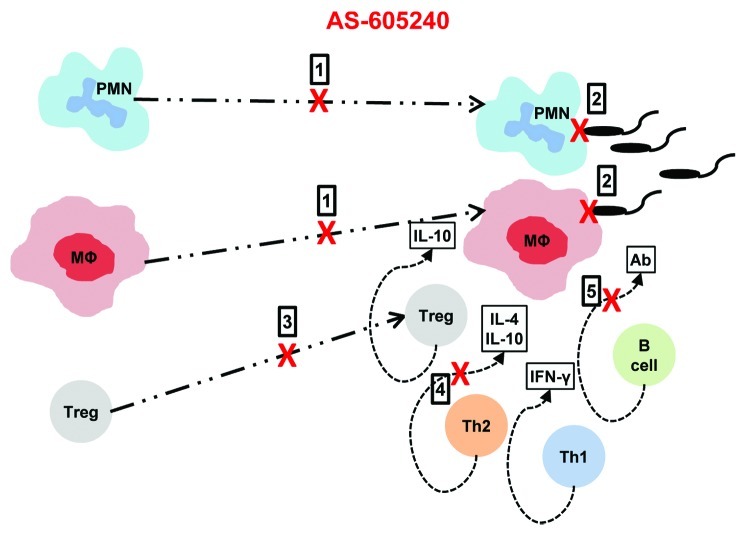
Our increased understanding of host pathogen interactions shows that pathogens could capitalize on host cell pathways to favor entry and disease establishment. One such pathway used by Leishmania mexicana to enter into neutrophils and macrophages is the PI3Kγ signaling pathway. We recently showed that the use of the PI3Kγ inhibitor AS-605240 for the treatment of experimental L. mexicana infection in mice resulted in significantly lower parasite burdens and lesion sizes than WT untreated mice. Further, AS-605240 was found to be as effective as Sodium Stibogluconate, the drug of choice for treatment of L. mexicana infection, in reducing parasite burdens in mice. Here, we provide potential mechanisms of PI3Kγ blockade in promoting resistance to L. mexicana infection in mice. As a proof of principle, we propose that targeting host cell signaling pathways used in the establishment of infection could be a possible therapeutic option in the management of obligate intracellular pathogens.
我们对宿主与病原体相互作用的深入了解表明,病原体可利用宿主细胞途径促进自身进入并建立感染。墨西哥利什曼原虫进入中性粒细胞和巨噬细胞所利用的一条途径就是PI3Kγ信号通路。我们最近发现,使用PI3Kγ抑制剂AS - 605240治疗小鼠实验性墨西哥利什曼原虫感染,与未治疗的野生型小鼠相比,寄生虫负荷和病变大小显著降低。此外,在降低小鼠寄生虫负荷方面,发现AS - 605240与治疗墨西哥利什曼原虫感染的首选药物葡糖酸锑钠效果相当。在此,我们阐述了PI3Kγ阻断在促进小鼠对墨西哥利什曼原虫感染产生抗性中的潜在机制。作为原理验证,我们提出,针对感染建立过程中所使用的宿主细胞信号通路进行靶向干预,可能是管理专性细胞内病原体的一种可行治疗选择。