Center for Bioinformatics and Computational Biology, 15 Innovation Way, Suite 205, University of Delaware, Newark, DE 19711, USA.
Database (Oxford). 2013 Jun 7;2013:bat038. doi: 10.1093/database/bat038. Print 2013.
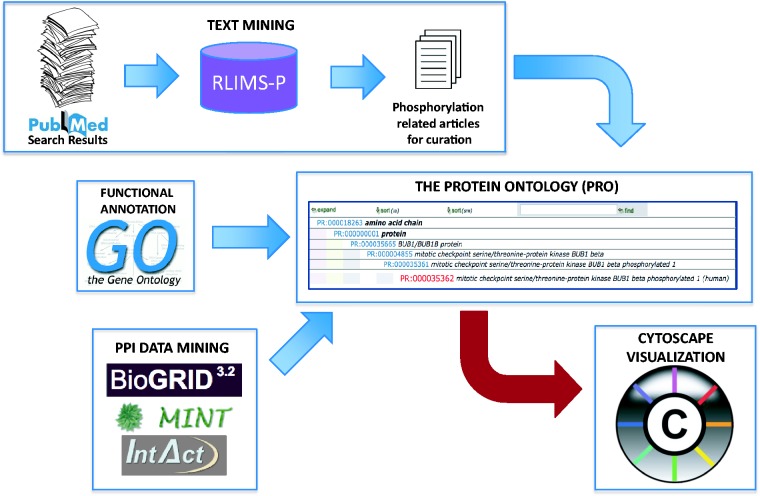
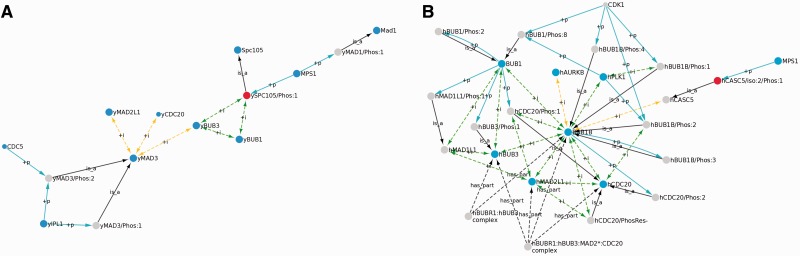
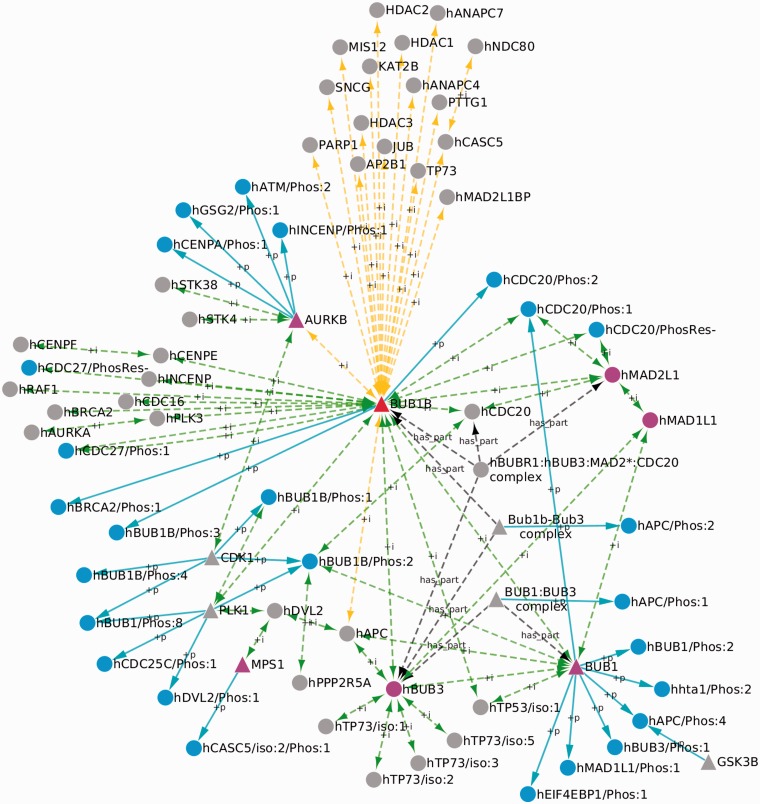
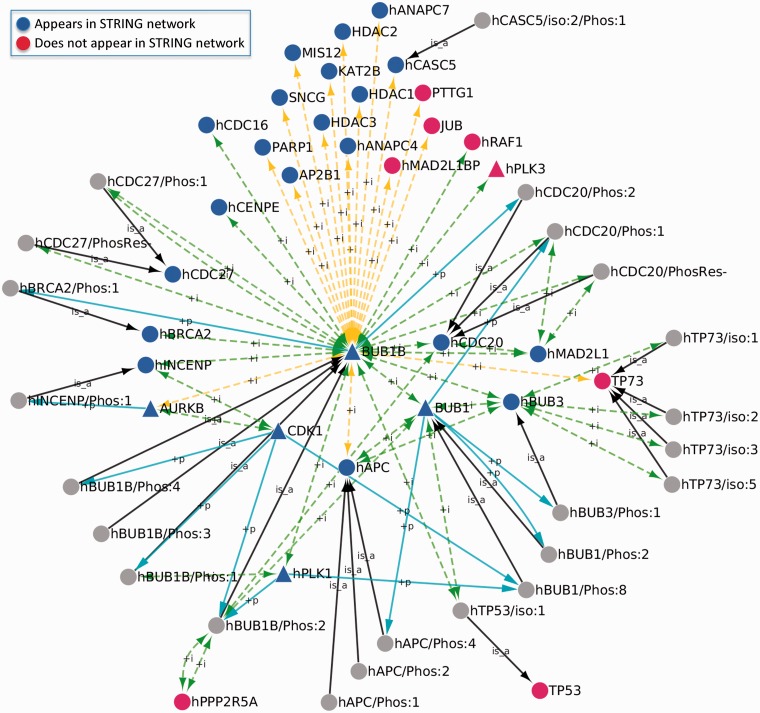
Knowledge representation of the role of phosphorylation is essential for the meaningful understanding of many biological processes. However, such a representation is challenging because proteins can exist in numerous phosphorylated forms with each one having its own characteristic protein-protein interactions (PPIs), functions and subcellular localization. In this article, we evaluate the current state of phosphorylation event curation and then present a bioinformatics framework for the annotation and representation of phosphorylated proteins and construction of phosphorylation networks that addresses some of the gaps in current curation efforts. The integrated approach involves (i) text mining guided by RLIMS-P, a tool that identifies phosphorylation-related information in scientific literature; (ii) data mining from curated PPI databases; (iii) protein form and complex representation using the Protein Ontology (PRO); (iv) functional annotation using the Gene Ontology (GO); and (v) network visualization and analysis with Cytoscape. We use this framework to study the spindle checkpoint, the process that monitors the assembly of the mitotic spindle and blocks cell cycle progression at metaphase until all chromosomes have made bipolar spindle attachments. The phosphorylation networks we construct, centered on the human checkpoint kinase BUB1B (BubR1) and its yeast counterpart MAD3, offer a unique view of the spindle checkpoint that emphasizes biologically relevant phosphorylated forms, phosphorylation-state-specific PPIs and kinase-substrate relationships. Our approach for constructing protein phosphorylation networks can be applied to any biological process that is affected by phosphorylation. Database URL: http://www.yeastgenome.org/
磷酸化作用的知识表示对于理解许多生物过程具有重要意义。然而,这种表示形式具有挑战性,因为蛋白质可以存在于具有各自特征的蛋白质-蛋白质相互作用(PPIs)、功能和亚细胞定位的众多磷酸化形式中。在本文中,我们评估了当前磷酸化事件编纂的状态,然后提出了一种生物信息学框架,用于注释和表示磷酸化蛋白质,并构建磷酸化网络,以解决当前编纂工作中的一些差距。综合方法包括(i)由 RLIMS-P 指导的文本挖掘,RLIMS-P 是一种在科学文献中识别磷酸化相关信息的工具;(ii)从经过编纂的 PPI 数据库中进行数据挖掘;(iii)使用蛋白质本体(PRO)表示蛋白质形式和复合物;(iv)使用基因本体论(GO)进行功能注释;以及(v)使用 Cytoscape 进行网络可视化和分析。我们使用这个框架来研究纺锤体检查点,这个过程监测有丝分裂纺锤体的组装,并在中期阻止细胞周期进程,直到所有染色体都形成双极纺锤体附着。我们构建的以人类检查点激酶 BUB1B(BubR1)及其酵母对应物 MAD3 为中心的磷酸化网络提供了一个独特的纺锤体检查点视图,强调了具有生物学意义的磷酸化形式、磷酸化状态特异性 PPIs 和激酶-底物关系。我们构建蛋白质磷酸化网络的方法可以应用于任何受磷酸化影响的生物过程。数据库 URL:http://www.yeastgenome.org/