Read Jenny C A, Begum Shah Farzana, McDonald Alice, Trowbridge Jack
Institute of Neuroscience, Newcastle University, Framlington Place, Newcastle upon Tyne NE2 4HH, UK; e-mail:
Iperception. 2013 Mar 20;4(2):101-10. doi: 10.1068/i0565. Print 2013.
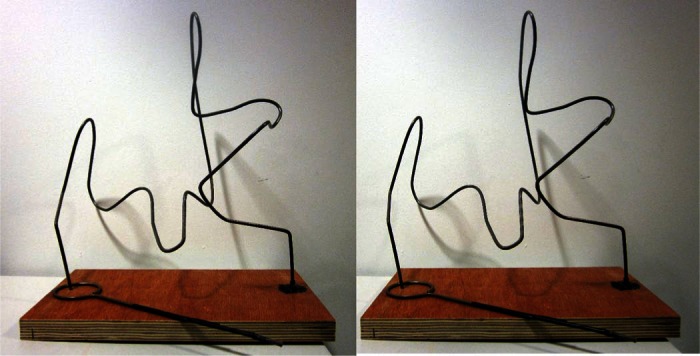
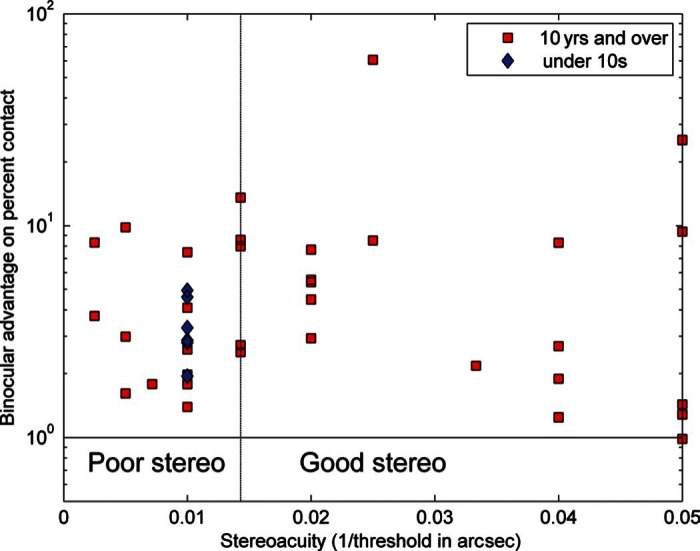
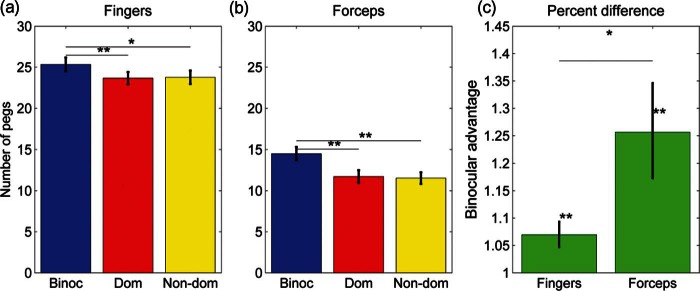
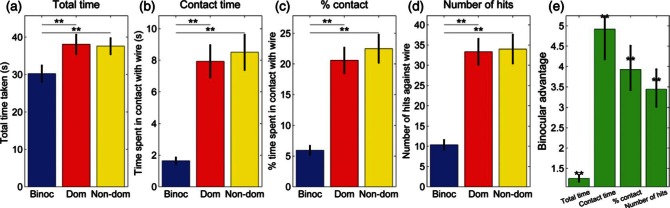
We compared performance on three manual-dexterity tasks under monocular and binocular viewing. The tasks were the standard Morrisby Fine Dexterity Test, using forceps to manipulate the items, a modified version of the Morrisby test using fingers, and a "buzz-wire" task in which subjects had to guide a wire hoop around a 3D track without bringing the hoop into contact with the track. In all three tasks, performance was better for binocular viewing. The extent of the binocular advantage in individuals did not correlate significantly with their stereoacuity measured on the Randot test. However, the extent of the binocular advantage depended strongly on the task. It was weak when fingers were used on the Morrisby task, stronger with forceps, and extremely strong on the buzz-wire task (fivefold increase in error rate with monocular viewing). We suggest that the 3D buzz-wire game is particularly suitable for assessing binocularly based dexterity.
我们比较了单眼和双眼观察条件下在三项手动灵巧性任务中的表现。这些任务包括标准的莫里斯比精细灵巧性测试,即使用镊子操作物品;莫里斯比测试的一个修改版本,使用手指操作;以及一个“嗡嗡线”任务,在该任务中,受试者必须引导一个金属丝环在三维轨道上移动,且环不能与轨道接触。在所有这三项任务中,双眼观察时的表现更好。个体中双眼优势的程度与他们在兰多测试中测得的立体视锐度没有显著相关性。然而,双眼优势的程度在很大程度上取决于任务。在莫里斯比任务中使用手指时优势较弱,使用镊子时优势较强,而在“嗡嗡线”任务中优势极强(单眼观察时错误率增加了五倍)。我们认为三维“嗡嗡线”游戏特别适合评估基于双眼的灵巧性。