Department of Epidemiology and Health Statistics, School of Public Health, Shandong University, Jinan City, Shandong Province, PR China.
PLoS One. 2013 Jun 6;8(6):e65112. doi: 10.1371/journal.pone.0065112. Print 2013.
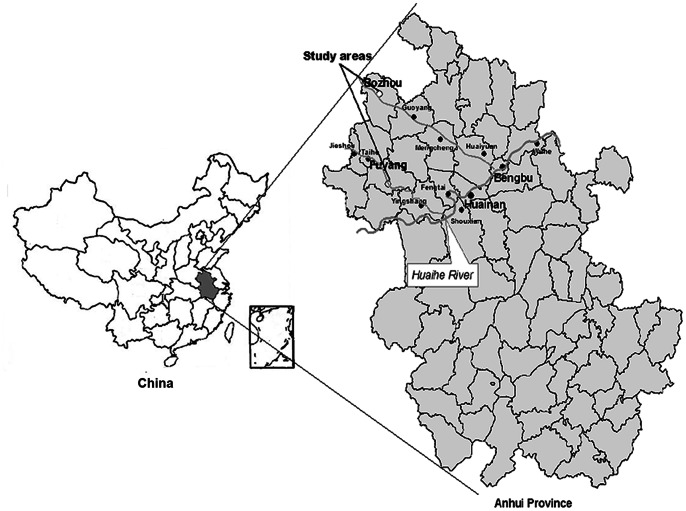
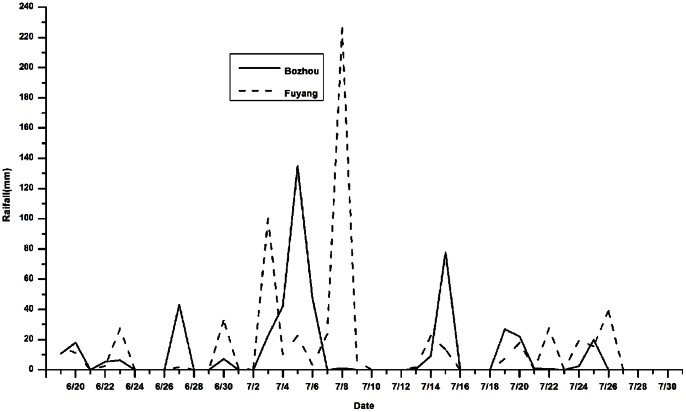
Persistent and heavy rainfall in the upper and middle Huaihe River of China brought about severe floods during the end of June and July 2007. However, there has been no assessment on the association between the floods and infectious diarrhea. This study aimed to quantify the impact of the floods in 2007 on the burden of disease due to infectious diarrhea in northwest of Anhui Province.
A time-stratified case-crossover analysis was firstly conducted to examine the relationship between daily cases of infectious diarrhea and the 2007 floods in Fuyang and Bozhou of Anhui Province. Odds ratios (ORs) of the flood risk were quantified by conditional logistic regression. The years lived with disability (YLDs) of infectious diarrhea attributable to floods were then estimated based on the WHO framework of the calculating potential impact fraction in the Burden of Disease study.
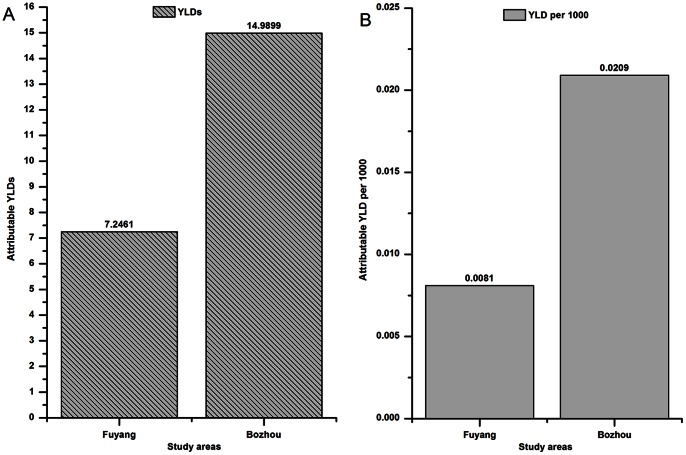
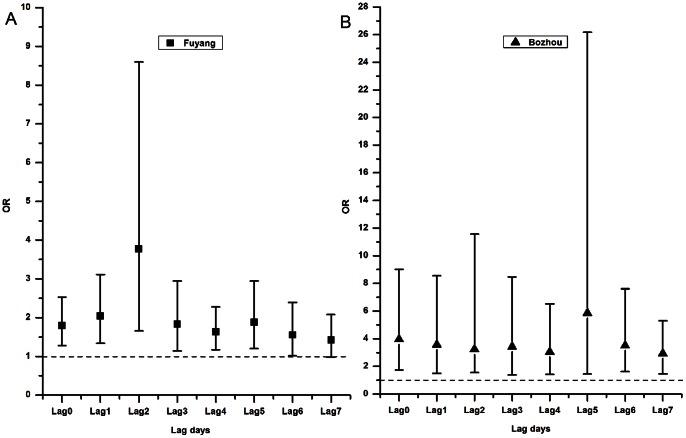
A total of 197 infectious diarrheas were notified during the exposure and control periods in the two study areas. The strongest effect was shown with a 2-day lag in Fuyang and a 5-day lag in Bozhou. Multivariable analysis showed that floods were significantly associated with an increased risk of the number cases of infectious diarrhea (OR = 3.175, 95%CI: 1.126-8.954 in Fuyang; OR = 6.754, 95%CI: 1.954-23.344 in Bozhou). Attributable YLD per 1000 of infectious diarrhea resulting from the floods was 0.0081 in Fuyang and 0.0209 in Bozhou.
Our findings confirm that floods have significantly increased the risks of infectious diarrhea in the study areas. In addition, prolonged moderate flood may cause more burdens of infectious diarrheas than severe flood with a shorter duration. More attention should be paid to particular vulnerable groups, including younger children and elderly, in developing public health preparation and intervention programs. Findings have significant implications for developing strategies to prevent and reduce health impact of floods.
2007 年 6 月末至 7 月,中国淮河流域中上游持续强降雨引发严重洪涝灾害,但目前尚无研究评估洪水与感染性腹泻之间的关联。本研究旨在定量评估 2007 年洪水对安徽省西北部感染性腹泻疾病负担的影响。
首先采用时间分层病例交叉研究,分析安徽省阜阳市和亳州市每日感染性腹泻病例与 2007 年洪水的关系。采用条件 logistic 回归量化洪水风险的比值比(OR)。基于世界卫生组织疾病负担研究中计算潜在影响分数的框架,估算洪水导致的感染性腹泻伤残调整生命年(YLD)。
在两个研究地区的暴露期和对照期共报告了 197 例感染性腹泻。在阜阳市,最强的关联出现在滞后 2 天,而在亳州市,最强的关联出现在滞后 5 天。多变量分析表明,洪水与感染性腹泻病例数增加显著相关(阜阳市 OR=3.175,95%CI:1.126-8.954;亳州市 OR=6.754,95%CI:1.954-23.344)。洪水导致的每 1000 例感染性腹泻的归因 YLD 在阜阳市为 0.0081,在亳州市为 0.0209。
我们的研究结果证实,洪水显著增加了研究地区感染性腹泻的风险。此外,持续时间较长的中度洪水可能会导致比持续时间较短的重度洪水造成更多的感染性腹泻负担。在制定公共卫生准备和干预计划时,应特别关注包括幼儿和老年人在内的弱势群体。这些发现对于制定预防和减轻洪水健康影响的策略具有重要意义。