Adaptation Physiology Group, Department of Animal Sciences, Wageningen University, Wageningen, The Netherlands.
PLoS One. 2013 Jun 6;8(6):e65136. doi: 10.1371/journal.pone.0065136. Print 2013.
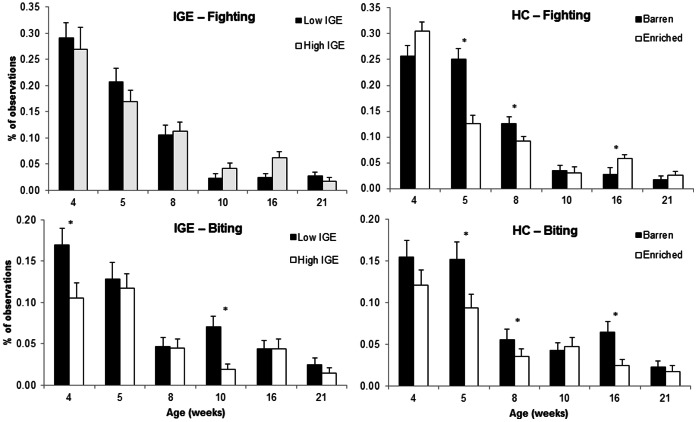
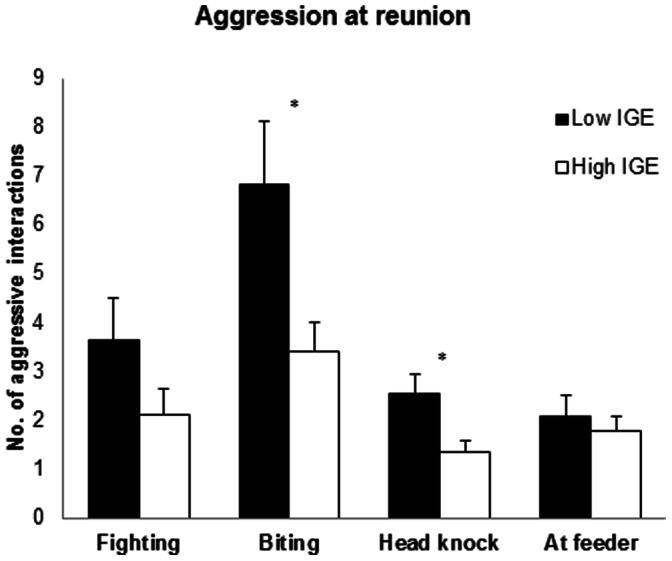
Indirect Genetic Effects (IGEs), also known as associative effects, are the heritable effects that an individual has on the phenotype of its social partners. Selection for IGEs has been proposed as a method to reduce harmful behaviours, in particular aggression, in livestock and aquaculture. The mechanisms behind IGEs, however, have rarely been studied. The objective was therefore to assess aggression in pigs which were divergently selected for IGEs on growth (IGEg). In a one generation selection experiment, we studied 480 offspring of pigs (Sus scrofa) that were selected for relatively high or low IGEg and housed in homogeneous IGEg groups in either barren or enriched environments. Skin lesion scores, a proxy measure of aggression, and aggressive behaviours were recorded. The two distinct IGEg groups did not differ in number of skin lesions, or in amount of reciprocal fighting, both under stable social conditions and in confrontation with unfamiliar pigs in a 24 h regrouping test. Pigs selected for a positive effect on the growth of their group members, however, performed less non-reciprocal biting and showed considerably less aggression at reunion with familiar group members after they had been separated during a 24 h regrouping test. The enriched environment was associated with more skin lesions but less non-reciprocal biting under stable social conditions. Changes in aggression between pigs selected for IGEg were not influenced by G×E interactions with regard to the level of environmental enrichment. It is likely that selection on IGEg targets a behavioural strategy, rather than a single behavioural trait such as aggressiveness.
间接遗传效应(IGEs),也称为关联效应,是指个体对其社交伙伴表型的可遗传影响。选择 IGEs 已被提议作为减少家畜和水产养殖中有害行为(特别是攻击性)的一种方法。然而,IGEs 的机制很少被研究。因此,本研究的目的是评估在生长(IGEg)方面具有不同 IGEs 选择的猪的攻击性。在一代选择实验中,我们研究了 480 头猪(Sus scrofa)的后代,这些猪因相对较高或较低的 IGEg 而被选择,并在贫瘠或丰富的环境中以同质的 IGEg 群体饲养。记录了皮肤损伤评分,这是攻击性的一个替代指标,以及攻击性行为。这两个不同的 IGEg 群体在皮肤损伤数量或相互攻击的程度上没有差异,无论是在稳定的社会条件下还是在与陌生猪的 24 小时重新分组测试中。然而,选择对其群体成员的生长有积极影响的猪,在与熟悉的群体成员团聚时,表现出较少的非相互攻击的咬伤,并且攻击性明显较低,因为它们在 24 小时的重新分组测试中被分开了一段时间。在稳定的社会条件下,丰富的环境与更多的皮肤损伤有关,但非相互攻击的咬伤较少。在环境丰富度方面,与 IGEg 选择相关的攻击性变化不受 G×E 相互作用的影响。IGEg 的选择可能针对的是一种行为策略,而不是单一的行为特征,如攻击性。