Organ Transplant Center, the First Affiliated Hospital, Sun Yat-sen University, Guangzhou, China.
PLoS One. 2013 Jun 7;8(6):e66382. doi: 10.1371/journal.pone.0066382. Print 2013.
It is of importance to minimize ischemia reperfusion (I/R) injury during liver operations. Reducing the inflammatory reaction is an effective way to achieve this goal. Notably, adiponectin (APN) was found to have anti-inflammatory activity in heart and renal I/R injury. Herein, we investigated the role of APN in liver I/R injury.
WISTAR RATS WERE RANDOMIZED TO FOUR GROUPS: (1) sham group; (2) I/R control group; (3) I/R+APN group; and (4) I/R+APN+AMPK inhibitor group. Liver and blood samples were collected 6h and 24h after reperfusion. Liver function and histopathologic changes were assessed. Macrophage and neutrophil infiltration was detected by immunohistochemistry staining, while pro-inflammatory cytokines and chemokines released in the liver were measured using ELISA and RT-PCR, respectively. Apoptosis was analyzed by TUNEL staining and caspase-3 expression in the liver. Downstream molecules of APN were investigated by Western blotting.
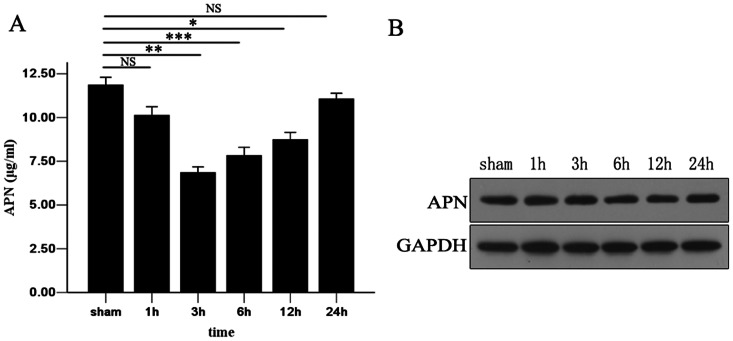
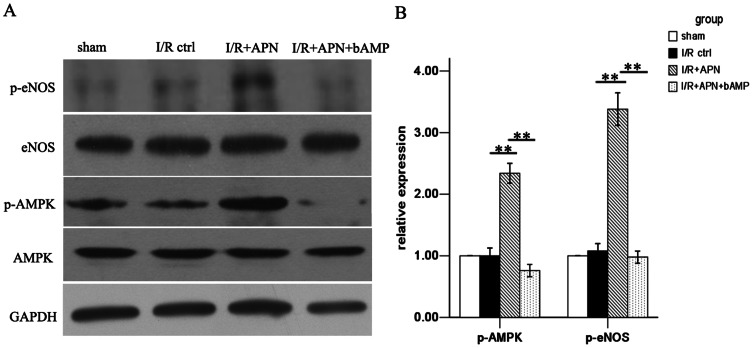
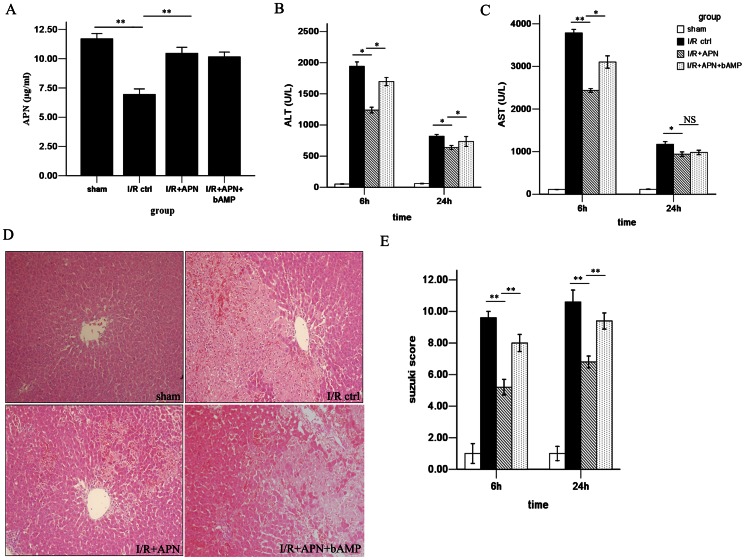
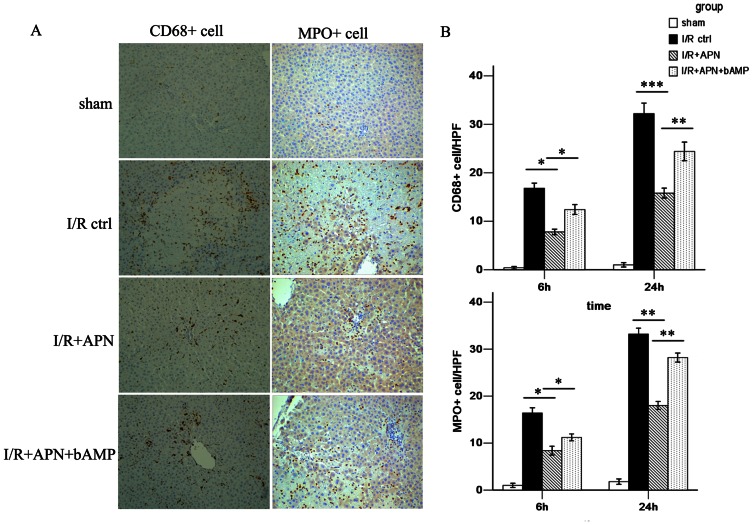
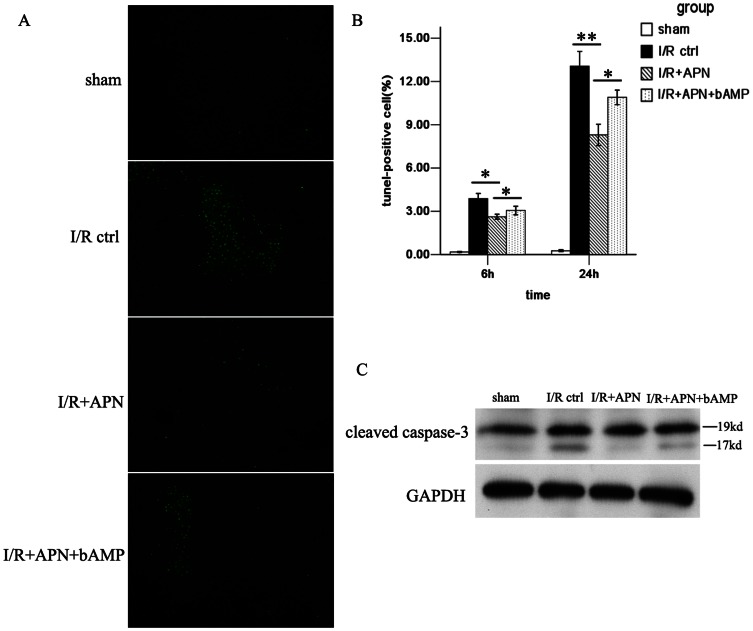
Circulatory APN was down-regulated during liver I/R. When exogenous APN treatment was administered during liver I/R, alanine transaminase (ALT) and aspartate aminotransferase (AST) were decreased, and less hepatocyte necrosis was observed. Less inflammatory cell infiltration and pro-inflammatory cytokines/chemokines release were also observed in the I/R+APN group when compared with the I/R control group. APN treatment also reduced hepatocyte apoptosis, evidenced by reduced TUNEL positive cells and less caspase-3 expression in the reperfused liver. Finally, the AMPK/eNOS pathway was found to be activated by APN, and administration of an AMPK inhibitor reversed the beneficial effects of APN.
APN can protect the liver from I/R injury by reducing the inflammatory response and hepatocyte apoptosis, a process that likely involves the AMPK/eNOS pathway. The current study provides a potential pharmacologic target for liver I/R injury.
在肝脏手术中,尽量减少缺血再灌注(I/R)损伤非常重要。减少炎症反应是实现这一目标的有效途径。值得注意的是,脂联素(APN)在心脏和肾脏 I/R 损伤中具有抗炎活性。在此,我们研究了 APN 在肝 I/R 损伤中的作用。
WISTAR 大鼠随机分为四组:(1)假手术组;(2)I/R 对照组;(3)I/R+APN 组;(4)I/R+APN+AMPK 抑制剂组。再灌注后 6h 和 24h 采集肝脏和血液样本。评估肝功能和组织病理学变化。通过免疫组织化学染色检测巨噬细胞和中性粒细胞浸润,通过 ELISA 和 RT-PCR 分别测量肝脏中释放的促炎细胞因子和趋化因子。通过 TUNEL 染色和肝脏中 caspase-3 的表达分析细胞凋亡。通过 Western blot 检测 APN 的下游分子。
循环 APN 在肝 I/R 期间下调。当在肝 I/R 期间给予外源性 APN 治疗时,丙氨酸氨基转移酶(ALT)和天冬氨酸氨基转移酶(AST)降低,且观察到较少的肝细胞坏死。与 I/R 对照组相比,I/R+APN 组的炎症细胞浸润和促炎细胞因子/趋化因子释放也较少。APN 治疗还减少了肝实质细胞凋亡,表现为再灌注肝脏中 TUNEL 阳性细胞减少和 caspase-3 表达减少。最后,发现 APN 激活了 AMPK/eNOS 通路,而 AMPK 抑制剂的给药逆转了 APN 的有益作用。
APN 通过减少炎症反应和肝实质细胞凋亡来保护肝脏免受 I/R 损伤,这一过程可能涉及 AMPK/eNOS 通路。本研究为肝 I/R 损伤提供了一个潜在的药物靶点。