Centre de recherche de la Tour du Valat Le Sambuc, 13200, Arles, France ; Centre d'Ecologie Fonctionnelle et Evolutive, CNRS UMR 5175 1919 route de Mende, 34293, Montpellier cedex 5, France.
Ecol Evol. 2013 May;3(5):1413-25. doi: 10.1002/ece3.554. Epub 2013 Apr 12.
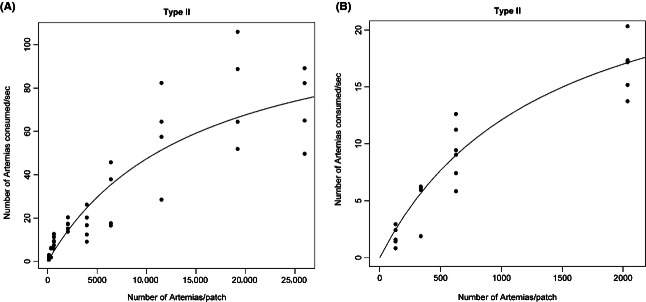
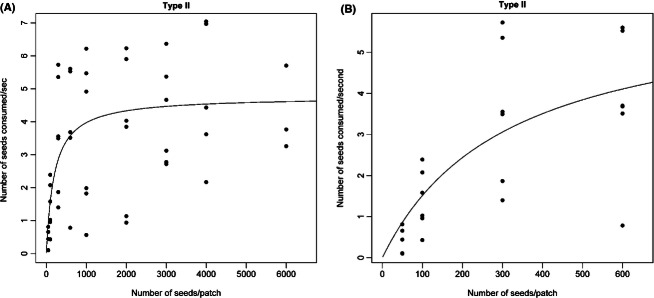
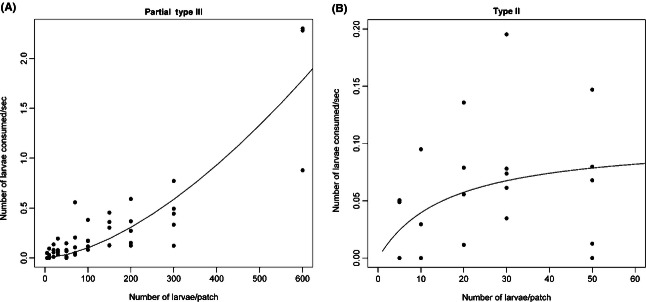
Accurate knowledge of the functional response of predators to prey density is essential for understanding food web dynamics, to parameterize mechanistic models of animal responses to environmental change, and for designing appropriate conservation measures. Greater flamingos (Phoenicopterus roseus), a flagship species of Mediterranean wetlands, primarily feed on Artemias (Artemia spp.) in commercial salt pans, an industry which may collapse for economic reasons. Flamingos also feed on alternative prey such as Chironomid larvae (e.g., Chironomid spp.) and rice seeds (Oryza sativa). However, the profitability of these food items for flamingos remains unknown. We determined the functional responses of flamingos feeding on Artemias, Chironomids, or rice. Experiments were conducted on 11 captive flamingos. For each food item, we offered different ranges of food densities, up to 13 times natural abundance. Video footage allowed estimating intake rates. Contrary to theoretical predictions for filter feeders, intake rates did not increase linearly with increasing food density (type I). Intake rates rather increased asymptotically with increasing food density (type II) or followed a sigmoid shape (type III). Hence, flamingos were not able to ingest food in direct proportion to their abundance, possibly because of unique bill structure resulting in limited filtering capabilities. Overall, flamingos foraged more efficiently on Artemias. When feeding on Chironomids, birds had lower instantaneous rates of food discovery and required more time to extract food from the sediment and ingest it, than when filtering Artemias from the water column. However, feeding on rice was energetically more profitable for flamingos than feeding on Artemias or Chironomids, explaining their attraction for rice fields. Crucially, we found that food densities required for flamingos to reach asymptotic intake rates are rarely met under natural conditions. This allows us to predict an immediate negative effect of any decrease in prey density upon flamingo foraging performance.
准确了解捕食者对猎物密度的功能反应对于理解食物网动态、将动物对环境变化的反应机制模型参数化以及设计适当的保护措施至关重要。大火烈鸟(Phoenicopterus roseus)是地中海湿地的旗舰物种,主要以商业盐田中生产的卤虫(Artemia spp.)为食,而这一产业可能因经济原因而崩溃。火烈鸟也以其他替代猎物为食,例如摇蚊幼虫(例如,Chironomid spp.)和稻种(Oryza sativa)。但是,这些食物对火烈鸟的利润仍然未知。我们确定了火烈鸟以卤虫、摇蚊或稻种为食的功能反应。在 11 只圈养的火烈鸟身上进行了实验。对于每种食物,我们提供了不同范围的食物密度,最高可达自然丰度的 13 倍。视频片段可用于估算摄食率。与过滤觅食者的理论预测相反,摄食率并未随食物密度的增加而呈线性增加(I 型)。摄食率随着食物密度的增加而呈渐近增加(II 型)或呈 S 形增加(III 型)。因此,火烈鸟无法按照其丰度的比例摄取食物,这可能是由于独特的喙结构导致过滤能力有限。总的来说,火烈鸟对卤虫的觅食效率更高。当以摇蚊为食时,鸟类发现食物的即时率较低,并且需要更多的时间从沉积物中提取食物并将其吞咽,比从水柱中过滤卤虫时需要更多的时间。然而,与吃卤虫或摇蚊相比,火烈鸟吃稻种的能量更有利可图,这解释了它们对稻田的吸引力。至关重要的是,我们发现火烈鸟达到渐近摄食率所需的食物密度在自然条件下很少满足。这使我们可以预测任何猎物密度下降对火烈鸟觅食行为的直接负面影响。