Kalakonda Butchibabu, Pradeep Koppolu, Mishra Ashank, Reddy Krishnanjaneya, Muralikrishna Tupili, Lakshmi Vijaya, Challa Radhika
Department of Periodontics, Sri Sai College of Dental Surgery, Vikarabad 501101, India.
Case Rep Dent. 2013;2013:517145. doi: 10.1155/2013/517145. Epub 2013 May 20.
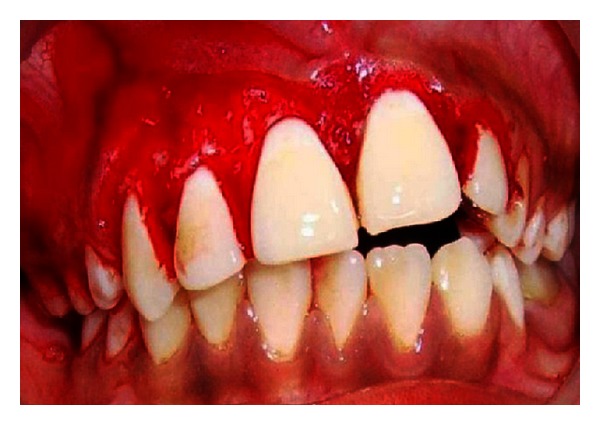
Sturge-Weber syndrome (SWS) is a sporadic disorder and is frequent among the neurocutaneous syndromes specifically with vascular predominance. This syndrome consists of constellation of clinical features like facial nevus, seizures, hemiparesis, intracranial calcifications, and mental retardation. It is characterized by focal port-wine stain, ocular abnormalities (glaucoma), and choroidal hemangioma and leptomeningeal angioma most often involving occipital and parietal lobes. The present paper reports three cases of SWS with oral manifestations and periodontal management, which included thorough scaling and root planing followed by gingivectomy with scalpel and laser in cases 1 and 3 consecutively to treat the gingival enlargement. However, the treatment in case 2 was deferred as the patient was not a candidate for periodontal surgery.
斯特奇-韦伯综合征(SWS)是一种散发性疾病,在以血管病变为主的神经皮肤综合征中较为常见。该综合征由一系列临床特征组成,如面部痣、癫痫、偏瘫、颅内钙化和智力发育迟缓。其特征为局限性葡萄酒色斑、眼部异常(青光眼)、脉络膜血管瘤和软脑膜血管瘤,最常累及枕叶和顶叶。本文报告了3例伴有口腔表现的SWS病例及其牙周治疗情况,其中病例1和病例3连续进行了彻底的龈上洁治和根面平整,随后分别用手术刀和激光进行牙龈切除术以治疗牙龈增生。然而,病例2的治疗被推迟,因为该患者不适合进行牙周手术。