The Wallace H. Coulter Department of Biomedical Engineering, School of Chemistry and Biochemistry, Georgia Institute of Technology, Atlanta, Georgia 30332, United States.
ACS Appl Mater Interfaces. 2013 Jul 10;5(13):6391-9. doi: 10.1021/am4015633. Epub 2013 Jun 25.
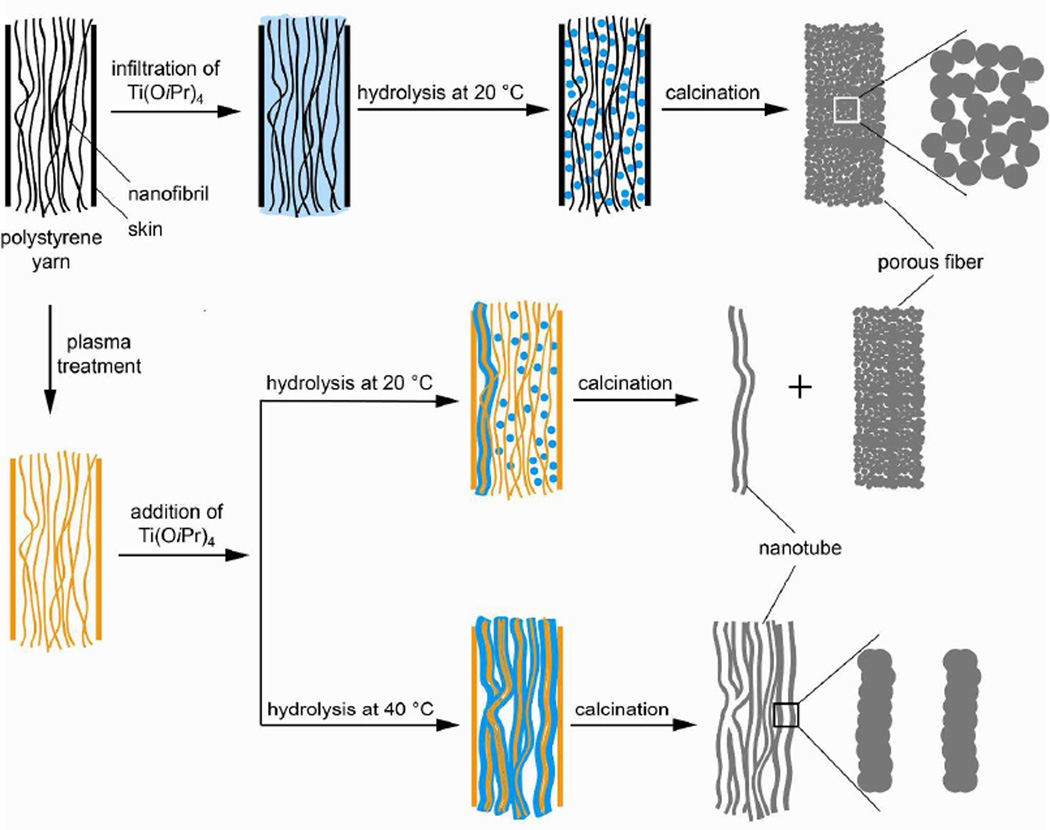
This Article describes a facile approach to the synthesis of rutile nanostructures in the form of porous fibers or bundles of nanotubes by maneuvering the surface wettability of yarns made of polystyrene nanofibrils. Specifically, hierarchically porous fibers were obtained by hydrolyzing titanium tetraisopropoxide to form TiO2 nanoparticles in the void spaces among hydrophobic nanofibrils in each yarn. After calcination in air at 800 °C, the resultant fibers were comprised of many interconnected rutile nanoparticles whose diameters were in the range 20-80 nm. After converting the nanofibrils and yarns into hydrophilic surfaces through plasma treatment, however, the TiO2 formed conformal coatings on the surfaces of nanofibrils in each yarn during hydrolysis instead of just filling the void spaces among the nanofibrils. As a result, bundles of rutile nanotubes were obtained after the sample had been calcined in air at 800 °C. The thermodynamically stable rutile nanostructures were then explored as supports for Pt nanoparticles whose catalytic activity was evaluated using the reduction of p-nitrophenol by NaBH4. The Pt supported on porous rutile fibers exhibited a better performance than the Pt on rutile nanotubes in terms of both induction time (t(ind)) and apparent rate constant (k(app)).
本文描述了一种通过操纵由聚苯乙烯纳米纤维制成的纱线的表面润湿性来合成锐钛矿纳米结构的简便方法,其形式为多孔纤维或纳米管束。具体而言,通过将钛四异丙醇酯水解以在每个纱线中的疏水性纳米纤维之间的空隙中形成 TiO2 纳米颗粒,从而获得具有分级多孔的纤维。在 800°C 的空气中煅烧后,所得纤维由许多相互连接的锐钛矿纳米颗粒组成,其直径在 20-80nm 范围内。然而,通过等离子体处理将纳米纤维和纱线转化为亲水性表面后,TiO2 在水解过程中在每个纱线中的纳米纤维表面上形成了共形涂层,而不仅仅是填充纳米纤维之间的空隙。因此,在将样品在 800°C 的空气中煅烧后,得到了锐钛矿纳米管束。然后,探索了热力学稳定的锐钛矿纳米结构作为 Pt 纳米颗粒的载体,并用 NaBH4 还原对硝基苯酚来评估其催化活性。与负载在锐钛矿纳米管上的 Pt 相比,负载在多孔锐钛矿纤维上的 Pt 在诱导时间(t(ind))和表观速率常数(k(app))方面都表现出更好的性能。