Montero-Marín Jesús, Asún Sonia, Estrada-Marcén Nerea, Romero Rosario, Asún Roberto
Departamento de Medicina y Psiquiatría, Universidad de Zaragoza, Zaragoza, España.
Aten Primaria. 2013 Aug-Sep;45(7):376-83. doi: 10.1016/j.aprim.2013.03.002. Epub 2013 Jun 12.
To study the influence of a short programme of stretching exercises on anxiety levels of workers in a Spanish logistic company.
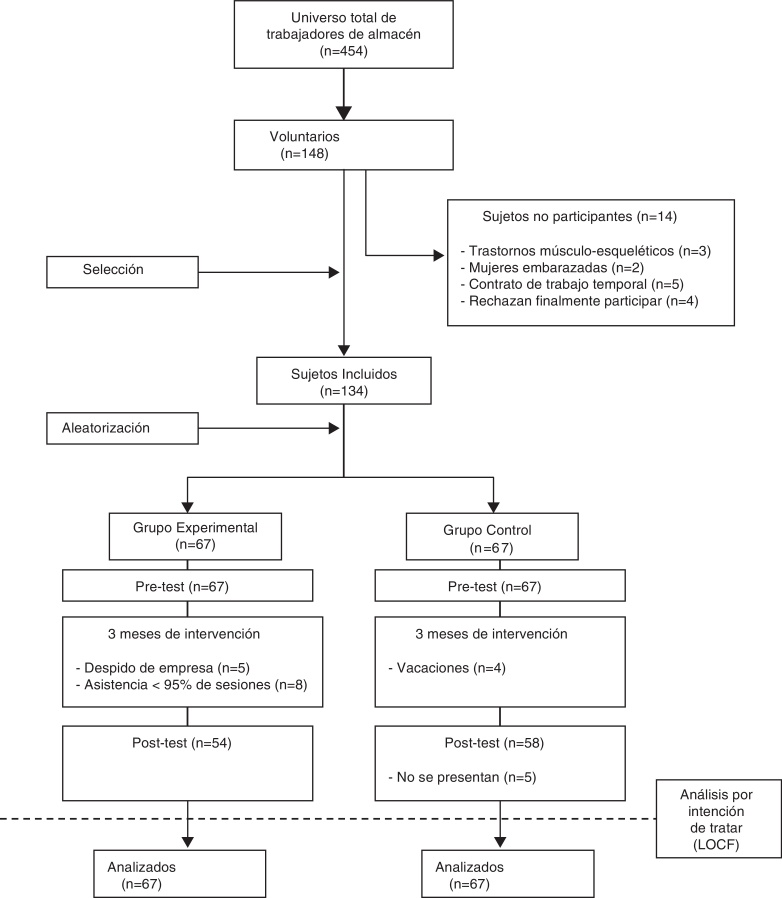
A controlled clinical trial was carried out by means of an inter-subject design of random homogeneous blocks. Participants were assigned to the experimental group (n=67), treated with a programme of stretching exercises of 10-minute duration after working hours for a period of 3 months, or to the untreated control group (n=67). The primary result variable was anxiety, and the secondary variables were burnout syndrome, quality of life and flexibility. An analysis of covariance (ANCOVA) by intention to treat was performed on each of the result variables by controlling the baseline scores, the age and the practice of introjective activities outside the program, with the size effect calculated by means of the partial eta-squared value (η(2)).
The results of the ANCOVA showed a moderate effect of the stretching exercise programme on the levels of anxiety (η(2)=0,06; P=.004). Other effects found were substantial for flexibility (η(2)=0,13; P<.001); moderately high for bodily pain (η(2)=0,08; P=.001), and moderate for vitality (η(2)=0,05; P=.016); mental health (η(2)=0,05; P=.017); general health (η(2)=0,04; P=.028) and exhaustion (η(2)=0,04; P=.025).
The implementation of a short programme of stretching exercises in the work place was effective for reducing levels of anxiety, bodily pain and exhaustion, and for raising levels of vitality, mental health, general health and flexibility. This type of intervention could be seen as a low-cost strategy for improving the well-being of workers.
研究短期伸展运动计划对一家西班牙物流公司员工焦虑水平的影响。
采用随机同质区组的组间设计进行对照临床试验。参与者被分配到实验组(n = 67),在工作时间后接受为期10分钟的伸展运动计划治疗,为期3个月,或分配到未接受治疗的对照组(n = 67)。主要结果变量是焦虑,次要变量是倦怠综合征、生活质量和柔韧性。通过意向性分析的协方差分析(ANCOVA)对每个结果变量进行分析,控制基线分数、年龄和计划外内摄性活动的实践情况,并通过偏 eta 平方值(η(2))计算效应量。
ANCOVA 的结果显示,伸展运动计划对焦虑水平有中等程度的影响(η(2)=0.06;P = 0.004)。发现的其他影响在柔韧性方面较大(η(2)=0.13;P < 0.001);在身体疼痛方面中等偏高(η(2)=0.08;P = 0.001),在活力方面中等(η(2)=0.05;P = 0.016);心理健康方面(η(2)=0.05;P = 0.017);总体健康方面(η(2)=0.04;P = 0.028)和疲惫方面(η(2)=0.04;P = 0.025)。
在工作场所实施短期伸展运动计划可有效降低焦虑水平、身体疼痛和疲惫,并提高活力、心理健康、总体健康和柔韧性水平。这种干预类型可被视为改善员工福祉的低成本策略。