Yuan Ting, Liao Wei, Feng Nian-Hua, Lou Yuan-Lei, Niu Xin, Zhang Ai-Jun, Wang Yang, Deng Zhi-Feng
Stem Cell Res Ther. 2013 Jun 14;4(3):73. doi: 10.1186/scrt224.
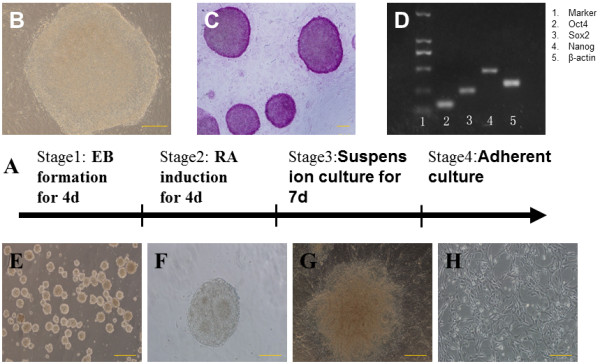
Stroke is a major cause of permanent neurologic damage, with few effective treatments available to restore lost function. Induced pluripotent stem cells (iPSCs) have the potential to generate all cell types in vitro and can be generated from a stroke patient. Therefore, iPSCs are attractive donor sources of genetically identical "patient-specific" cells to hold promise in therapy for stroke. In the present study, we established a four-stage culture system by using serum-free medium and retinoic acid (RA) to differentiate iPSCs into neural stem cells (NSCs) effectively and stably. Our hypothesis was that iPSC-derived NSCs would survive, migrate, and differentiate in vivo, and improve neurologic function after transplantation into the brains of rats with ischemic stroke.
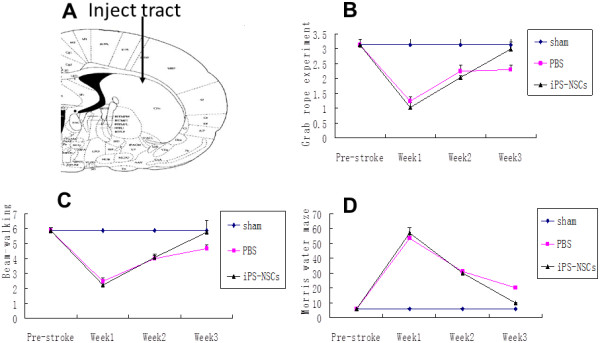
Human iPSCs (iPS-S-01) and human ESCs (HuES17) were used to differentiate into NSCs by using our four-stage culture system. iPSCs and differentiated NSCs were characterized by immunocytochemistry staining and reverse transcription-polymerase chain reaction (RT-PCR) analysis. After establishment of focal cerebral ischemia with occlusion of the middle cerebral artery (MCA) and cell transplantation, animals were killed at 1 week and 2 weeks to analyze survival, migration, and differentiation of implanted cells in brain tissue. Animal behavior was evaluated via rope grabbing, beam walking, and Morris water maze tests.
iPSCs were efficiently induced into NSCs by using a newly established four-stage induction system in vitro. iPSCs expressed pluripotency-associated genes Oct4, Sox2, and Nanog before NSC differentiation. The iPSC-derived NSCs spontaneously differentiated into neurons and astrocytes, which highly express β-tubulin and glial fibrillary acidic protein (GFAP), respectively. On transplantation into the striatum, CM-DiI labeled iPSC-derived NSCs were found to migrate into the ischemia area at 1 week and 2 weeks, and animal-function recovery was significantly improved in comparison with control groups at 3 weeks.
The four-stage induction system is stable and effective to culture, differentiate, and induce iPSCs to NSCs by using serum-free medium combined with retinoic acid (RA). Implanted iPSC-derived NSCs were able to survive, migrate into the ischemic brain area to differentiate into mature neural cells, and seem to have potential to restore lost neurologic function from damage due to stroke in a rat model.
中风是永久性神经损伤的主要原因,几乎没有有效的治疗方法可恢复丧失的功能。诱导多能干细胞(iPSC)有潜力在体外生成所有细胞类型,并且可以从中风患者体内获取。因此,iPSC作为基因相同的“患者特异性”细胞的有吸引力的供体来源,有望用于中风治疗。在本研究中,我们使用无血清培养基和视黄酸(RA)建立了一个四阶段培养系统,以有效且稳定地将iPSC分化为神经干细胞(NSC)。我们的假设是,iPSC来源的NSC在体内能够存活、迁移和分化,并在移植到缺血性中风大鼠脑内后改善神经功能。
使用人iPSC(iPS-S-01)和人胚胎干细胞(HuES17)通过我们的四阶段培养系统分化为NSC。通过免疫细胞化学染色和逆转录-聚合酶链反应(RT-PCR)分析对iPSC和分化的NSC进行表征。在通过大脑中动脉(MCA)闭塞建立局灶性脑缺血并进行细胞移植后,在1周和2周处死动物,以分析植入细胞在脑组织中的存活、迁移和分化情况。通过抓绳、走杆和莫里斯水迷宫试验评估动物行为。
在体外使用新建立的四阶段诱导系统可有效将iPSC诱导为NSC。在NSC分化之前,iPSC表达多能性相关基因Oct4、Sox2和Nanog。iPSC来源的NSC自发分化为神经元和星形胶质细胞,分别高表达β-微管蛋白和胶质纤维酸性蛋白(GFAP)。移植到纹状体后,发现CM-DiI标记的iPSC来源的NSC在1周和2周时迁移到缺血区域,并且在3周时与对照组相比动物功能恢复明显改善。
四阶段诱导系统通过使用无血清培养基结合视黄酸(RA)来培养、分化和诱导iPSC成为NSC是稳定且有效的。植入的iPSC来源的NSC能够存活,迁移到缺血脑区分化为成熟神经细胞,并且似乎有潜力恢复大鼠模型中因中风损伤而丧失的神经功能。