Dental and Craniofacial Research Institute and Section of Orthodontics, School of Dentistry, University of California, Los Angeles, Los Angeles, CA, USA.
Department of Chemistry and Biochemistry, University of California, Los Angeles, Los Angeles, CA, USA.
Biochem Biophys Res Commun. 2013 Jul 5;436(3):530-535. doi: 10.1016/j.bbrc.2013.06.005. Epub 2013 Jun 11.
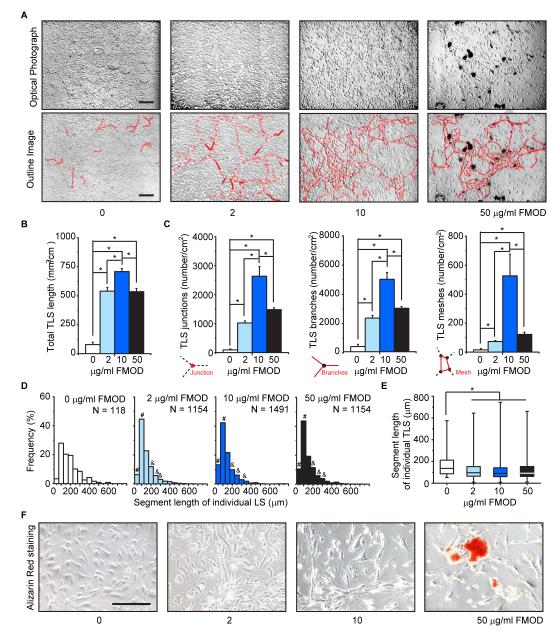
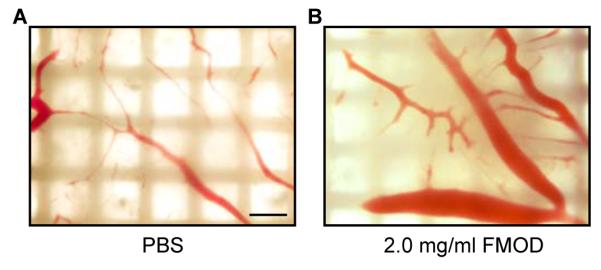
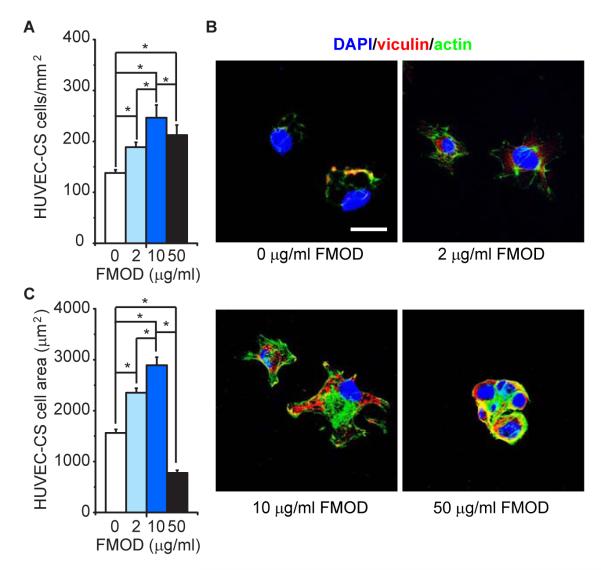
Fibromodulin (FMOD) is an extracellular matrix (ECM) small leucine-rich proteoglycan (SLRP) that plays an important role in cell fate determination. Previous studies revealed that not only is FMOD critical in fetal-type scarless wound healing, but it also promotes adult wound closure and reduces scar formation. In addition, FMOD-deficient mice exhibit significantly reduced blood vessel regeneration in granulation tissues during wound healing. In this study, we investigated the effects of FMOD on angiogenesis, which is an important event in wound healing as well as embryonic development and tumorigenesis. We found that FMOD accelerated human umbilical vein endothelial HUVEC-CS cell adhesion, spreading, actin stress fiber formation, and eventually tube-like structure (TLS) network establishment in vitro. On a molecular level, by increasing expression of collagen I and III, angiopoietin (Ang)-2, and vascular endothelial growth factor (VEGF), as well as reducing the ratio of Ang-1/Ang-2, FMOD provided a favorable network to mobilize quiescent endothelial cells to an angiogenic phenotype. Moreover, we also confirmed that FMOD enhanced angiogenesis in vivo by using an in ovo chick embryo chorioallantoic membrane (CAM) assay. Therefore, our data demonstrate that FMOD is a pro-angiogenic and suggest a potential therapeutic role of FMOD in the treatment of conditions related to impaired angiogenesis.
纤调蛋白(FMOD)是细胞外基质(ECM)中的一种小分子富含亮氨酸的蛋白聚糖(SLRP),在细胞命运决定中起着重要作用。先前的研究表明,FMOD 不仅在胎儿型无瘢痕伤口愈合中至关重要,而且还促进成人伤口闭合并减少瘢痕形成。此外,FMOD 缺陷小鼠在伤口愈合过程中的肉芽组织中血管再生明显减少。在这项研究中,我们研究了 FMOD 对血管生成的影响,血管生成是伤口愈合以及胚胎发育和肿瘤发生中的一个重要事件。我们发现 FMOD 可加速人脐静脉内皮细胞 HUVEC-CS 细胞在体外的黏附、铺展、肌动蛋白应力纤维形成,最终形成管状结构(TLS)网络。在分子水平上,通过增加胶原 I 和 III、血管生成素(Ang)-2 和血管内皮生长因子(VEGF)的表达,并降低 Ang-1/Ang-2 的比例,FMOD 提供了一个有利的网络,将静止的内皮细胞动员到血管生成表型。此外,我们还通过鸡胚尿囊膜(CAM)实验证实 FMOD 可增强体内血管生成。因此,我们的数据表明 FMOD 是一种促血管生成的物质,并提示 FMOD 在治疗与血管生成受损相关的疾病方面具有潜在的治疗作用。