Department of Neuroscience, Rehabilitation, Ophthalmology, Genetics, Maternal and Child Health, University of Genoa, Genoa, Italy.
Sci Rep. 2013;3:2001. doi: 10.1038/srep02001.
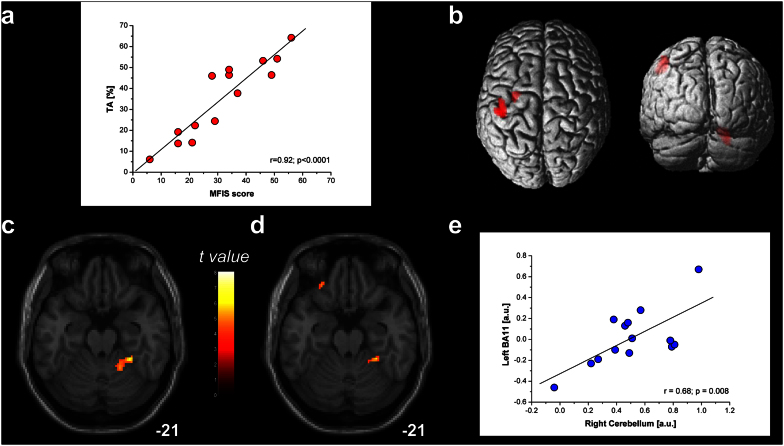
Subjective fatigue is a typical symptom in Multiple Sclerosis (MS) even in the earliest stages of the disease. The relationship between persistent fatigue and motor task performance is still unclear. Aim of this study was to better investigate this relationship at both the motor behavioral and neuroanatomical levels. Towards this goal, we combined a quantitative evaluation of an undemanding finger motor task with concurrent brain functional magnetic resonance imaging (fMRI) in a group of MS patients with minimal disability but reporting persistent subjective fatigue. We found an unexpected significant positive correlation between persistent subjective fatigue and task-related temporal accuracy, revealing a "fatigue-motor performance paradox". fMRI analysis indicated that this association is potentially mediated by cerebellar and orbitofrontal cortex activity, suggesting a role of these regions in developing subjective fatigue. Our data point to a possible adaptive role for fatigue as the subjective correlate of increased resource demand for motor activities.
主观疲劳是多发性硬化症(MS)的典型症状,即使在疾病的早期阶段也是如此。持续性疲劳与运动任务表现之间的关系仍不清楚。本研究的目的是在运动行为和神经解剖学水平上更好地研究这种关系。为此,我们将一项简单的手指运动任务的定量评估与同时进行的脑功能磁共振成像(fMRI)相结合,对一组报告持续性主观疲劳但残疾程度最小的 MS 患者进行了研究。我们发现持续性主观疲劳与任务相关的时间准确性之间存在意外的显著正相关,揭示了“疲劳-运动表现悖论”。fMRI 分析表明,这种关联可能由小脑和眶额皮层活动介导,提示这些区域在产生主观疲劳方面的作用。我们的数据表明,疲劳可能具有适应性作用,是运动活动中资源需求增加的主观相关因素。