Department of Plant Pathology, Kansas State University, Manhattan, Kansas 66506, USA.
Nat Commun. 2013;4:1996. doi: 10.1038/ncomms2996.
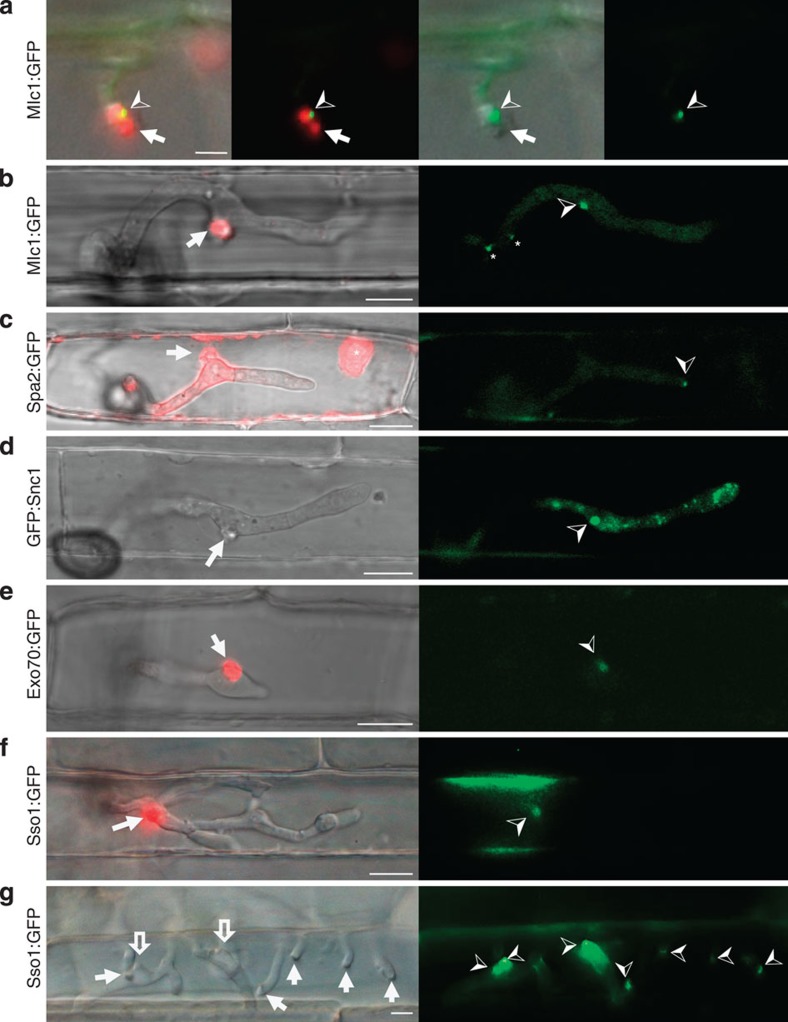
To cause plant diseases, pathogenic micro-organisms secrete effector proteins into host tissue to suppress immunity and support pathogen growth. Bacterial pathogens have evolved several distinct secretion systems to target effector proteins, but whether fungi, which cause the major diseases of most crop species, also require different secretory mechanisms is not known. Here we report that the rice blast fungus Magnaporthe oryzae possesses two distinct secretion systems to target effectors during plant infection. Cytoplasmic effectors, which are delivered into host cells, preferentially accumulate in the biotrophic interfacial complex, a novel plant membrane-rich structure associated with invasive hyphae. We show that the biotrophic interfacial complex is associated with a novel form of secretion involving exocyst components and the Sso1 t-SNARE. By contrast, effectors that are secreted from invasive hyphae into the extracellular compartment follow the conventional secretory pathway. We conclude that the blast fungus has evolved distinct secretion systems to facilitate tissue invasion.
为了引发植物疾病,病原微生物会将效应蛋白分泌到宿主组织中,以抑制免疫并支持病原体生长。细菌病原体已经进化出几种不同的分泌系统来靶向效应蛋白,但导致大多数作物物种主要疾病的真菌是否也需要不同的分泌机制尚不清楚。在这里,我们报告说,水稻稻瘟病菌 Magnaporthe oryzae 在植物感染过程中拥有两种不同的分泌系统来靶向效应物。细胞质效应物被递送到宿主细胞中,优先积累在生物营养界面复合物中,这是一种与侵染菌丝相关的新型富含植物膜的结构。我们表明,生物营养界面复合物与一种新的分泌形式有关,涉及外核蛋白复合物和 Sso1 t-SNARE。相比之下,从侵染菌丝分泌到细胞外腔室的效应物遵循常规分泌途径。我们的结论是,稻瘟病菌已经进化出不同的分泌系统来促进组织入侵。